
Key findings
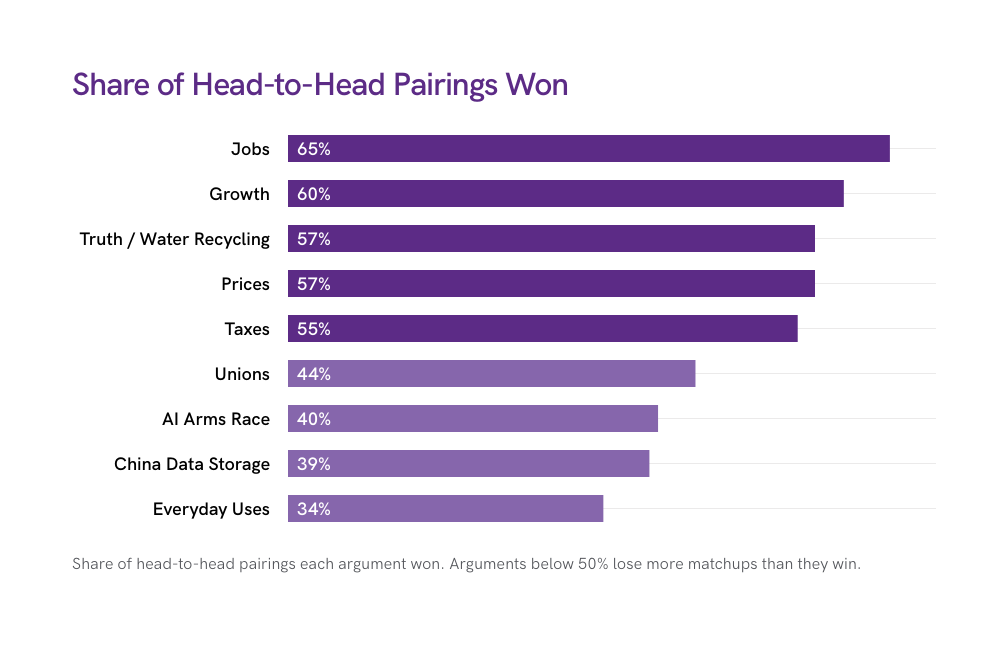
- Jobs (blue-collar work that can’t be outsourced) won 65% of its pairings, followed by Growth (60%), Truth and water recycling (57%), and Prices (57%).
- The three national-security frames finished at the bottom: the AI arms race won just 40%, Chinese data storage 39%, and everyday uses 34%.
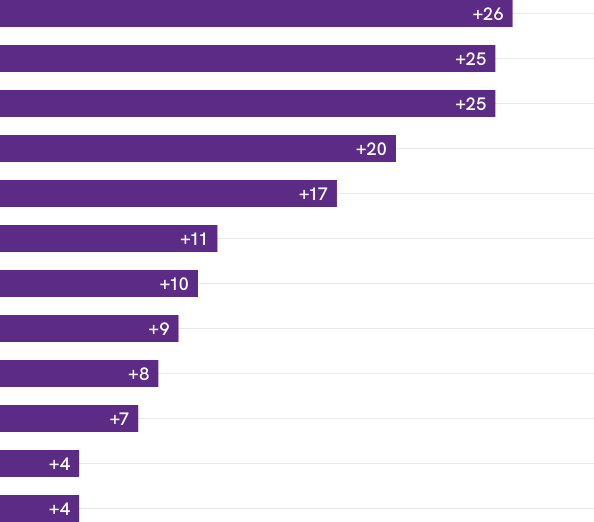
- Family members, farmers and landowners, and small business owners each run roughly net +25.
- The Columbia County, Georgia model, using data center revenue to eliminate local property taxes and fund large teacher bonuses, tests at 62% support versus 21% opposition.
- Transparency is nearly free persuasion: requiring public disclosure of water use, energy use, and tax breaks makes 47% more likely to support a project and only 9% less likely.
Executive summary
A paired-comparison exercise forced nine pro-data-center arguments into head-to-head matchups. Pocketbook arguments dominate: Jobs won 65% of its pairings, Growth 60%, and Truth and Prices 57% each. All three national-security frames finished at the bottom and lose more matchups than they win. Crosstabs sharpen the verdict: the China storage argument is net negative with every subgroup, while Jobs wins every subgroup, with its strongest margins among women (+33) and somewhat-liberal voters (+42). The strongest validators are local and unofficial, with family members, farmers and landowners, and small business owners each running roughly net +25, while every institutional messenger is weak. Personal pocketbook benefits dominate the community-benefits menu, the Columbia County, Georgia model tests at 62 to 21, and transparency requirements are nearly free persuasion. Free or reduced electricity and elimination of local property taxes lead, with guaranteed local jobs and infrastructure upgrades close behind. Beyond party, opposition has a clear demographic structure.
Jobs is the only true crossover message.
It wins every subgroup at net +18 to +42, while the China storage argument is net negative with every subgroup, even Republicans.
A paired-comparison exercise forced nine pro-data-center arguments into head-to-head matchups. Pocketbook arguments dominate: Jobs won 65% of its pairings, Growth 60%, and Truth and Prices 57% each. All three national-security frames finished at the bottom and lose more matchups than they win.
The strongest validators are local and unofficial, with family members, farmers and landowners, and small business owners each running roughly net +25, while every institutional messenger is weak. Personal pocketbook benefits dominate the community-benefits menu, the Columbia County, Georgia model tests at 62 to 21, and transparency requirements are nearly free persuasion.
Rainey Center surveyed 1,017 registered voters via online panel, July 14–15, 2026. Weighted by gender, race, education, age, and 2024/2020 vote recall. Margin of error ±3.5 points at the 95% confidence level.
- 65% of Pairings Won by Jobs—The Best Result in the Battery
- +33 Jobs’ Net Margin Among Women, One of Its Strongest Subgroups
- -13 China Storage Net Among Republicans—Negative with Every Subgroup
Message Testing
Jobs (blue-collar work that can’t be outsourced) won 65% of its pairings, followed by Growth (60%), Truth and water recycling (57%), and Prices (57%). The three national-security frames finished at the bottom: the AI arms race won just 40%, Chinese data storage 39%, and everyday uses 34%. Crosstabs sharpen the verdict: the China storage argument is net negative with every subgroup, while Jobs wins every subgroup, with its strongest margins among women (+33) and somewhat-liberal voters (+42).
The Practical Menu
The top tier is remarkably stable: Jobs wins 66% of its pairings with Democrats, 62% with Republicans, and 66% with Independents, and Prices is nearly identical across all three (56 to 57%). The partisan differences live in the second tier. Growth is the best Republican-specific argument (64% with Republicans, net +28, but only 55% and +11 with Independents). Taxes is the sleeper Independent argument: it wins 61% with Independents (net +22, second only to Jobs) while barely breaking even with Republicans (+3). Unions is a Democratic-only argument, splitting 50-50 with Democrats but losing badly with Republicans (39%, net −23). The China frames reach their ceiling with Republicans at 43% and still lose.
| Argument | Audience |
|---|---|
| Jobs & Prices | Travel everywhere |
| Growth | Red audiences |
| Taxes | Independents |
| Unions | Democratic audiences only |
| China Frames | No one |
Source: page 5
Local, Unofficial Voices Are the Strongest Validators
Family members, farmers and landowners, and small business owners each run roughly net +25. Every institutional messenger is weak: governors net +7, local elected officials +9, tech company employees +4, faith leaders +4.
Personal Pocketbook Items Dominate
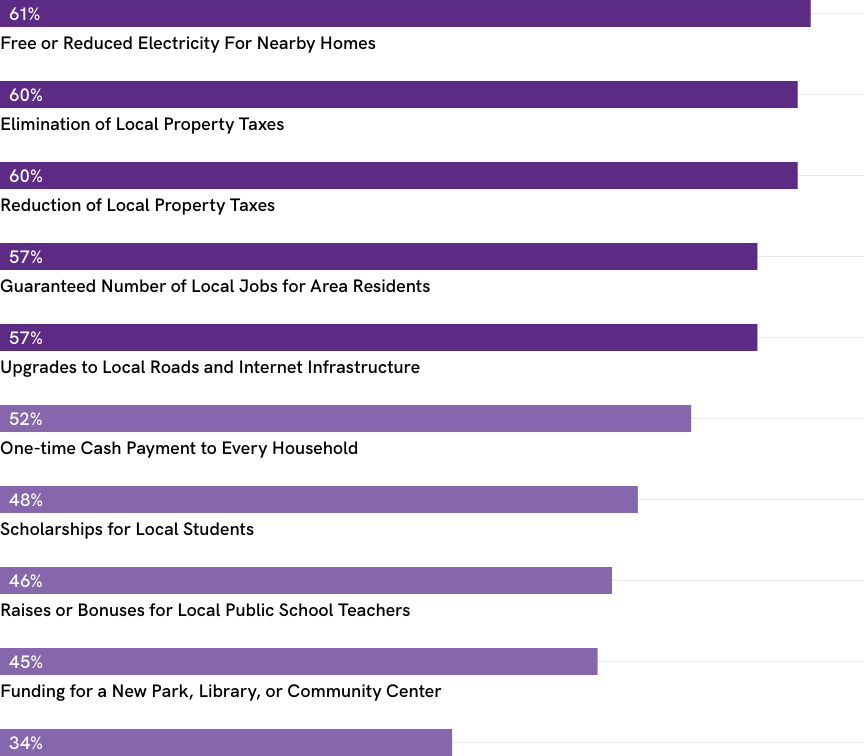
Free or reduced electricity and elimination of local property taxes lead, with guaranteed local jobs and infrastructure upgrades close behind. One-time cash payments and teacher raises trail.
- 62–21 The Columbia County, Georgia model, using data center revenue to eliminate local property taxes and fund large teacher bonuses, tests at 62% support versus 21% opposition.
- 47 / 9 Transparency is nearly free persuasion: requiring public disclosure of water use, energy use, and tax breaks makes 47% more likely to support a project and only 9% less likely.
The Structure of Opposition
Beyond party, opposition has a clear demographic structure. Data center opposition increasingly behaves like a left-coded intensity issue even though every ideological group is net negative at baseline.
- Gender: 42% v. 29%. The widest gap after ideology: 42% of women strongly oppose a data center in their community versus 29% of men, and women are less responsive to every messenger and argument tested.
- Education: 10% v. 23%. College graduates are somewhat warmer and far more opinionated, with about half the “not sure” rate. The remaining persuadable universe skews non-college and lower-information, a further argument for simple pocketbook framing over abstract national-security appeals.
- Race: 19% v. 10%. Black voters are the warmest group, nearly twice as likely as the sample overall to be very favorable, and far less likely to strongly oppose local siting (26% versus 39% among white voters).
- Ideology: 50% / 52%. Intensity is concentrated on the left: half of very liberal voters are very unfavorable and 52% strongly oppose community siting.
Appendix: Message Texts as Tested
Full wording of the nine arguments tested in the paired-comparison exercise (Q30), with the share of head-to-head pairings each won overall and by party identification. Respondents saw pairs of arguments and selected which they found more persuasive as a reason to support data center construction, even if they did not support construction themselves.
Jobs
WON 65% | D 66 | R 62 | I 66
“Data center construction creates blue collar jobs that don’t require a college degree and can’t be outsourced, jobs like electrician and heat and air conditioning installation.”
Growth
WON 60% | D 59 | R 64 | I 55
“AI will keep America’s economy growing. Economic growth means more jobs, more prosperity and more opportunity.”
Truth
WON 57% | D 55 | R 59 | I 56
“There have been a lot of lies spread about data centers. The truth is that new data centers bring their own power instead of drawing from the grid and they recycle water.”
Prices
WON 57% | D 56 | R 57 | I 57
“AI can keep prices low. By making companies more efficient, AI can drive lower prices for consumers, fighting inflation.”
Taxes
WON 55% | D 55 | R 51 | I 61
“Data centers pay large amounts in taxes, which lowers property taxes for people who live near the data centers.”
Unions
WON 44% | D 50 | R 39 | I 43
“AI data centers can create well-paying union jobs that create pathways to the middle class. That’s why unions support data center construction.”
AI
WON 40% | D 36 | R 43 | I 39
“If we don’t invest in data centers, China will beat America in the AI arms race. AI will keep America the leading superpower.”
China
WON 39% | D 36 | R 43 | I 38
“If we don’t build data centers here, they will have to be built in China which means your family photos and passwords will be stored in data centers accessible to the Chinese government.”
Uses
WON 34% | D 36 | R 32 | I 33
“Data centers aren’t just for AI, they make it easy and cheap to stream TV shows and store emails.”