Key findings
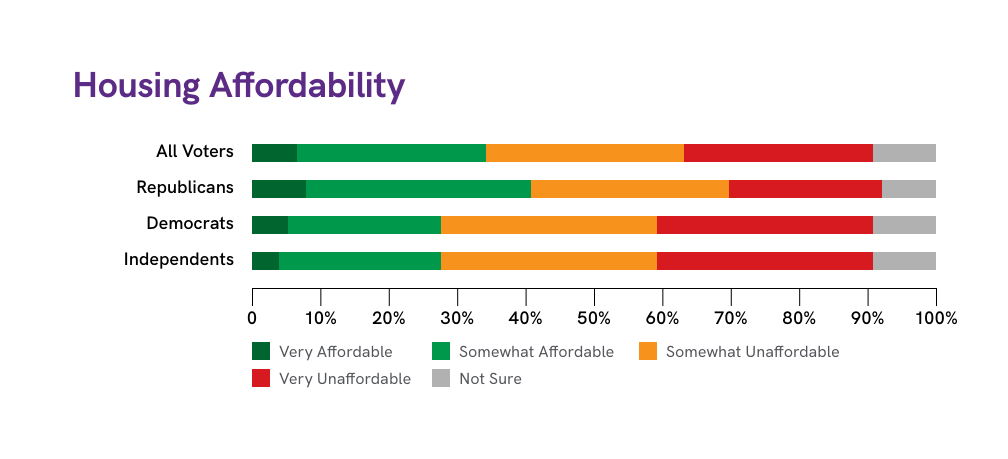
- Nearly six in ten voters (58%) rate housing in their area as somewhat or very unaffordable.
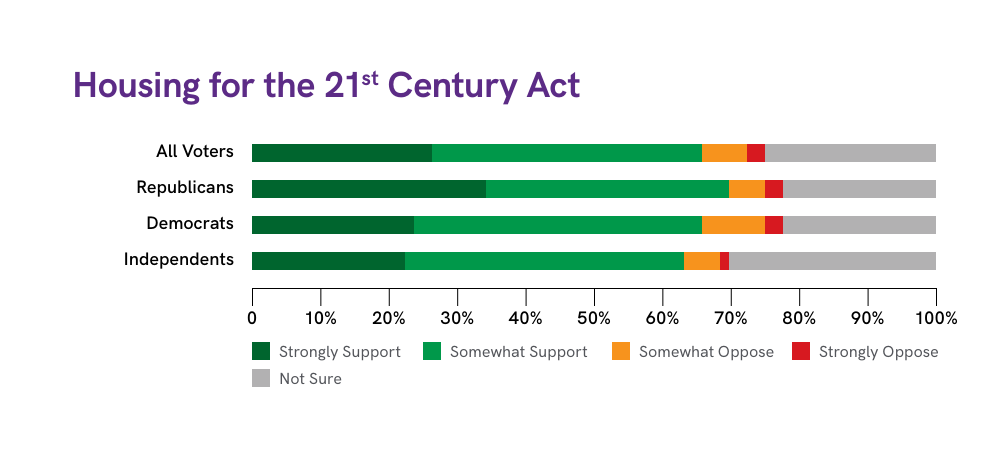
- The bill commands 66% support overall and enjoys majority support from Republicans (70%), Democrats (66%), and Independents (62%).
- Notably, 64% of voters have not heard about this legislation at all, which means the support numbers are likely to grow as awareness increases.
- The top performer is expanding home repair grants for low-income rural homeowners at 74% overall, a provision that resonates especially with the rural base at the heart of the Republican coalition.
- The “Don” Down Payment program, which would create a zero-to-low down payment option through FHA for creditworthy borrowers, polls at 66% support overall, with Republicans leading at 72%.
Housing affordability is a crisis that crosses every partisan, demographic, and geographic line in America.
Nearly six in ten voters (58%) rate housing in their area as somewhat or very unaffordable, including 22% of Republicans, 31% of Democrats, and 31% of Independents who say it is “very unaffordable.” This is the one of the defining kitchen-table issues of 2026.
That’s what makes the polling on the Housing for the 21st Century Act so remarkable. The bill commands 66% support overall and enjoys majority support from Republicans (70%), Democrats (66%), and Independents (62%). In a political environment where almost nothing gets bipartisan consensus, this bill does. And it does so because it is built on principles that resonate across the spectrum: cutting red tape, empowering local communities, and expanding homeownership without expanding government.
What’s more, every major individual provision of the housing package polls at supermajority levels. The data is not ambiguous: voters are begging Congress to act.
The Crisis Is Real
Before asking about any legislation, we tested how voters rate housing affordability in their area. Majorities of every partisan group say housing is unaffordable. Among voters in the peak homebuying age of 35–49, 63% say housing is unaffordable. Among those 18–34, 50% say the same. This is a generational crisis, and it is felt most acutely by the voters who will determine the 2026 elections.
66% Support, True Bipartisan Consensus
When described as bipartisan legislation that “aims to make it easier to build homes by cutting red tape, updating federal housing programs, and giving local communities more flexibility,” the Housing for the 21st Century Act receives 66% support (26% strongly, 40% somewhat) with only 9% opposed. Support is strong and consistent across party lines.
This is a 7-to-1 support-to-opposition ratio. The bill’s strongest supporters are Republicans at 70%, driven by the emphasis on deregulation and local control. But Democrats (66%) and Independents (62%) are right there with them. Notably, 64% of voters have not heard about this legislation at all, which means the support numbers are likely to grow as awareness increases.
Every Major Provision Polls at Supermajority Levels
We tested each of the bill’s key provisions individually. Every single one commands majority support from Republicans, Democrats, and Independents.
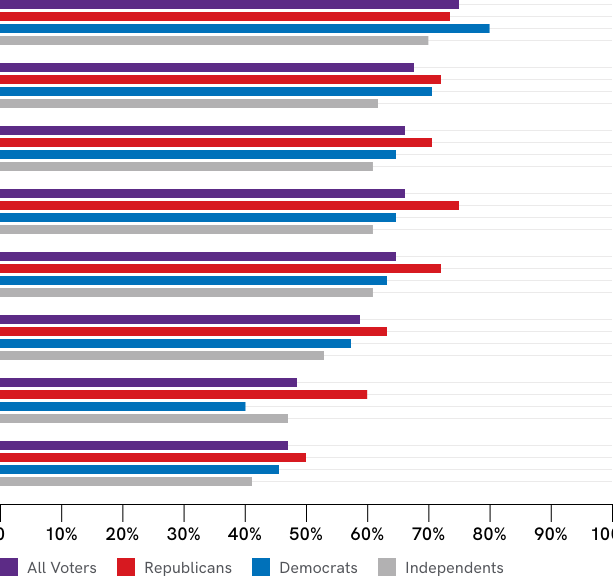
Six of the eight provisions poll above 59% support with all voters, and six provisions command majority support from every single partisan group. The top performer is expanding home repair grants for low-income rural homeowners at 74% overall, a provision that resonates especially with the rural base at the heart of the Republican coalition.
Provisions That Unite: The Bipartisan Sweet Spot
“Don” Down Payment Program (FHA)
The “Don” Down Payment program, which would create a zero-to-low down payment option through FHA for creditworthy borrowers, polls at 66% support overall, with Republicans leading at 72%. This is a program named for the President that puts homeownership in reach for families who have good credit but haven’t been able to save for a down payment. It is the embodiment of the Trump economic message: work hard, play by the rules, and the American Dream is yours.
Reduce Regulations on Small Community Banks
Reducing regulations on small community banks polls at 67% overall and 74% among Republicans. This appeals directly to the conservative instinct for deregulation while also serving communities, especially rural ones where community banks are the primary source of mortgage lending. Democrats support it at 66%.
Selling or Leasing Underused Federal Buildings
Selling or leasing underused federal buildings for affordable private-sector housing polls at 67% overall. This provision combines fiscal responsibility (putting idle government assets to productive use) with housing access, making it a natural fit for both parties. Support among seniors (65+) hits 76%, reflecting the common-sense appeal of not letting government property sit empty while Americans struggle to find housing.
The Message That Wins: Cut Red Tape, Build More Homes
The polling makes clear that the winning frame for housing legislation is deregulation. The bill’s description of “cutting red tape, updating federal housing programs, and giving local communities more flexibility” tested at 66% support precisely because it speaks to both conservative and progressive priorities simultaneously.
For Republicans, the message is: less government, more homeownership. For Democrats, the message is: more affordable homes, less bureaucratic delay. For Independents, it’s: common-sense solutions to a real problem.
Congress should move quickly. With 58% of voters calling housing unaffordable, 66% supporting the bill, and strong bipartisan backing for every major provision, the political conditions for passage could not be better. Members who vote for this bill will be on the right side of an issue that matters to nearly every voter in their district.
This poll surveyed 1,008 registered voters via online panel from February 25–27, 2026. Results were weighted by 2024 vote, gender, age, race, and education to match population demographics. The margin of error is ±3.3 percentage points at the 95% confidence level.