Key findings
- In the 19th century and continuing well into the 20th, the United States saw a proliferation of political parties, many operating within a single state or region, and often achieving a substantial degree of electoral success.
- It’s tedious enough when Congress conducts votes that way and that’s with only 435 or 100 members voting in the House and Senate, respectively.
- It was not until the late 19th century that states first started printing standardized ballots for all voters to use.
- It seems so obvious today we don’t even think about it, but the last state to adopt government-printed ballots, South Carolina, did not make the switch until 1950.
- While early third parties like the Anti-Masonic Party used fusion, the practice came into its own in the era of prolific party fracturing, fusion, and mergers that produced the destruction of the Whigs and the emergence of the Republicans in the 1840s and 1850s.
Executive summary
Free speech is at its most fundamental in freely voting for the candidate and party of your choice. For many conservatives, structural reform of America’s elections is seen as something only the left talks about. In these discussions, there is talk of abolishing the electoral college, adopting ranked choice voting, and in some quarters even talk of mandatory voting. All seem calculated to boost Democrats over Republicans, or to similarly harm the right flank of the Republican Party within GOP primaries. It’s not an entirely baseless perception. In some cases, that is how these changes would actually work; in other cases, that’s less true. But more importantly, it’s often how they are presented by their advocates, discussed in terms of why we should be more like Europe, and insisting the Constitution is outdated. Some reform ideas, however, have a thoroughly American pedigree tracing back to the Founding Fathers. Principled believers in smaller government, free markets, and traditional values, don’t have to be locked into a blind defense of the status quo and its many failings. A more promising election policy agenda is about making government more representative and responsive for those on the right, just as much as everyone else. And in some cases, it’s really just a question of getting big government overreach out of the way.
Free speech is at its most fundamental in freely voting for the candidate and party of your choice.
For many conservatives, structural reform of America’s elections is seen as something only the left talks about. In these discussions, there is talk of abolishing the electoral college, adopting ranked choice voting, and in some quarters even talk of mandatory voting.1 All seem calculated to boost Democrats over Republicans, or to similarly harm the right flank of the Republican Party within GOP primaries.
It’s not an entirely baseless perception. In some cases, that is how these changes would actually work; in other cases, that’s less true. But more importantly, it’s often how they are presented by their advocates, discussed in terms of why we should be more like Europe, and insisting the Constitution is outdated.
Some reform ideas, however, have a thoroughly American pedigree tracing back to the Founding Fathers. Principled believers in smaller government, free markets, and traditional values, don’t have to be locked into a blind defense of the status quo and its many failings. A more promising election policy agenda is about making government more representative and responsive for those on the right, just as much as everyone else. And in some cases, it’s really just a question of getting big government overreach out of the way.
Cold Fusion
In the 19th century and continuing well into the 20th, the United States saw a proliferation of political parties, many operating within a single state or region, and often achieving a substantial degree of electoral success. The most successful of these coalesced to form what is now the Republican Party.
This competitive market for political organizations produced the creative destruction of the Whigs and put a new, much better anti-slavery party in control of the White House and Congress. But we haven’t seen the emergence of a new major party since then, and few serious attempts. Instead, alternative parties are relegated to the irrelevant fringes.
So what changed? The single greatest cause for the decline of this marketplace of ideas was the prohibition of fusion, also known as cross-nomination.
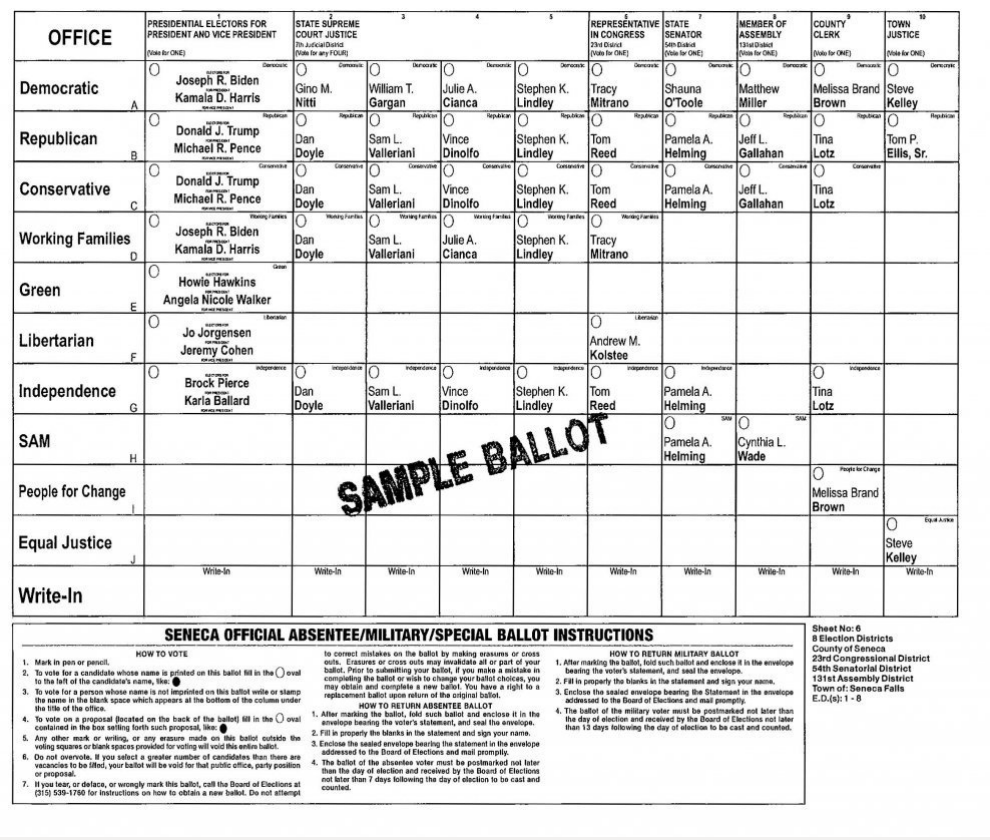
Fusion is simply the ability of multiple parties to nominate the same candidate if and when they want. For example, both Republicans and Libertarians might want to back the same candidate in some races, or likewise the Democrats and the Working Families Party. On rare occasions an exceptionally popular candidate might even appeal to primary voters in both major parties.
In banning fusion, mostly at the height of the Progressive era, unjustified government control was asserted over core political speech and freedom of association. The consequences of this change have been widely overlooked, but go to the core of why our political system is so toxic and dysfunctional today.
Many voters feel they have no voice, even if they generally prefer one major party over the other. They’re not wrong to feel that way. Their party can safely ignore them, taking their votes for granted in the general election. They might have minority viewpoints within that party, unable to win most contested primaries. The underlying diversity of the party’s coalition is suppressed, still present among voters but unrepresented in election outcomes.
Without fusion as a legal option, newer parties can no longer form, grow, win, and ultimately influence the direction of their more dominant competitors. Voters alienated from the party’s establishment (or its radicalism) no longer have a viable way to push back in the most natural and effective way, to organize their own party which can then give—or withhold—its endorsement as they see fit.
Instead, with bans on fusion, third parties were cast out of what became our uniquely absolute and entrenched two-party system. To join or support one became throwing your vote away, an act of self-marginalization, not a way to organize with like-minded citizens to advance your shared goals.
Re-legalizing fusion has the principle of the matter on its side, compelling constitutional arguments, and an underappreciated historical pedigree in the United States. This fact has not gone unnoticed, with a growing effort to permit fusion in states where it has long been banned.2
In New Jersey, a lawsuit is currently underway arguing that the state’s anti-fusion law violates the state constitution’s equivalent of the First Amendment, unjustifiably impinging on the rights of parties, voters, and candidates alike.3
The New Jersey Republican Party sided with the Democratic administration to oppose the right to fusion nominations, unsuccessfully asking the court of appeals to dismiss the case. But their opposition is mistaken, largely driven by the incidental fact that the issue arose from a close congressional race where a new party sought to cross-nominate the incumbent (and ultimately defeated) Democrat.
One of New Jersey’s former Republican governors, Christine Todd Whitman, better understands the issue and joined an amicus brief arguing that the anti-fusion laws are unconstitutional.4 Both the Rainey Center and the libertarian Cato Institute also joined Whitman’s brief.5
Bans on fusion are just as much an unwarranted intrusion, and produce similarly counterproductive effects, as price controls, quotas, and other failed models of regulation imposed on the participants in any other market. A state-mandated duopoly protected from competition does little better for consumers, so to speak, than state-mandated monopolies for other goods and services.
The government has no business telling parties, private organizations engaged in core First Amendment activity, who they can and cannot nominate. There should be no paternalistic regulation of how citizens in different political groups are allowed to work together, or when they choose not to. Candidates should be allowed to associate with any political parties they want, and voters should be free to support the candidate and the party of their choosing. The ability to freely speak and be heard through the ballot is fundamental to representative government.
An American Tradition
Fusion in the United States arose not as a deliberate policy choice, but for the simple reason that the government played a much more limited role in the first century of American elections. There were no laws about which parties or candidates could be on a voter’s ballot because the government did not even print the ballots.
In some cases, voting was done viva voce. That is, by voice. Voters in a public meeting, somewhat like the Iowa caucuses today, would have to announce their vote in front of all their friends and neighbors. But by the time of the Founding era, voice voting was already falling out of style in favor of paper ballots. Among other reasons, the expanding franchise made viva voce voting increasingly impractical with the rapidly growing number of voters. It’s tedious enough when Congress conducts votes that way and that’s with only 435 or 100 members voting in the House and Senate, respectively.
It was not until the late 19th century that states first started printing standardized ballots for all voters to use. At the time, this was a novel reform known as the “Australian ballot” and closely associated with protecting the right to cast a secret ballot. It seems so obvious today we don’t even think about it, but the last state to adopt government-printed ballots, South Carolina, did not make the switch until 1950.
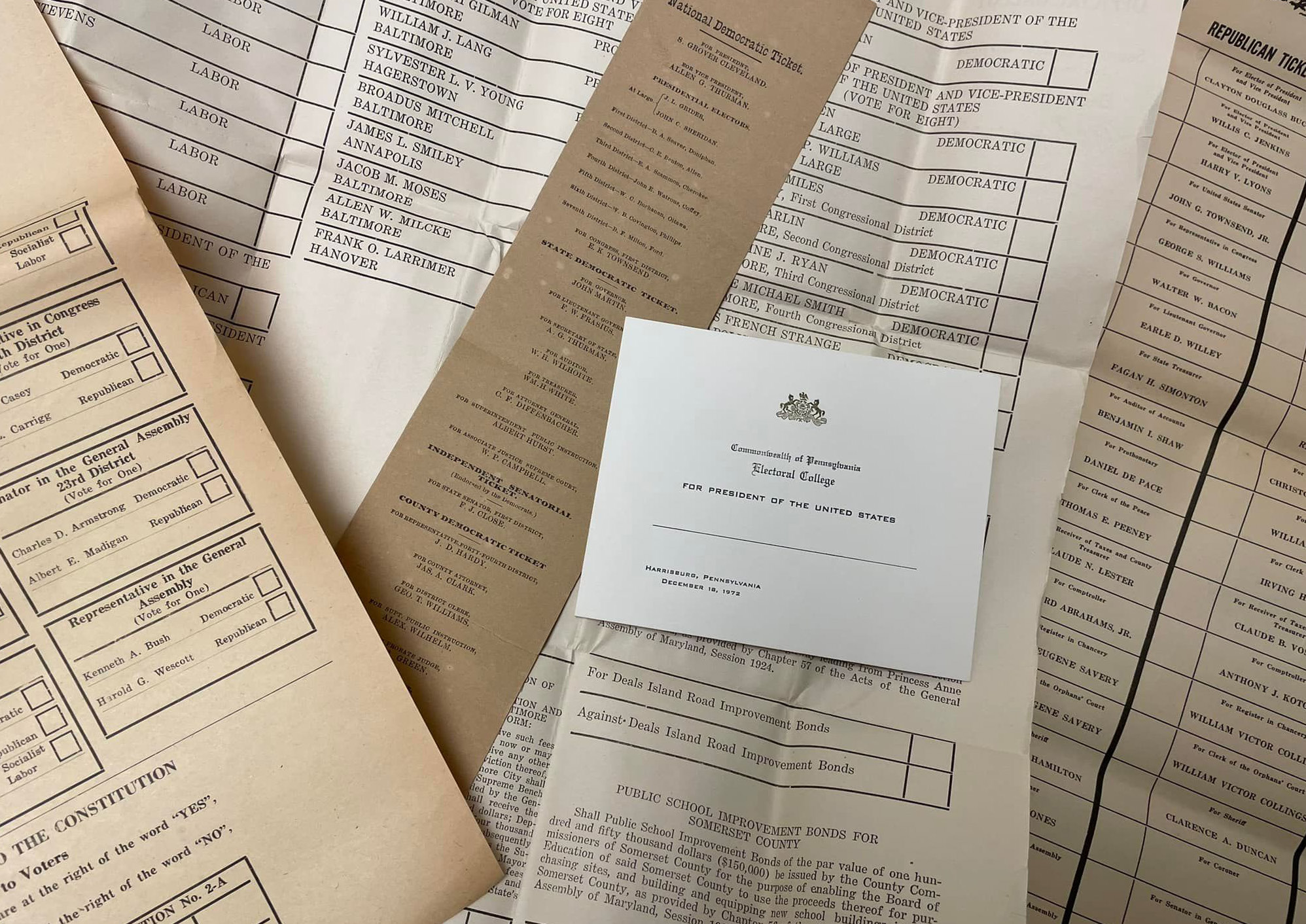
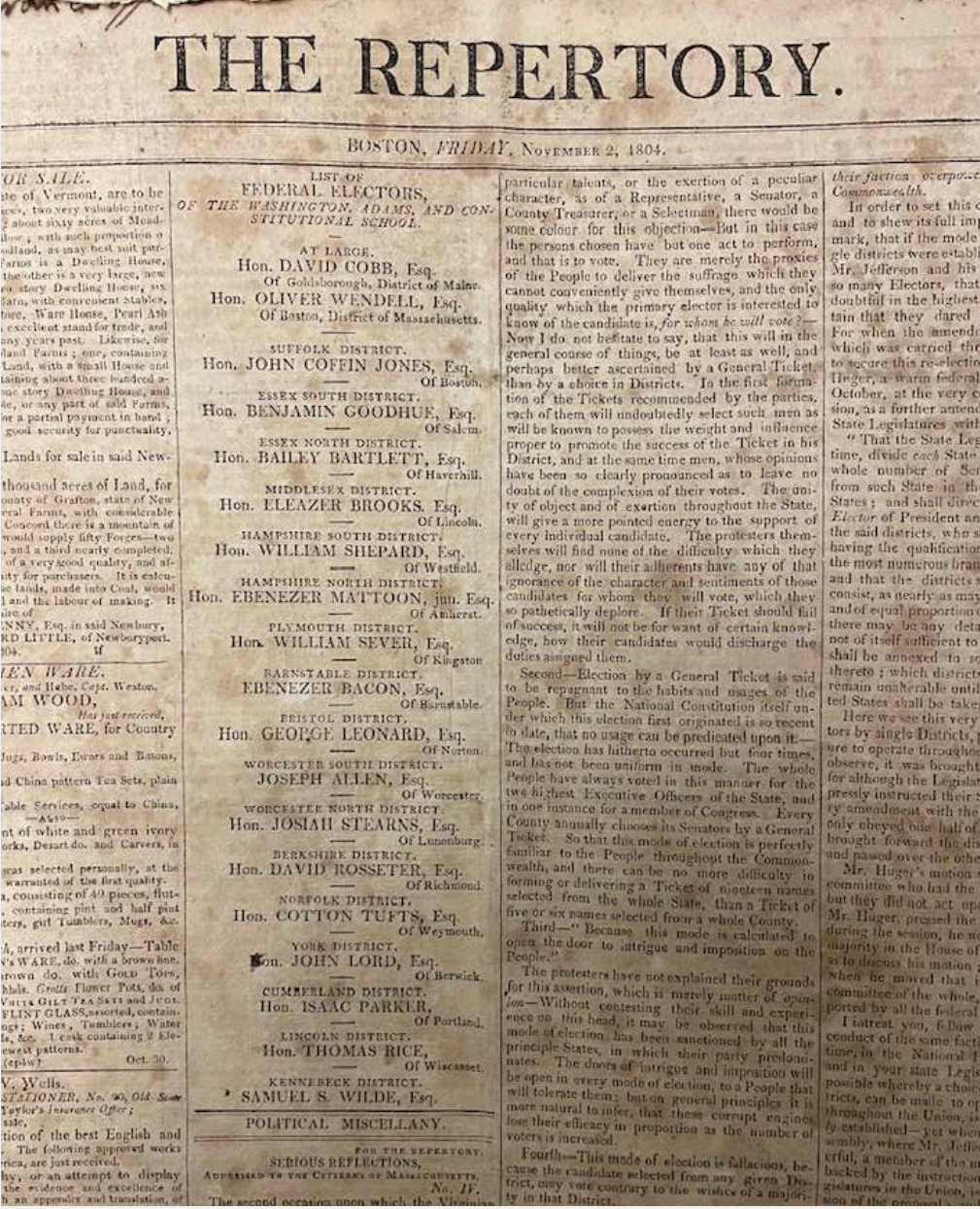
Instead, the most common practice for much of American history was for the parties themselves, often only loosely organized, to print and distribute their own ballots. These slips of paper (or in theory, any scrap of paper) could then be used to vote. Among other means of distributing these “party tickets” was printing them in the party’s aligned newspapers, where voters could simply cut them out and use them at the polls on Election Day.6 This legacy subtly persists today when we speak of a candidate’s running mate as being put “on the ticket” or talk about “straight-ticket voters.”
Because of this do-it-yourself ballot system, there were no restrictions on different parties or factions nominating some different and some overlapping candidates. In early presidential elections, for example, cross-nominations between Hamiltonian Federalists and Jeffersonian Democratic-Republicans produced mixed slates of presidential electors in some states.
While early third parties like the Anti-Masonic Party used fusion, the practice came into its own in the era of prolific party fracturing, fusion, and mergers that produced the destruction of the Whigs and the emergence of the Republicans in the 1840s and 1850s. The ability to engage in selective fusion endorsements was a key strategy for anti-slavery forces who coalesced into parties such as Liberty, Free Soil, and the Anti-Nebraska movement. Fusion also eased the way for the eventual merger of these smaller parties into a new major party.7
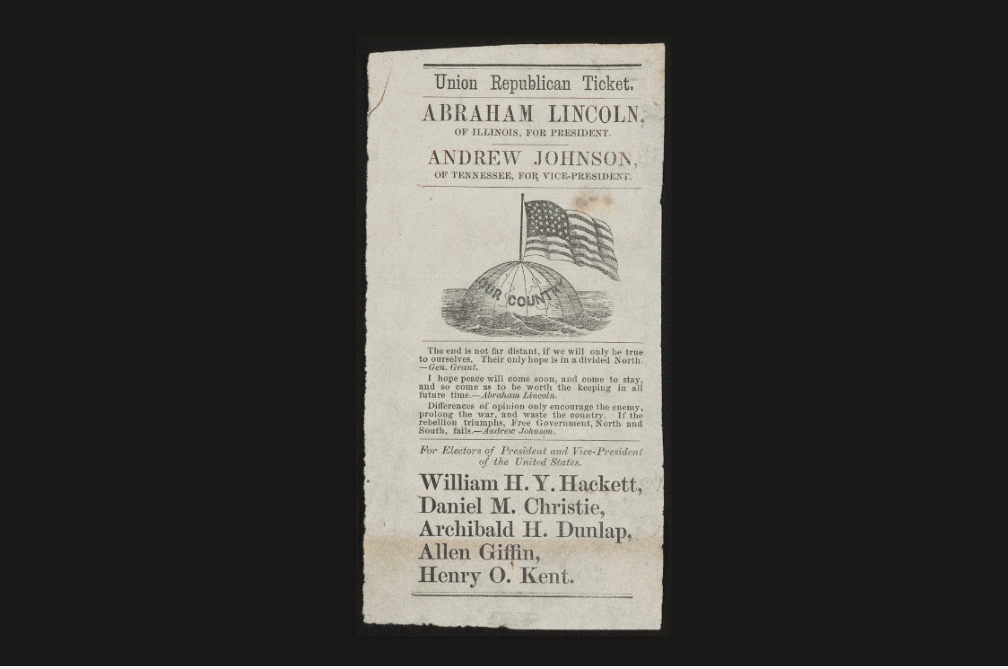
Lincoln’s wartime reelection in 1864 was an example of fusion on both his left and right flanks. In taking on Democrat Andrew Johnson as his running mate and seeking to emphasize a message of country over party, the Lincoln/Johnson ticket was officially nominated by the National Union Party. This was, for the most part, simply a rebranding of the Republicans and their convention. But it reflected a real fusion-style coalition in some parts of the country where War Democrats were the local majority.
Radical Republicans, on the other hand, split and instead nominated John C. Fremont, who had been the first Republican nominee in the 1856 election. Later during the campaign, Fremont chose to withdraw and endorse Lincoln with his supporters following suit. While the Radical Republican nomination was never transferred to Lincoln by any formal mechanism, this amounted to a late-breaking case of fusion. There was no need to remove Fremont from the official ballot, and today in many states it would have been too late to do so. His supporters could simply distribute and cast their own Republican or National Union party tickets.
The modern Republican Party, including the career and election and re-election of Abraham Lincoln, would not have been possible in the face of legal barriers to fusion.
Following the Civil War, fusion parties reached their peak during the latter half of the 19th century and into the early 20th. In some cases, these parties were more aligned with the Democrats in a given state. But often they represented successful coalitions with Republicans to break Democratic control of a state’s politics. Most notably, this played out in efforts to resist Jim Crow and white supremacist Democrats in the “Solid” South.
North Carolina offers a particularly compelling example.8 In a state with extremely racially polarized voting, Republicans struggled to attract support beyond African Americans and a relatively small number of historically Unionist whites.
Initially through a non-party Farmers Alliance and then organized as the Populist Party, lower-income white farmers experimented with seeking fusion, both with the dominant Democrats (who largely spurned them) and the minority Republicans. In the 1894 election, the Populist and Republican votes combined were observed to be over 50 percent, allowing the Democrats to win on a plurality.
In 1896, a fusion agreement was hammered out and a biracial Republican-Populist coalition was swept into power in North Carolina. This was the only instance between the end of Reconstruction and the post-Civil Rights era where the Democrats lost control of a state in the Deep South. Unfortunately, it didn’t last.
The coalition split over matters including the era’s hot-button issue, monetary policy, with free silver Populists vs. Republican gold bugs. In 1898, Democrats reclaimed legislative majorities and the governorship. They immediately set about passing a new white supremacist constitution to effect mass disenfranchisement of African-Americans. They also banned “Fusionism,” a term they had coined as a disparaging epithet. The name stuck for the general idea.
As the Democrats explained in their official handbook providing the party’s talking points for the 1898 election, “[t]he negroes constituted the large mass of the Republican Party, and the Black cohorts were faithful to the fusion. Common decency required that these faithful allies of the Populists who had cooperated with them in obtaining control of the Legislature, should receive their share of the spoils.” It then goes on to explain in increasingly vitriolic terms that these unjust “spoils” granted by the “Fusion Legislature” meant allowing Black voters to elect Black majorities to several town councils.9
Without fusion’s ability to bring together a broader opposition coalition, North Carolina followed the rest of the South into the nadir of American race relations and the worst decades of racist one-party Democratic rule.
Sometimes, fusion was used by the Republicans and Democrats uniting around a common candidate. In 1910 the Socialist Party, most famous for the perennial presidential campaigns of Eugene V. Debs, won its first major mayoral election. In Milwaukee, Socialist candidate Emil Seidel won on a plurality in a three-way race against both Republican and Democratic opponents.
Two years later, the parties had learned their lesson and united in nominating health commissioner and surgeon Gerhard Bading, who won handily. This built on an existing tradition of bipartisan fusion in the city to defeat radical populists on the left dating back to the 1880s and already common in city council elections. For decades that followed, Milwaukee politics was largely organized on the basis of Socialists versus Democratic-Republican (or somewhat inaccurately, “nonpartisan”) fusion candidates.10
Because fusion allowed the major parties to set aside their divisions on the local level, extremists were not able to rule unchallenged on a minority of the vote. Only by substantially moderating their radicalism were the Socialists able to remain a competitive force in municipal politics. They eventually came to be disparaged by their fellow Marxists as “Sewer Socialists” for their focus on sensible sanitation projects rather than the revolutionary abolition of capitalism.
Free Markets, Free Parties
In the modern era, conservatives have made good use of fusion in the handful of states where it is still permitted, most prominently in New York. The Conservative Party has been a flourishing presence in New York politics as a selective-fusion party for many decades, opposite the similarly positioned Liberal Party and more recently the progressive Working Families Party.
In the mid-20th century, party affiliation often told voters little about a candidate’s place on the ideological spectrum. With conservative and liberal politicians to be found in both major parties, fusion parties provided essential information for casting an informed vote.
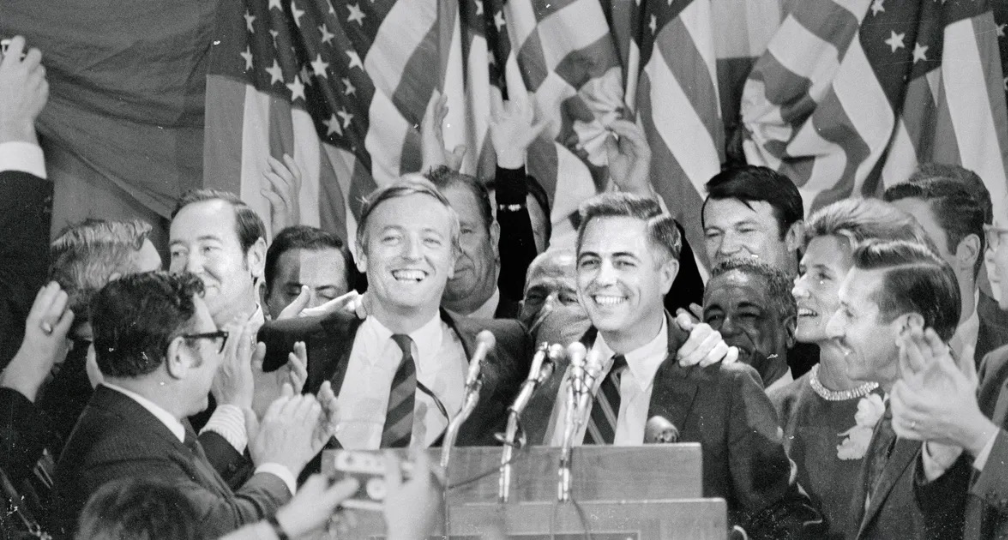
In 1965, conservative icon William F. Buckley launched a quixotic and somewhat tongue-in-cheek bid for mayor of New York City as the Conservative candidate, winning 13.4 percent. Five years later, his brother James L. Buckley was elected to the U.S. Senate as the Conservative candidate in a three-way race, defeating both the Democratic nominee and the Republican / Liberal nominee.
Buckley is the most recent example of a member of Congress elected as a third party candidate (not counting unaffiliated independents) while running against both a Republican and a Democratic opponent. As recently as 2009, the Conservatives running on their own came within a couple of points of winning a congressional special election in New York after the Republican nominee dropped out.
Neither of the Buckley campaigns were cases of Republican/Conservative fusion. William F. Buckley ran for mayor solely as the Conservative candidate, and his older sibling ran for Senate as the nominee of the Conservatives and the much smaller Independent Alliance.
But the Conservative Party itself would not have been in the position to mount these campaigns without the growth and success its selective use of fusion provided. They were not relegated to the fringes of playing spoiler, except when they deliberately wanted to be one. Securing the Conservative endorsement could, and still can, mean the difference between victory and defeat.
In 1980, Ronald Reagan received 42.5 percent of the vote on the Republican ballot line in New York, to Jimmy Carter’s 44 percent. But the Conservative nomination put Reagan over the top to win the state, providing another crucial four points. Conservatives were satisfied with Reagan and threw their support to him, but disgruntled Liberals decided to punish Carter by withholding their nomination from the incumbent Democrat. While Reagan won the state on the combined Republican and Conservative ballot lines, independent John Anderson took 7.5 percent as the Liberal nominee.
1980 wasn’t the last time fusion in New York boosted Republicans. In 1994, 6.3 percent on the Conservative line gave an upset win to George Pataki in a razor-thin gubernatorial race against incumbent Mario Cuomo.
In more recent decades, right of center fusion candidates have won state legislative seats in New Hampshire as recently as the 1990s, when four were elected to the House as both Libertarian and Republican nominees. New Hampshire only permits fusion if a candidate can win one party’s primary by write-ins or petitions onto the general election ballot for an unqualified party, but this has proven occasionally feasible in New Hampshire’s very small districts.
At the presidential level, Donald Trump appeared on the ballot in California as the nominee of both the Republican Party and the American Independent Party in 2016 (California permits fusion only for presidential elections), and in New York as both the Republican and Conservative candidate in 2016 and 2020.
In Oregon, the ballot-qualified centrist Independent Party regularly endorses mixed slates, cross-nominating dozens of Republicans and Democrats for offices up and down the ballot. Appearing as “Republican, Independent” can provide a decisive boost, frequently putting candidates over the top in competitive races. In a state where Biden defeated Trump by a sixteen-point margin, the GOP needs to appeal to independent swing voters. Fusion provides that opportunity without diluting the ability of conservative Republicans to control their own party. Everyone gets their fair say, and the state has more competitive elections as a result.
Fusion, in short, has a long record of being used to the advantage of Republicans. Conservatives have nothing to fear from letting parties speak freely on the ballot, and no reason to defend anti-fusion laws.
Originalism and Fusion
Alongside this history, state laws prohibiting fusion voting are difficult to reconcile with originalist, constitutionalist principles.
The First Amendment protects freedom of speech and freedom of association for political parties as private organizations. Government regulation of internal party structures and nominating processes, including through primaries, has generally been something imposed by progressive reformers against conservative opposition. In some cases, these laws have been struck down by the Supreme Court.11 Even today, states like Utah and Virginia see a strong conservative preference for party nominating conventions over state-run primaries.
The general argument against government regulation of core political speech also runs parallel to reasoning used to strike down campaign finance restrictions, to the chagrin of many on the left.
In Citizens United v. FEC, Supreme Court Justice Antonin Scalia noted a parallel between political parties in the marketplace of ideas and participants in a competitive free market, rejecting the idea that political organizations as such lack First Amendment rights. In his concurring opinion he wrote that “[s]urely the dissent does not believe that speech by the Republican Party or the Democratic Party can be censored because it is not the speech of ‘an individual American.’ It is the speech of many individual Americans, who have associated in a common cause, giving the leadership of the party the right to speak on their behalf.”
Originalist luminaries on the bench have also criticized fusion bans on similar grounds. In 1991, Judges Kenneth Ripple, Richard Posner, and Frank Easterbrook dissented from a denial of en banc rehearing in a case challenging Wisconsin’s anti-fusion law. As they explained, “[t]he Supreme Court has recognized that the right of a party to nominate a candidate of its choice is a vital aspect of the party’s role in our political structure,” pointing to the 1989 case of Eu v. San Francisco County Democratic Central Committee, where an 8-1 Court struck down a ban on party organizations endorsing candidates in primary elections.
“The ability to choose the same person as another party is an important aspect of that right. It allows a party to form significant political alliances,” the three Reagan appointees explained. “If a person standing as the candidate of a major party prevails only because of the votes cast for him or her as the candidate of a minor party, an important message has been sent by the voters to both the candidate and to the major party. If a majority of the members of both major parties believe the same person is the best candidate, that alliance is of major significance in our political life. Such information is of immense value to the electorate, and it would indeed be salutary for the candidate to know which platform the majority of the voters favor. In short, permitting people to vote for a candidate on one party line rather than another increases the opportunity of both voter and party to be heard and for workable political alliances to be formed.”
In their view, the state had offered no legitimate justification for what they called “this broad and severe regulation” of banning “multiparty nominations” because “a state’s interest in political stability does not give it the right to frustrate freely made political alliances simply to protect artificially the political status quo.”12
Bans on fusion amount to the government censoring political parties and voters, and not just minor parties. Republicans and Democrats are no less constrained by these laws, and their rights as private organizations are also violated.
Allowing fusion is much closer to an originalist perspective on how elections were understood to work at the time of the adoption of the Constitution. Because it didn’t implicate any system of government-printed ballots, it would have been unthinkable to the Founders that the state could somehow regulate and prohibit two “factions” from working together to support a candidate. This would have required direct censorship of the parties printing and distributing their party tickets.
We’ll never go back to parties printing their own ballots instead of having a standardized official ballot for all voters to use, but nothing about that change requires abridging the freedom of parties to nominate who they choose.
The case is even stronger under state constitutions. Thanks to our system of federalism, state courts can use their respective constitutions to protect rights more broadly than the floor set by federal courts applying federal law. Many have done so on a wide variety of topics, including free speech, with encouragement from conservative justices on the Supreme Court.13
In interpreting these state constitutional provisions, the original public meaning is just as important as for understanding the federal Constitution. And in the vast majority of cases, state protections for free speech and free elections were drafted in an environment where fusion was both possible and common. In later adopting anti-fusion laws, this original understanding was set aside in favor of something closer to living constitutionalism or, more bluntly, ignoring the constitutional question altogether.
Party Freely
Electoral reforms of any sort often suffer from being coded as a progressive or left-leaning cause, and there is strong suspicion on the right side of the aisle. This wary skepticism is not entirely unjustified, given the prominence of topics such as the National Popular Vote Interstate Compact and the increasingly left-coded way ranked choice voting is discussed. Importantly, any reform must not perpetuate the impression that it’s just about electing more Democrats and fewer Republicans.
In the case of fusion, it’s easy to see re-legalization is no gambit to help the left. Attacks on fusion have mostly come from Democrats, both historically and in the present day.
Gov. Andrew Cuomo launched an all-out war on New York’s fusion parties, dramatically increasing party qualification thresholds in a bid to force them off the ballot. Delaware’s Democratic governor and legislature banned fusion in 2011. In New Jersey, the Democratic secretary of state is vehemently fighting to preserve the state’s anti-fusion laws. In 2022, New York Democrats again targeted fusion with a law banning a long-established centrist party from calling itself “Independence,” on the grounds that voters would supposedly be confused by this name.
It’s worth considering why Democrats so often see an advantage in regulating who parties can nominate and what nominations can appear on the ballot. Their motive is obvious in trying to preserve their own unchallenged control in deep-blue states. And even in many Republican-dominated states, the lack of fusion makes it harder for conservatives as such to organize effectively within the majority coalition. The overall effect is that bans on fusion plausibly skew outcomes to the left in liberal states and conservative states alike.
Repealing anti-fusion laws is a politically neutral principle that stands on its own merits rather than pure partisan or ideological gamesmanship. The goal is for everyone to be more freely heard and more accurately represented. But that means the full diversity of voters’ political beliefs, across the ideological spectrum, including those who are currently under-represented.
Nobody should be happy with a rigid, sclerotic, unresponsive political system. A representative government must be truly representative of the people. As we have seen in recent years, without that essential feedback loop, resentment quickly builds from voters who feel they are not being heard. A party system that cannot bend will eventually break.
This frustration is not unreasonable when the government is literally telling voters what they can and cannot say with their ballots. Restoring freedom of speech in the voting booth starts with ending bans on parties freely nominating the candidate of their choice. As a matter of right, fusion should be allowed once again, in every state in the Union.
Footnotes
- Corrin, Noah. “Bill in state Senate that would compel Washingtonians to vote advances out of committee” KHQ Local News. Feb. 9, 2023. Spokane, WA. https://www.khq.com/news/bill-in-state-senate-that-would-compel-washingtonians-to-vote-advances-out-of-committee/article_a095a838-a8d8-11ed-ba84-0f9c790a3909.html ↩
- Hounshell, Blake. “Does Fusion Voting Offer Americans a Way Out of the Partisan Morass?” New York Times. Nov. 21, 2022. https://www.nytimes.com/2022/11/21/us/politics/fusion-voting-new-jersey.html; Galston, William A. “Fusion Voting Could Lower the Temperature” Wall Street Journal. Oct. 3, 2023 https://www.wsj.com/articles/fusion-voting-could-lower-the-temperature-politics-elections-1d41b3b8 ↩
- In re Tom Malinowski, Petition for Nomination for General Election, November 8, 2022, for United States House of Representatives New Jersey Congressional District 7. N.J. Sup. (App. Div.) ↩
- “Whitman & Torricelli: Why we need a 3rd political party in New Jersey” NJ.com. Apr. 23, 2023. https://www.nj.com/opinion/2023/04/whitman-torricelli-why-we-need-a-3rd-political-party-in-new-jersey-opinion.html ↩
- “Rainey Center files amicus brief in the New Jersey Superior Court Appellate Division, in the case In re Tom Malinowski” /insights/policy-brief-free-speech-on-the-ballot-the-case-for-fusion ↩
- These party tickets make for fascinating historical items. The Boston Athenaeum, for example, has an extensive digitized collection representing a wide range of historical parties in Massachusetts. https://cdm.bostonathenaeum.org/digital/collection/p16057coll29 ↩
- For more on this history, see: Brooks, Corey M. Liberty Power: Antislavery Third Parties and the Transformation of American Politics (The University of Chicago Press, 2016). ↩
- Hunt, James L. (2006). "Fusion of Republicans and Populists". NCPedia. North Carolina Government & Heritage Library. https://www.ncpedia.org/fusion-republicans-and-populists ↩
- “The Democratic Hand Book. 1898. Prepared by the State Democratic Executive Committee of North Carolina.” (North Carolina Collection, University of North Carolina at Chapel Hill, call no. C329 N87d c.3) https://docsouth.unc.edu/nc/dem1898/dem1898.html ↩
- Gurda, John. The Making of Milwaukee. Milwaukee County Historical Society, 1999. ↩
- Eu v. S.F. Cty. Democratic Cent. Comm., 489 U.S. 214 (1989); Tashjian v. Republican Party of Connecticut, 479 U.S. 208 (1986) ↩
- Swamp v. Kennedy, 950 F.2d 383 (7th Cir. 1991) ↩
- Sandra Day O'Connor, Our Judicial Federalism, 35 Case W. Res. L. Rev. 1, 4-6 (1984) https://scholarlycommons.law.case.edu/caselrev/vol35/iss1/3/ ↩