Key findings
- With Congress preparing to extend the 2017 tax cuts via reconciliation, Rainey Center surveyed Americans to gauge their views on clean energy tax credits and related government funding choices.
- The online survey included 1,400 respondents, and was conducted from March 13-14, 2025.
- Responses were weighted to reflect education, age, gender, race, and 2024 election results.
- Just under a quarter of voters (24%) support keeping credits unchanged, while 21% would limit them to U.S. companies.
- Eliminating credits is the least favored option (16%), while uncertainty remains high (39%).
Navigating Voter Preferences Amid Tax Policy Tradeoffs on Clean Energy
Introduction
With Congress preparing to extend the 2017 tax cuts via reconciliation, Rainey Center surveyed Americans to gauge their views on clean energy tax credits and related government funding choices. The results show a clear preference among voters for retaining clean energy incentives. To further understand attitudes we explored voter support for keeping the credits while reducing their cost by limiting them to U.S. companies. We found that this option is far more appealing to voters, including Republicans, than full repeal.
Republican voters support retaining domestic manufacturing incentives while preventing adversaries from taking advantage of them. Consistent with past polling, we find that even limiting the electric vehicle (EV) tax credits to domestically-owned and produced cars does not save it from the ire of Republican voters.
Republican voters support Congress curtailing access to clean energy manufacturing tax credits while eliminating EV tax credits. If foreign access to these credits was ended, Republican voters would consider Trump to have fulfilled his pledge to end the “Green New Scam.” Fulfilling this pledge does not require full repeal of the tax credits for domestic companies.
Methodology
The online survey included 1,400 respondents, and was conducted from March 13-14, 2025. Responses were weighted to reflect education, age, gender, race, and 2024 election results. The margin of error is +/- 3.0%.
Topline Findings
Voters prefer keeping clean energy tax credits but strongly favor restricting these benefits exclusively to American companies.
There’s pronounced skepticism about extending these credits to foreign manufacturers or retaining electric vehicle subsidies, reflecting partisan divides and broader fiscal conservatism.
Overall Preference
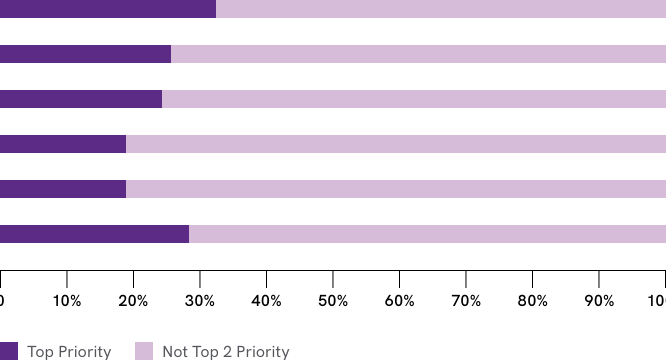
Just under a quarter of voters (24%) support keeping credits unchanged, while 21% would limit them to U.S. companies. Eliminating credits is the least favored option (16%), while uncertainty remains high (39%).
Domestic Manufacturing Priority
Tax credits for companies that manufacture clean energy technologies domestically enjoy robust support (35% keep unchanged, 26% limit to U.S. companies).
Electric Vehicle Subsidy Skepticism
Voters disagree on electric vehicle subsidies, with 30% favoring continuation–44% of Democrats and only 17% of Republicans. Republican opposition is notably high (35% favor elimination).
Hydrogen and Nuclear Energy
Hydrogen (34% unchanged, 27% limit to domestic companies) and nuclear energy (32% unchanged, 26% limit to domestic companies) tax credits show solid, bipartisan support for either continuation or limitation to U.S. companies.
Clean Energy Tax Credits: Top Preferences
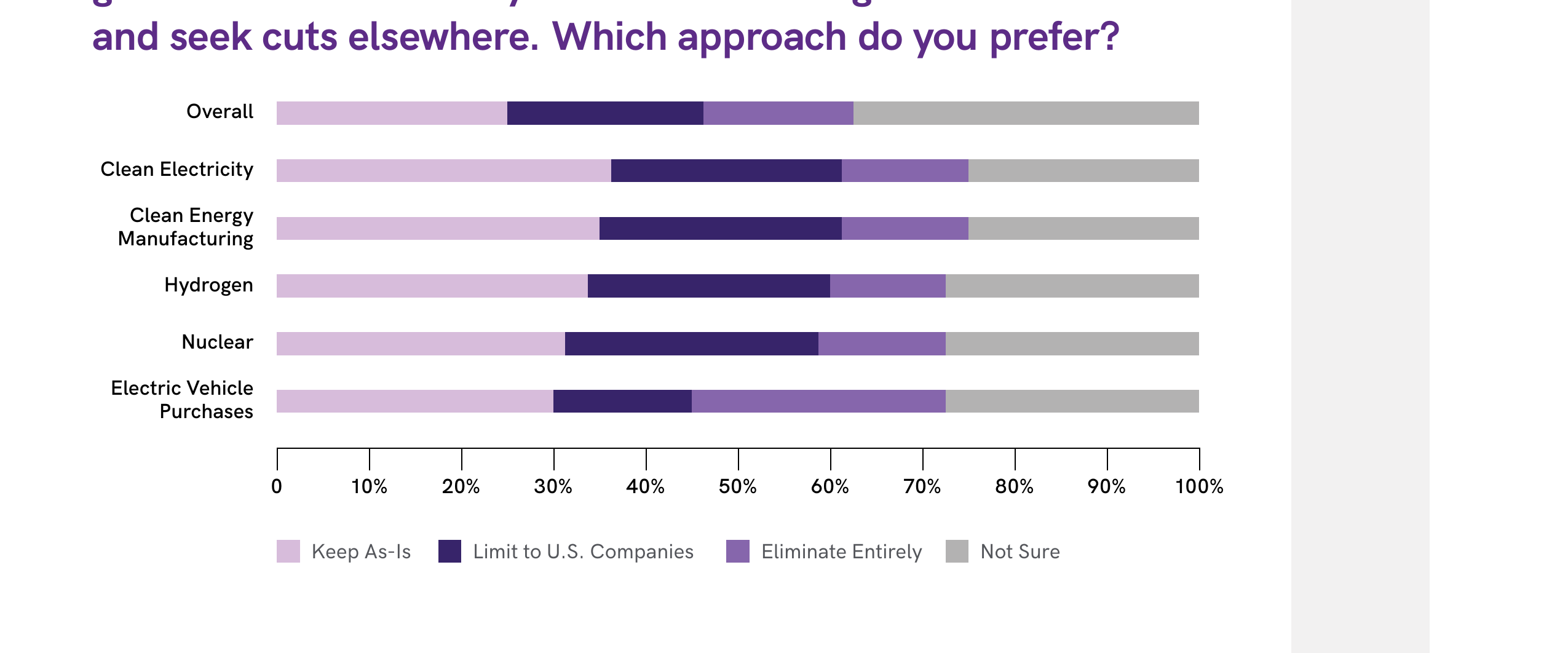
Tax credits supporting clean electricity production (solar, wind, nuclear, battery storage) emerge as most crucial to voters (33%), especially among Democrats (41%), while 35% of Republicans oppose prioritizing any of the tax credits offered (28% of overall voters).
Tax credits for companies that manufacture solar panels, wind turbines, batteries, and other clean energy technology in the United States come in a close second of those eligible at 27% of voters listing it as one of their two top priorities.
Domestic vs. Foreign Companies
A strong majority of voters (59%) support tax credits for American companies that manufacture clean energy technologies, compared to 16% opposing. 60% of Republicans support domestic clean technology tax credits, compared to 58% of Independents and 60% of Democrats.
Support for extending these credits to foreign companies manufacturing in the U.S. is lower (35%), highlighting a clear preference for domestically owned industry.
Impact of Domestic-only Credits
Voters report increased likelihood to support clean energy incentives if limited to U.S. companies (41% combined more likely), with cross-cutting support Republicans at 42% combined and Independents at 41%.
“Green New Scam” Dynamics
If President Trump were to eliminate “Green New Scam” policies, specifically maintaining tax credits exclusively for U.S. firms while ending politically aligned nonprofit funding, Republicans believe this would be keeping his campaign promise at 53% kept, 22% broken, 25% unsure, with Independents at net 13% kept.
Democrats remain skeptical at 22% kept, 31% broken, 47% unsure, highlighting sharp partisan divides in both preferences and voter perceptions.
Conclusion
As Republicans in Congress consider the fate of clean energy manufacturing credits, voters reject the binary that these should either be ended or kept that is often portrayed.
Instead, voters support limiting manufacturing and production credits to U.S. companies, while eliminating the EV tax credit. This would be sufficient for Republican voters to consider Trump’s promise to end Biden’s “Green New Scam” kept.
Voters support an “America First” approach to energy dominance. This includes clean energy tax credits which are essential for a reliable, affordable grid.
About the Rainey Center Polling Team
Connor Sandagata is a technologist, pollster, and data scientist specializing in public opinion research. With a background in applied machine learning in a campaign context, having informed strategy and built targeting for dozens of campaigns ranging from Congressional to Presidential, he advises the Rainey Center’s polling methodology to keep in line with industry best practices. He brings 3 years of experience as a right-of-center pollster to the team.
Downloads
Toplines
Download Toplines (PDF)↓Crosstabs
Download Crosstabs (PDF)↓Methodology
Polling methodology↗