Washington, D.C., October 6, 2025 — In a time when it’s rare to find an issue that unites Americans, energy production, date security, information privacy and national security bring voters together. A new national survey conducted by the Joseph Rainey Center for Public Policy finds broad, bipartisan agreement among likely voters that America’s energy and data infrastructure must remain secure, independent, and domestically powered.
A national survey conducted on September 28, 2025, among 2,010 likely voters found that Americans across party lines view domestic energy production and data security as essential pillars of both economic strength and national security.
96% of voters say it’s important that Americans’ personal data not be stored in Chinese data centers, with 82% calling it extremely or very important.
94% of voters believe it’s important that the energy powering U.S. data centers is generated exclusively from domestically produced sources.
70% agree that the United States is in a technological arms race with China, and 81% say energy security is a key component of national security.
71% support reducing regulatory burdens to make it easier to build new data centers and energy infrastructure within the United States.
79% of respondents would prefer the United States—not China—lead the world in installing new energy projects, even though a plurality (39%) believe China is currently moving faster on energy development. A majority, 83%, agree that data centers serving American consumers and companies should be based in the United States.
“These findings make clear that voters understand the connection between energy, technology, and national security,” said Connor Sandagata, Senior Public Opinion Fellow at the Joseph Rainey Center for Public Policy. “The numbers show a strong, bipartisan consensus that keeping America’s data and energy secure isn’t a partisan issue. It’s a top priority for voters across the political spectrum.”
The survey also underscores strong support for pro-growth energy and infrastructure policies, with nearly three-quarters of voters calling for the U.S. to expand its energy capacity and data infrastructure to compete against China and other foreign adversaries.
“Americans want to see more domestic production, less reliance on foreign adversaries, and smart policies that empower innovation here at home,” said Sarah Hunt, President of the Joseph Rainey Center for Public Policy.
This week, elected officials, energy experts, technology innovators, and policy leaders from across the country will gather at the Joseph Rainey Center’s LAMP National Summit in Washington, D.C. to discuss these issues, focusing on how to strengthen America’s energy independence, secure its data infrastructure, and keep the nation competitive in the global race for innovation and security.
Full polling memo
Our poll finds overwhelming bipartisan consensus that it is important to ensure American data remains in American, not Chinese data centers, and that American data centers are powered by American energy.
A major concern for voters is data security. An overwhelming 83% agree that data centers serving American consumers should be located in the United States. This sentiment is driven by a strong fear of foreign influence, with 77% of voters viewing American data held in Chinese data centers as an “extremely” or “very” important national security threat. Sixty percent of voters feel it is “extremely” important that their personal data is not stored in Chinese data centers.
Voters also view energy independence as a high priority. A significant 70% of voters say it is “extremely” or “very” important for the U.S. not to rely on foreign countries for energy. This directly connects to the data center buildout, with 74% agreeing that American data centers should be powered by domestic energy sources. The link between energy and national security is clear to voters, with 81% agreeing that energy security is a key component of national security.
The findings also highlight a strong sense of competition with China. A solid 70% of voters believe the U.S. is in a “technological arms race with China,” and 77% agree that no part of the U.S. energy or data center supply chain should rely on China. To meet these challenges, 71% of voters support reducing regulatory burdens to make it easier to build new data centers and energy infrastructure in America.
Methodology
Online sample of 2011 likely voters fielded over web panels from September 28 – October 1, 2025 and weighted by gender, race, education, 2024 vote choice and birth year. Respondents were also weighted by whether they passed attention checks. The margin of error is 3.1%.
Voters view energy dominance as a key priority.
Voters believe it is “extremely” (36%) and “very” (31%) important for data centers to use energy that is exclusively domestically produced. Support is bipartisan with 29% of Democrats, 44% of Republicans and 35% of Independents rating it as “extremely” important.
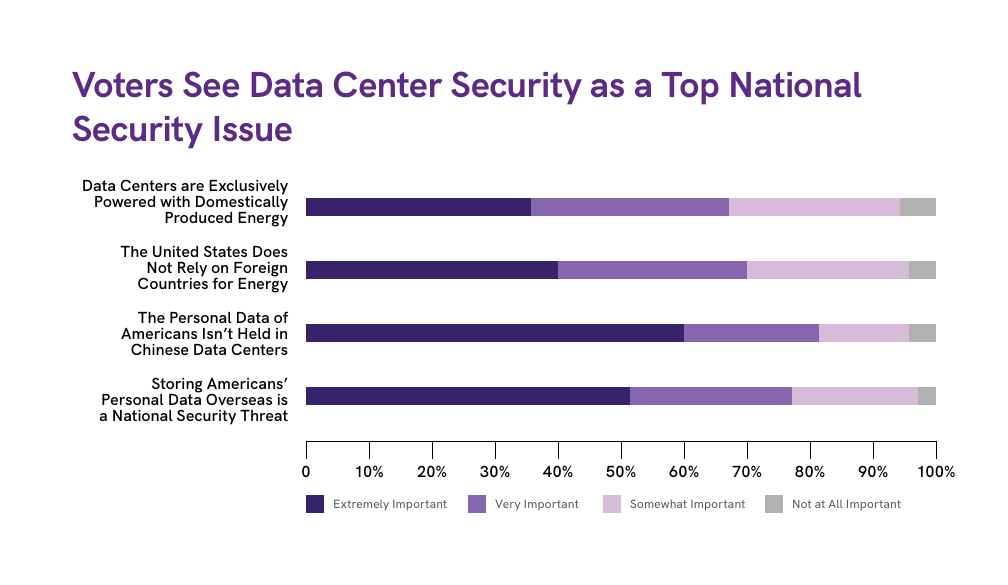
Voters very strongly feel it is important that their personal data is not held in Chinese data centers, with an overwhelming majority (60%) saying it is “extremely” important. The issue is considered “extremely” or “very” important by 74% of Democrats, 88% of Republicans, and 82% of Independents.
Voters also support energy independents, with (40%) saying it is “extremely” important that the US not rely on foreign countries for energy and (30%) saying it is very important. A majority of Democrats (60%), Republicans (81%), and Independents (69%) rate this as either “extremely” or “very” important.
Voters view American data being held in Chinese data centers as an “extremely” (51%) and “very” (26%) important national security threat.
This view is shared by 70% of Democrats, 83% of Republicans, and 74% of Independents.
Voters believe the United States should be data independent from China.
Thirty-nine percent of American voters correctly believe that China installs more energy projects each year than the United States (20% believe the opposite, and 41% are unsure). However, 79% of voters—including 75% of Democrats, 82% of Republicans and 79% of Independents would prefer the U.S. to install more new energy projects than China.
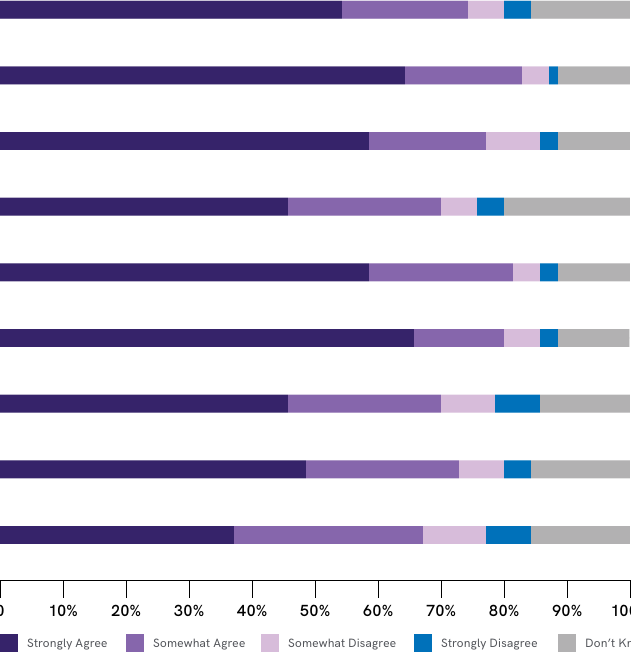
Seventy-four percent of American voters agree (53% strongly) that American data centers should be powered by domestic energy with only 10% disagreeing. Support is bipartisan with 69% of Democrats agreeing (44% strongly) along with 77% of Republicans (61% strongly) and 78% of Independents (54% strongly).
Eighty-three percent of American voters agree (65% strongly) that data centers that serve American consumers should be based in the United States (6% disagree). This includes 79% of Democrats (56% strongly), 86% of Republicans (74% strongly) and 83% of Independents (61% strongly).
Seventy-seven percent of voters agree (59% strongly) that no part of our energy or data center supply chain should rely on China, while just 11% disagree. This concern is shared across the aisle, with 72% of Democrats, 83% of Republicans, and 77% of Independents agreeing with the statement.
A solid 70% of voters agree that the U.S. is in a technological arms race with China (45% strongly). This belief is held by a strong majority of Democrats (68%), Republicans (72%), and Independents (70%).
When it comes to the connection between energy and national security, 81% of American voters agree (59% strongly) that energy security is a key component of national security. This view has overwhelming bipartisan backing from 76% of Democrats, 82% of Republicans, and 84% of Independents.
Seventy-one percent of voters agree (45% strongly) that we should reduce regulatory burdens to make it easier to build new data centers and energy infrastructure in America. This includes 64% of Democrats, 79% of Republicans, and 69% of Independents.
American Data Centers
Voters understand data centers drive energy demand.
Most voters understand that data centers consume large amounts of energy, with 33% saying that AI datacenters use an “extremely large” amount of energy, 19% a “very large” amount of energy, 9% a “somewhat large” amount of energy and 3% “not much at all,” while a third of voters were unsure.
Voters support permitting reform.
A clear majority of American voters believe that government regulations and red tape are significant obstacles to developing new infrastructure, and they broadly support streamlining these processes, especially to reduce reliance on foreign countries like China.
This sentiment is bipartisan, though Republicans consistently express stronger agreement that regulations are a problem. For example, 60% of Republicans agree there is “too much red tape” preventing new energy infrastructure, compared to 53% of Democrats. This pattern holds for streamlining permitting, which is supported by 69% of Republicans and 58% of Democrats. The strongest consensus is on making it easier to build energy infrastructure to avoid relying on China, a goal supported by 79% of Republicans and 69% of Democrats.
Our survey demonstrates a clear and unified mandate from the American electorate for American Energy dominance.
Across party lines, voters express strong concerns about the security of their personal data and the nation’s energy supply, viewing both as critical components of national security.
Voters overwhelmingly see China as a direct competitor and a potential threat in the technological and energy sectors. There is a strong desire to onshore critical infrastructure, keeping data centers within U.S. borders and powering them with domestic energy and reducing reliance on foreign nations, especially China. This widespread agreement suggests strong public backing for policies aimed at bolstering America’s technological sovereignty and energy independence. To achieve these goals, American voters support streamlining the permitting of new energy sources.