Key findings
- Americans support making it easier to build transmission overall (net +11 easier) and also specifically for solar (net +31), wind (net +23), nuclear (net +7), oil (net +10), and natural gas (net +28), but not coal (net -8).
- The public opposes electric vehicle subsidies (end +10), but supports subsidies for companies that produce hydrogen (net +27 keep), solar, wind, and batteries (net +25 keep), and nuclear (net +10 keep).
- A majority of voters (51%) support tax credits for companies that build or produce clean electricity, including solar, wind, nuclear, and battery storage.
- Americans (53%) support tax credits for companies that manufacture solar panels, wind turbines, batteries, and other clean energy technology in the United States.
- Electric vehicle tax credits are underwater with Americans by 10 percentage points–and more so with Republicans (-39) and Independents (-8).
A Landscape View of Voters’ Positions on Tax Cuts and Credits in Advance of Congressional Action
Introduction
As the Congressional session heats up, the Rainey Center conducted a survey of Americans to understand how voters are thinking about energy and tax policy, particularly with regard to different energy sources, tax incentives, and fiscal tradeoffs. We find that Americans overwhelmingly support American energy, want most forms of energy to be built more easily–from renewables to nuclear, oil, and natural gas, and support subsidies for domestic energy manufacturing. Our findings show how legislators can navigate the complex landscape of public opinion; one that prioritizes prosperity, growth, and domestic industry.
Methodology
The survey was conducted with an online sample of 1,383 respondents fielded over web panels from February 16 -17, 2025 and weighted to education, age, gender, race, and 2024 election results, with a margin of error of +/- 3.1%.
Topline Findings
Voters support key elements of the IRA while also supporting targeted cuts on electric vehicle subsidies.
Voters are more skeptical of incentives for union labor than they are of incentives for domestic production.
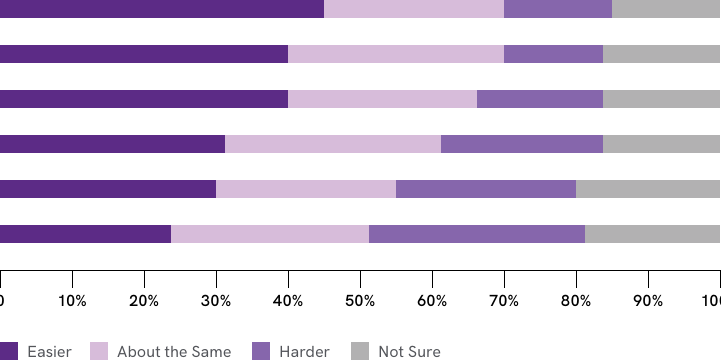
Americans support making it easier to build transmission overall (net +11 easier) and also specifically for solar (net +31), wind (net +23), nuclear (net +7), oil (net +10), and natural gas (net +28), but not coal (net -8).
The public opposes electric vehicle subsidies (end +10), but supports subsidies for companies that produce hydrogen (net +27 keep), solar, wind, and batteries (net +25 keep), and nuclear (net +10 keep).
Tradeoffs: Tax Cuts and Credits
A majority of voters (51%) support tax credits for companies that build or produce clean electricity, including solar, wind, nuclear, and battery storage.
Americans (53%) support tax credits for companies that manufacture solar panels, wind turbines, batteries, and other clean energy technology in the United States.
Electric vehicle tax credits are underwater with Americans by 10 percentage points–and more so with Republicans (-39) and Independents (-8).
Clean Energy Tax Credit Adders
Voters also weighed in on bonus incentives (“adders”) that would boost tax credits under specific conditions:
Low-Income Community
A clear majority supports extra credits in low-income areas, with 53% of voters supporting keeping the adder. Only 11% each strongly or somewhat feel these adders should end, while 25% remain uncertain.
Materials Sourced from the U.S.
For projects using domestically sourced materials, 33% “somewhat feel we should keep” and 25% “strongly feel we should keep” the adder, versus 7% “somewhat feel we should end” and 11% “strongly feel we should end,” with 24% not sure.
Union Labor
Responses are split—30% are unsure, 22% “somewhat feel we should keep,” and 17% “strongly feel we should keep” the adder. However, 14% of voters somewhat and 16% strongly feel that the adder should be ended.
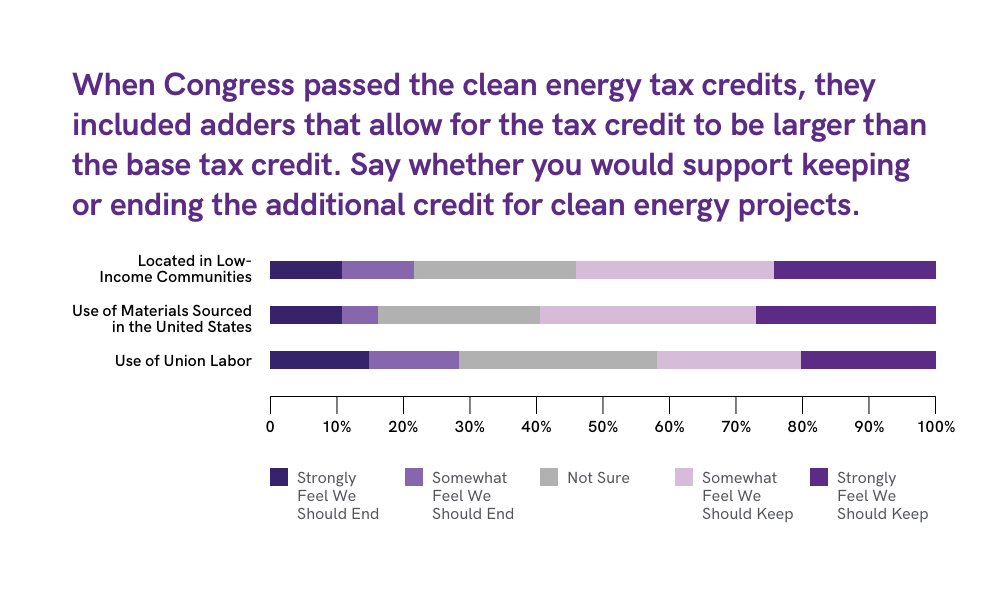
These adders suggest voters want incentives that promote both equitable community benefits and domestic economic strength.
Alternative Vehicle Adoption
When it comes to personal transportation, voter sentiment is notably cautious:
Plug-in Hybrids
A dominant 43% would never buy a plug-in hybrid, 33% say they are unlikely to buy one, while 21% are considering ownership and only 3% already own one.
Electric Vehicles
Similarly, 44% would never buy an electric vehicle, 31% are unlikely to purchase one, with 21% considering it and a mere 4% currently owning one.
These trends highlight a significant gap between clean energy aspirations and consumer readiness for alternative vehicles.
Energy Transmission Development
Overall Transmission
A plurality of voters—38%—supports easing transmission development to boost energy production and lower bills—but many remain unsure.
Energy-Specific Views
Support for easier transmission sees considerable variation by energy type–while Americans generally support easier transmission construction, they are more supportive of transmission for solar (net +31), wind (net +23), nuclear (net +7), oil (net +10), and natural gas (net +28), than for coal (net -8).
Decision-Making Authority
Voters slightly favor state over federal control, yet uncertainty remains high: they lean slightly toward state governments making transmission decisions (36%), compared to 29% favoring federal control, with 35% not sure.
The data suggest a clear push for renewable-friendly policies while cautioning against a one-size-fits-all approach for conventional energy sources.
Self-Generation By Technology Companies
As tech companies move toward self-generation:
Renewables Lead
There’s strong support for allowing self-generation of solar and wind energy.
Traditional Fuels Face Resistance
Opinions become more divided—and cautious—when it comes to natural gas, coal, oil, and nuclear energy.
Voters clearly differentiate between the potential benefits of renewable self-generation and the risks associated with conventional energy sources.
Policy Trade-Offs
A critical trade-off emerges: should Congress scrap clean energy tax credits to extend broader tax cuts or preserve them to protect American manufacturing? When asked if Congress should repeal clean energy tax credits to extend broader tax cuts, or if it should it maintain them to protect American manufacturing, voters favored keeping the clean energy credits to safeguard manufacturing—57% of them compared to 22% supporting ending them. An additional 21% remain uncertain.
This division underscores deep partisan tensions, highlighting the broader debate between fiscal conservatism and industrial priorities.
Conclusion
Our survey exposes a battleground of opinions on clean energy tax policy.
Voters back incentives that drive domestic manufacturing and renewable energy, yet remain skeptical about alternative vehicle adoption and traditional energy expansion. The stark partisan splits—especially on the electric vehicle credit and policy trade-offs—highlight the challenges Congress faces. Moving forward, robust public education and transparent dialogue will be key to bridging these divides and crafting policies that balance economic discipline with sustainable innovation.
About the Rainey Center Polling Team
Connor Sandagata is a technologist, pollster, and data scientist specializing in public opinion research. With a background in applied machine learning in a campaign context, having informed strategy and built targeting for dozens of campaigns ranging from Congressional to Presidential, he advises the Rainey Center’s polling methodology to keep in line with industry best practices. He brings 3 years of experience as a nationally ranked right-of-center pollster to the team.
Downloads
Toplines
Download Toplines (PDF)↓Crosstabs
Download Crosstabs (PDF)↓Methodology
Polling methodology↗