Key findings
- Among Independents, 46 percent choose “someone else,” the largest response in the survey. Vance’s 19 percent with this group is barely ahead of Rubio’s 12 percent.
- Trump Jr. leads with 23% of Black Republicans, followed by Vance with 14% and Rubio pulling in 12%.
- Among voters 18-34, the race looks different than the overall picture. Vance still leads (35%), but Trump Jr. runs a strong second at 18%.
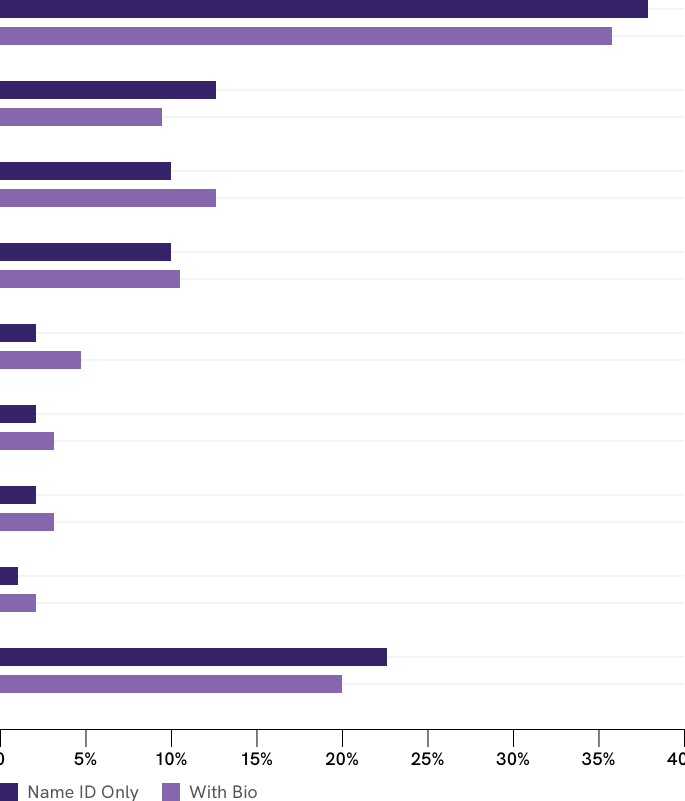
- The 23 percent of voters choosing "someone else" is the most important number in this poll.
Vice President Vance’s 38 percent makes him the clear frontrunner, but the underlying numbers tell a more complicated story. His support is heavily concentrated among the party’s traditional base: older, white, self-identified Republicans.
Vance’s central vulnerability is Independents. Among Independents, 46 percent choose “someone else,” the largest response in the survey. Vance’s 19 percent with this group is barely ahead of Rubio’s 12 percent. The candidate who figures out how to consolidate the Independent lane could fundamentally reshape this race.
This poll surveyed 832 registered Republicans and Independents via online panel from January 28-29, 2026. Results were weighted by gender, age, race, and education to match population demographics. The margin of error is ±3.7 percentage points at the 95% confidence level.
The Minority Vote: An Open Contest
One of the most striking findings in the crosstabs is that the minority vote within the Republican coalition is genuinely up for grabs. Vance does not dominate among non-white voters the way he does among white Republicans.
Among Black Republicans and Independents
Trump Jr. leads with 23% of Black Republicans, followed by Vance with 14% and Rubio pulling in 12%. This is a group where the frontrunner is at a clear disadvantage, and where a candidate who invests early could build real support.
Among Latino Republicans and Independents
Vance and Trump Jr. are tied at 24% each. DeSantis is notably weak here at just 9%. Trump Jr.’s strength with Latinos combined with his youth appeal, represents a distinctive coalition unlike any other candidate in the field.
The Youth Vote: Trump Jr.’s Lane
Among voters 18-34, the race looks different than the overall picture. Vance still leads (35%), but Trump Jr. runs a strong second at 18% a gap of just 17 points compared to 25 points overall. DeSantis, meanwhile, collapses to 9% with this group. Vance, meanwhile, is strongest with voters 65 and older, leading the pack with 39%.
The Gender Gap
Women were more likely to be undecided, with 26% choosing “someone else,” compared to 20% of men. Vance (40% women, 36% men) had a more female base, while Rubio (8% women, 12% men) skewed male.
The Education Divide
The education split in the field is modest but real. Vance performs slightly better with non-college voters (40%) than college-educated voters (36%).
The more telling education split is in the undecided vote. College-educated Republicans are slightly more likely to choose “someone else” (25%) than non-college voters (20%), suggesting that the candidate with room to grow among educated voters hasn’t emerged yet.
The Jennings Factor
For fun, we tossed in CNN Senior Political Commentator Scott Jennings, who registered at 1 percent in the name-ID-only ballot, predictable for a candidate who has never held elected office and who works for a media entity that Republicans don't really watch. But the more interesting signal is what happens when voters receive biographical information.
Jennings doubles to 2 percent when voters hear a little about his bio, which perhaps reveals an audience within the Republican electorate for a communicator-candidate who has battle-tested credibility from the media trenches.
Jennings's profile is unlike anyone else in the field. He is not a governor, senator, or scion of the Trump family. He is the candidate who goes on hostile territory every night and wins. In a primary where 23 percent of voters are looking for "someone else," a profile like that has latent potential.
For context, several candidates who ultimately won presidential nominations began their campaigns in the low single digits two years before the primary. The question for Jennings is whether the skills that make him effective on cable news such as the ability to communicate conservative ideas clearly under pressure, to frame issues for persuadable audiences, and to dismantle liberal arguments in real time can translate into a campaign message that moves voters in early states.
His 6 percent among voters 18-34 in the bio-informed ballot is a small but telling data point. Younger Republican voters, many of whom discovered Jennings through viral cable clips on social media, may represent a natural base for a candidacy built on communication and combativeness rather than traditional political credentials.
Other Bio Gaps
It’s not just Jennings benefiting from a bio: Cotton also rises, from 2% to 5% as does Rubio, from 10% to 12%, both have national security heavy bios, suggesting some interest from voters in robust foreign policy expertise.
The "Someone Else" Electorate
The 23 percent of voters choosing "someone else" is the most important number in this poll. It represents a massive bloc of persuadable voters who could swing the race in any direction.
The pattern is clear: the voters most open to an alternative are Independents, minority voters, and college-educated Republicans. These are precisely the voters the party needs to grow its coalition and the voters Vance is weakest with. The candidate who consolidates this bloc would immediately become the primary challenger to the Vice President.
Bottom Line
J.D. Vance is the frontrunner, but this is not a coronation. His 38 percent is built on a foundation of older, white, core-party voters, a strong base, but not a majority. Among Independents, minority voters, and younger Republicans, the race is genuinely open.
The 2028 primary will be shaped by three questions:
First, can Vance expand beyond his base to consolidate the party, or does his Independent problem leave an opening for a candidate with broader appeal? Second, which candidate captures the growing minority Republican vote? Trump Jr. and DeSantis are well-positioned with Black and Latino voters, but neither has broken out. Third, is the 23 percent "someone else" vote waiting for an existing candidate to earn their support, or for a new entrant who offers something this field doesn't? A candidate like Scott Jennings with a natural media presence could be the breakout candidate.
Two years is a long time. This race is far from over.