Key findings
- 95% are proud to be American. 85% believe in the American Dream. 76% say the United States is one of the greatest countries in the world.
- Deportation moved from net opposition in 2024 to nearly 60% support.
- 62% support prosecuting Somali fraud leaders to the fullest extent of the law. 52% say Muslim leaders should condemn the scandal more forcefully.
- The gender gap in voting behavior is stark. When asked how they typically vote (Q28), 48% of men say they vote all or mostly Republican, compared to just 12% of women.
- 61% approve of President Trump’s efforts to negotiate peace deals and end foreign wars.
Executive Summary
As American approaches its 250th anniversary, Rainey Center in partnership with the Muslim American Leadership Alliance (MALA) and the American Muslim League (AML) conducted a national poll of 768 Muslim American registered voters (±4.3 MOE) to survey the state of the community. A follow-up to a previous survey conducted before the 2024 presidential election, the new poll reveals a community that is patriotic, politically heterogeneous, and divided on many aspects of domestic and foreign policy.
Six Themes Emerge Across the Data
Strong American Identity
95% are proud to be American. 85% believe in the American Dream. 76% say the United States is one of the greatest countries in the world.
Broad Rejection of Fraud and Corruption
62% support prosecuting Somali fraud leaders to the fullest extent of the law. 52% say Muslim leaders should condemn the scandal more forcefully.
Openness to Bipartisan Engagement
36% explicitly say Muslims should engage both political parties. 41% say Muslims have conservative values and should not be lumped in with the progressive left.
Concern About Social Extremism from All Directions
38% worry equally about right-wing discrimination and left-wing ideology for their children’s future. 58% are concerned about far-right ideology; 53% are concerned about far-left ideology.
Support for Peace and Stability
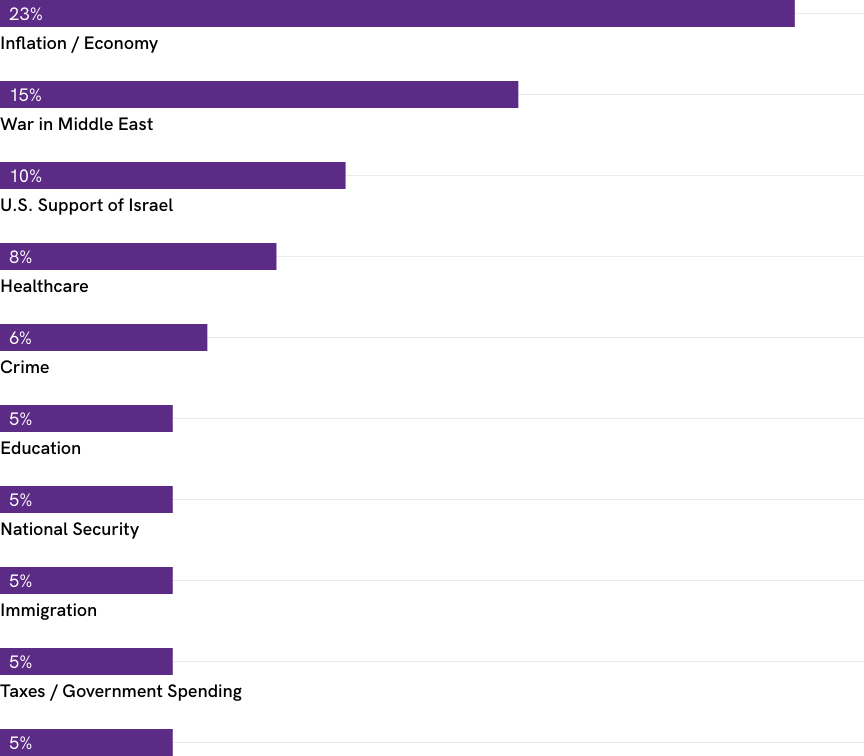
61% approve of President Trump’s efforts to negotiate peace deals and end foreign wars. The economy (23%) and Middle East conflicts (25% combined) dominate as top issues.
Frustration with Ideological Gatekeeping
43% say Muslim-LGBTQ alliances compromise Islamic principles. 44% say community groups are too focused on Palestine. The community wants broader domestic engagement on its own terms.
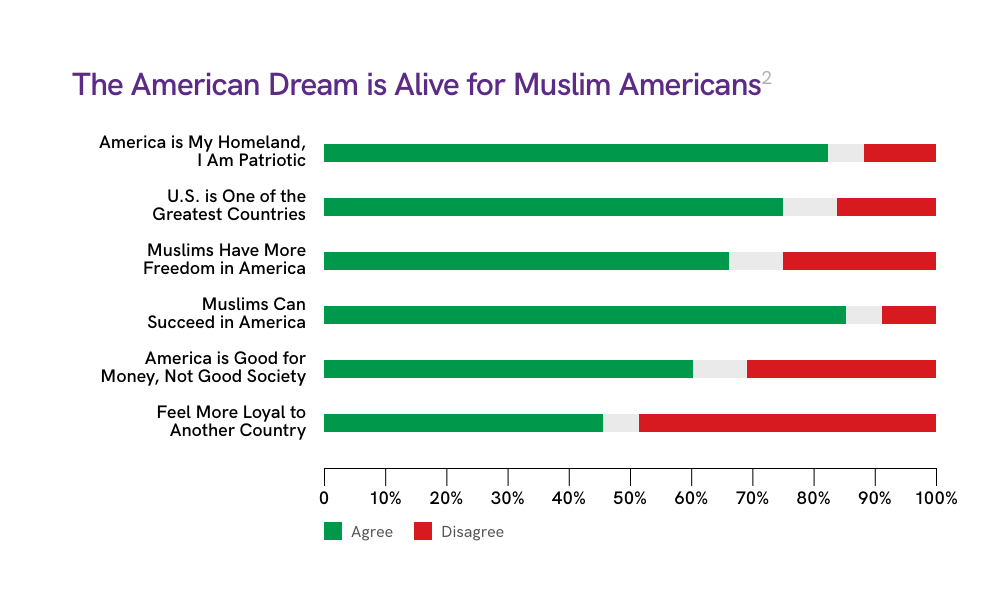
American Dream and Patriotism
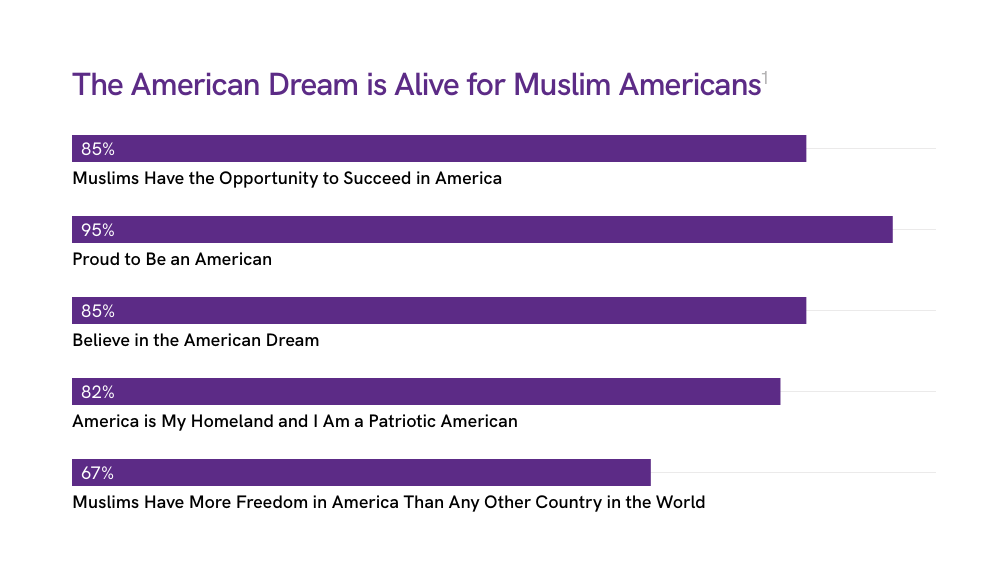
79% percent of Muslim Americans say they are “definitely” proud to be American, and 64% “definitely” believe in the American Dream. 76% say the United States is one of the greatest countries in the world. 67% agree that Muslims have more freedom in America than any other country. And 85% say Muslims have the opportunity to succeed here. At the same time, nearly half acknowledge ties to other countries, a phenomenon that deserves further research.
This is also a highly educated community: 43% hold a Masters degree or PhD, and 68% have at least a bachelor’s degree. 72% say they are definitely voting in the 2026 midterm elections.
Economy and Government Spending
The economy is the top issue heading into the 2026 midterms, with 23% of Muslim Americans naming inflation/prices/economy as most important, more than double any other single issue. 77% are “extremely” or “very” concerned about the state of the current economy.
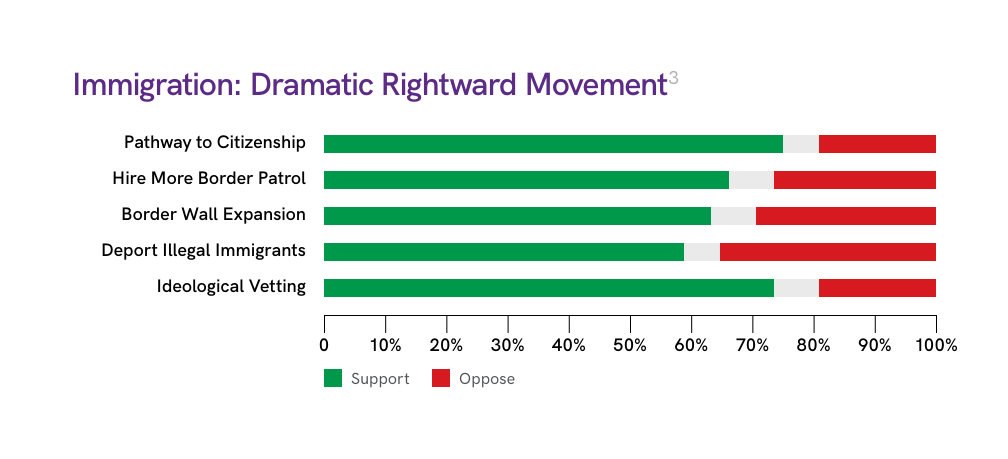
Immigration and Border Security
Immigration is the policy area with the most dramatic rightward movement among Muslim Americans since our 2024 poll. Support has surged across every enforcement measure tested.
Deportation moved from net opposition in 2024 to nearly 60% support. 73% support strengthening the vetting process for new entrants to ensure no one with radical or anti-American ideologies is permitted to immigrate.
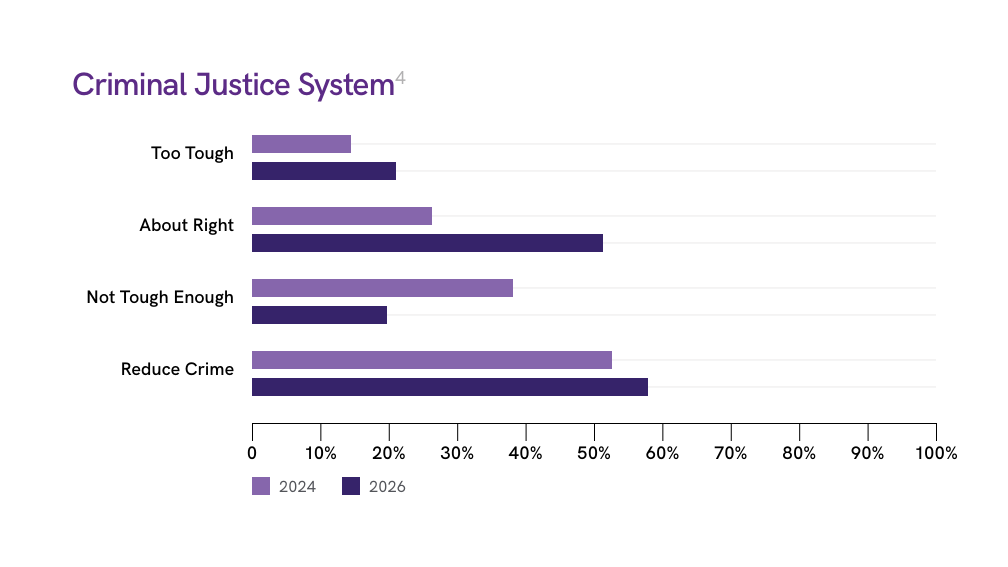
Crime and Criminal Justice
73% of Muslim Americans are “extremely” or “very” concerned about rising crime and threats to public safety. When forced to choose between harsher sentences to reduce crime and shorter sentences to reduce mass incarceration, 58% choose reducing crime (up from 52% in 2024).
On the criminal justice system itself: 52% now say it is “about right” in its handling of crime, up from 27% in 2024. Those saying the system is “not tough enough” dropped from 39% to 20%.
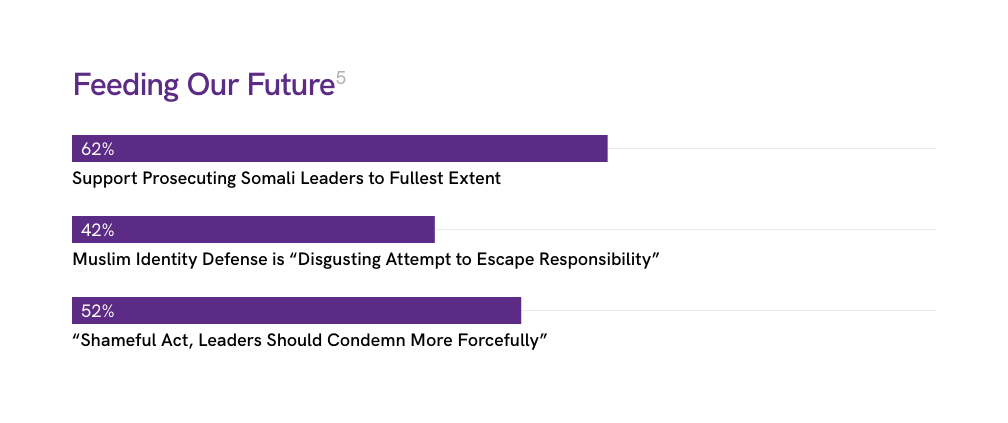
Welfare Fraud and the “Feeding Our Future” Scandal
Poll participants were presented with the Feeding Our Future fraud case in Minnesota, in which federal prosecutors allege individuals in the Somali community stole over $250 million in taxpayer funds intended for children’s meals. The response shows a willingness to hold their own accountable.
A strong majority supports full prosecution, and a plurality rejects the cultural defense, that Muslims face bias in the legal system. 52% say it is a shameful act that Muslim leaders should condemn more forcefully, compared to 35% who see the story as being weaponized to smear Somali Muslims. 62% are “extremely” or “very” concerned about rising welfare fraud more broadly.
Education and Parental Rights
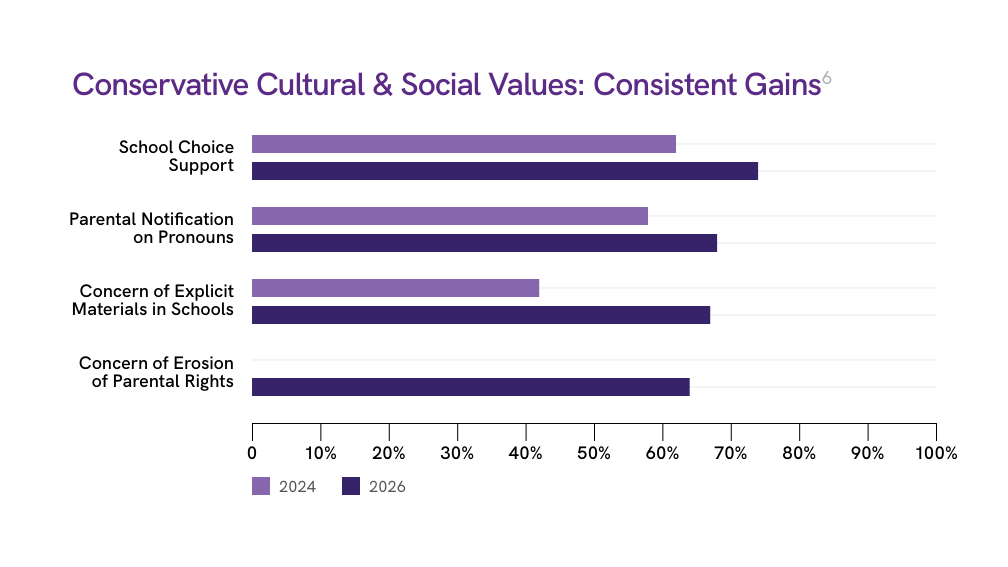
A significant percentage of Muslim Americans firmly align with conservative positions on education policy. School choice support has climbed to 74% (up from 62% in 2024), with 40% “strongly” supporting. Parental notification requirements when children request different gender pronouns are backed by 68% (up from 58%).
Concern about sexually explicit materials being taught to children is high, with 67% “extremely” or “very” concerned. 64% express the same level of concern about the erosion of parental rights in public education.
Gender, Abortion, and Transgender Issues
57% of Muslim Americans are “extremely” or “very” concerned about rising transgender medical treatments for minors. When asked directly, 53% say children under 18 should not be allowed to medically transition, even if they identify as transgender (vs. 37% who say they should). On transgender athletes, 48% say athletes should compete based on sex at birth (down from 61% in 2024), while 39% say by chosen gender identity. Parental notification on pronouns in schools is supported by 68%.
When asked about Muslim organizations forming alliances with LGBTQ+ activist groups, 43% call it “a mistake that compromises Islamic principles,” while 38% call it “a smart political strategy.” The community is split on where the line falls between coalition politics and religious values.
Many respondents resist binary framing on abortion. The largest group (41%) says “abortion is a complicated moral and legal matter that should be decided on a case-by-case basis.” The community splits evenly between those who say it should be legal in all or most cases (26%) and those who say it should be illegal in all or most cases (26%). This pragmatic, case-by-case instinct is consistent across partisan lines.
Gender and Generational Divides on Political Alignment
Despite a majority voting for Kamala Harris in 2024 (53% vs. 39% for Trump), Muslim American registered voters are politically divided along gender and generational lines that mirror faultlines in the broader American electorate.
Gender and Voting Behavior
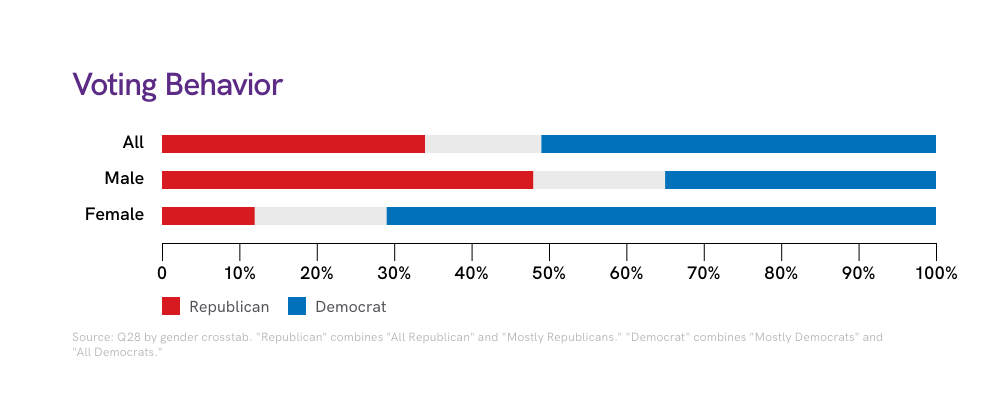
The gender gap in voting behavior is stark. When asked how they typically vote (Q28), 48% of men say they vote all or mostly Republican, compared to just 12% of women. Conversely, 71% of women say they vote all or mostly Democrat, compared to 35% of men.
Formal party registration (Q3) confirms the same pattern: 52% of men are registered Republican vs. 13% of women; 66% of women are registered Democrat vs. 34% of men. And in 2026 Congressional vote intention (Q5), 55% of men plan to vote Republican vs. 9% of women. This gender-partisan sorting is one of the most pronounced findings in the survey.
Generational Divide
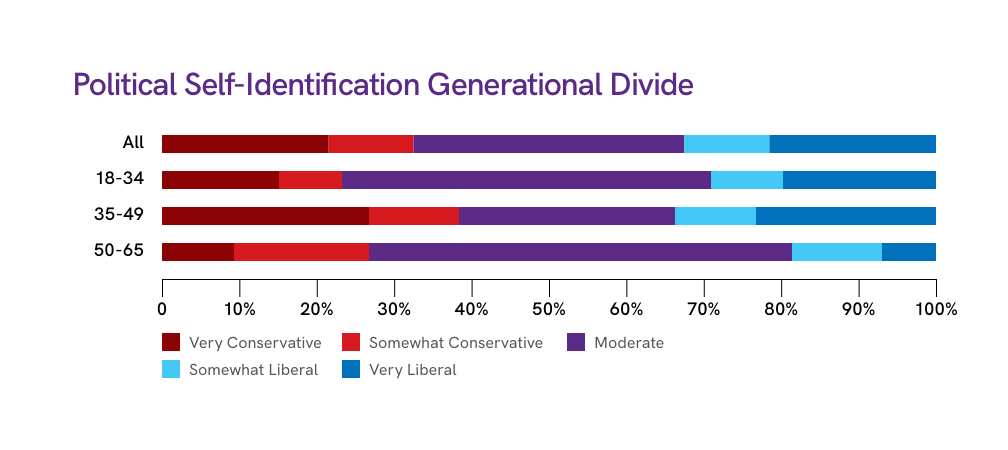
Younger Muslim Americans (ages 18–34) lean more heavily toward the Democratic Party, while middle-aged respondents (35–49) show stronger conservative and Republican alignment.
Among 18–34-year-olds, 45% self-identify as moderate compared to 27% of 35–49-year-olds. The 35–49 cohort contains the largest share of “very conservative” respondents at 26%, nearly double the 15% among 18–34-year-olds.
Voting behavior (Q28) mirrors this pattern. Among 18–34-year-olds, 67% vote all or mostly Democrat, compared to 42% of 35–49-year-olds. Republican-leaning voting (all or mostly Republican) runs at 14% for 18–34-year-olds and rises to 44% among 35–49-year-olds.
Identity and Partisanship
Republican-registered respondents are more likely to identify as “American first and Muslim second” (26%) than Democrat-registered respondents (18%). However, 41% of Republicans still identify as “Muslim first,” indicating that religious identity remains primary across partisan lines.
Progressive Coalition vs. Conservative Values
When asked directly whether Muslim Americans are natural allies of the progressive left or hold distinct conservative values (Q77), respondents are closely divided: 41% say Muslims have conservative values and should not be grouped with the progressive left, while 38% see a natural alliance based on shared marginalization. 22% are unsure.
This split is notable: a plurality, however narrow, rejects automatic alignment with the progressive left, even as the community continues to vote majority-Democrat.
Cultural Muslim Identity and Religious Practice
The 2026 poll reveals that a large majority of Muslim American respondents identify as “Cultural Muslims,” relating to their Muslim identity primarily through heritage and cultural traditions rather than through theology or religious rituals.
Cultural Muslim Self-Identification
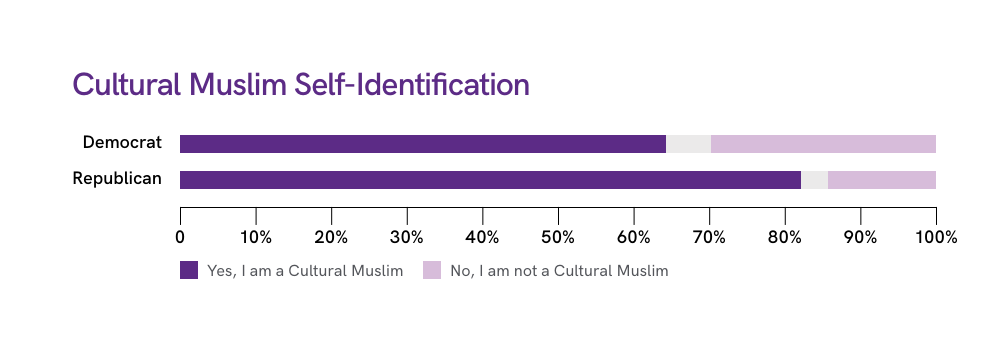
71% of respondents identify as Cultural Muslims (Q14), a significant increase from 50% in the 2024 Rainey Center / MALA poll. Just 25% say they are not Cultural Muslims, and 4% are unsure.
Cultural Muslim identification is high across party lines but especially prevalent among Republican-registered respondents.
By self-described ideology, Cultural Muslim identification is highest among those who identify as very conservative (82%) and somewhat conservative (82%), compared to 65% among moderates and 56% among somewhat liberal respondents.
Religious Practice
Despite the high rate of Cultural Muslim identification, religious observance among respondents remains substantial. 59% attend religious services at least once a week (31% more than once a week, 28% once a week), while 14% attend rarely or never (Q12).
67% say the main way they relate to their religion is through prayer and ritual observance, while 32% relate primarily through culture and community (Q13). Among Republican-registered respondents, the culture-and-community share rises to 43%, compared to 26% among Democrats.
Religious Tradition
58% of respondents identify as Sunni, 21% as Cultural Muslim (as a tradition category distinct from sect), 7% as Ismaili, 4% as Shi’a, 2% as Ahmadi, and 7% as Other (Q10).
Parental Background and Conversion
74% of respondents report that both parents are or were Muslim. 18% say they chose to become Muslim (identifying as converts), while 8% have one Muslim and one non-Muslim parent (Q11).
Children’s Religious Education
Among respondents with children (81% of the sample), the most common arrangement is that children attend secular public school with religious education happening informally at home or at a place of worship (45%). 22% supplement public school with formal Muslim education through a religious institution. 14% send their children to a Muslim private school (Q15).
Marriage Patterns and Endogamy
65% of respondents are married to a Muslim, 7% to a non-Muslim, and 4% to someone of Muslim heritage who does not identify as Muslim. 24% are unmarried (Q16).
On whether children should marry within their background: 31% say children should marry within both their religious and ethnic background, 30% within their religious background only, and 6% within their ethnic background only. 29% say background does not matter (Q17). In total, 67% express a preference for some form of endogamy.
Future of Muslim Children and Democratic Socialism
Concerns About Muslim Children
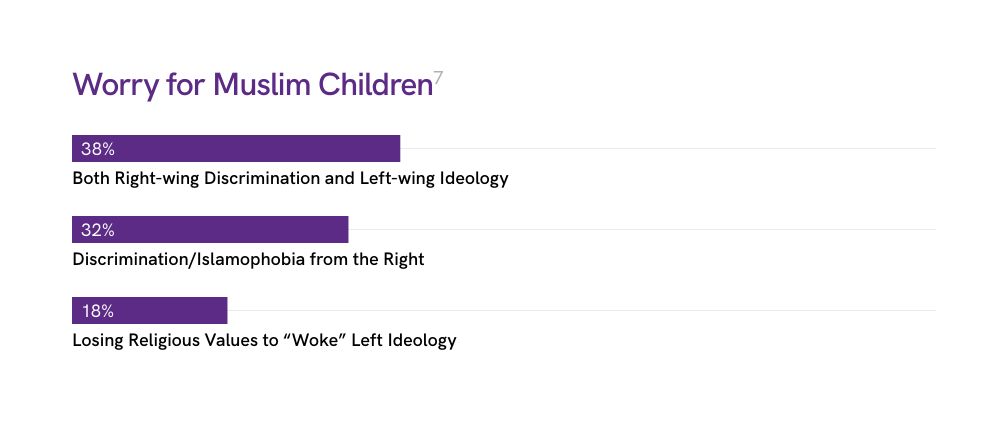
When asked what worries them more regarding the future of Muslim children in America, the largest group (38%) says both right-wing discrimination and left-wing “woke” ideology are equally concerning. 32% are primarily worried about Islamophobia from the political right; 18% are primarily worried about losing religious values to gender and LGBTQ ideologies from the political left; and 13% say neither is concerning.
Zohran Mamdani and Democratic Socialism
New York City Mayor Zohran Mamdani holds a 67% favorable rating (35% very favorable). When asked how his views compare, 25% say “about the same as me,” while 23% place him to their left and 35% to their right. After being told about “a rising trend of Muslim American politicians who identify as Democratic Socialists, like New York City Mayor Zohran Mamdani,” whose policy agenda focuses on “defunding police, using public funds for transgender reassignment surgeries, and implementing socialist economic policies like rent freezes and government-run healthcare,” 57% view this political trend positively (38% very positive), while 17% view it negatively.
Foreign Policy and the Middle East
The Middle East cluster is the second-largest concern heading into the midterms (15% cite the war in the Middle East, 10% cite U.S. support of Israel). 72% are “extremely” or “very” concerned about the war in Iran, and 65% express the same concern about U.S. support of Israel. 66% are “extremely” or “very” concerned that the war with Iran is increasing discrimination against Muslim Americans.
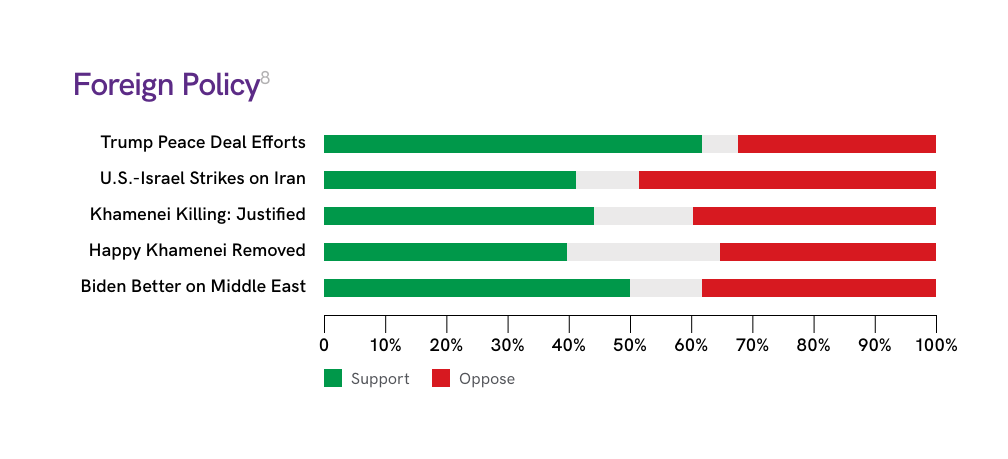
Trump’s Middle East peace efforts receive 61% approval (34% strongly, 27% somewhat). On the US-Israel strikes against Iran, opinion is more divided: 41% support vs. 48% oppose. Muslim Americans were told that U.S. and Israeli strikes killed Iran’s Supreme Leader Ayatollah Ali Khamenei and asked their opinion on it. The killing of Khamenei is view as justified by 44% and unjustified by 39%; 39% are happy he was removed from power while 35% are sad. On the Israel-Hamas conflict, a plurality (39%) supports neither side, while 35% support Hamas and 16% support Israel.
On the U.S./Israel-Iran conflict, sympathies are almost evenly split: 32% side with the United States and Israel, 33% with the Iranian government, and 26% support neither side. But when the question shifts from geopolitics to moral framing, a clearer consenus emerges: 53% say that regardless of what you think of the Iranian regime, a foreign military attack on a Muslim-majority country is wrong and will hurt ordinary Iranians, while 29% say the regime is an enemy whose removal could benefit Iranians and the Muslim world. Asked who benefits from the war, 42% say the United States, 25% say Israel, and 30% say no one. Only 17% believe the Iranian people benefit.
Many respondents expressed significant concern about foreign government influence on American Muslim leadership and organizations. Concern is highest about Iran (58% extremely or very concerned), followed by China (55%), Turkey (50%), and Qatar (52%). These findings suggest the community is aware of and wary about external actors shaping its domestic institutions.
Muslim Community, Organizations, and Identity
Muslim Brotherhood and CAIR
Our poll tested whether terrorism-related allegations change how Muslim Americans view the Muslim Brotherhood and CAIR (Council on American Islamic Relations). Before hearing any additional information, the Muslim Brotherhood holds a 70% favorable rating and CAIR holds 72% favorable.
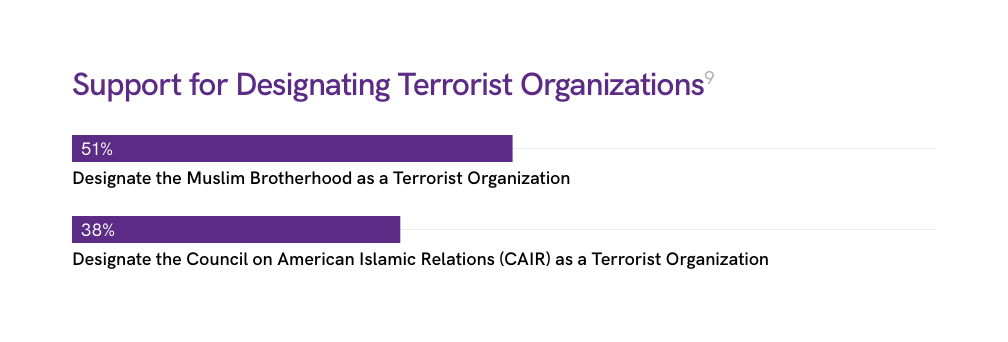
Respondents were then informed that Governors Abbott (TX) and DeSantis (FL) have designated the Muslim Brotherhood as a terrorist organization in their states, citing coordination with Hamas. They were also told both governors have called for designating CAIR, citing alleged payments to anti-Israel agitators and ties to Hamas. With that information in hand, 51% support the Muslim Brotherhood designation and 38% support the CAIR designation, while 45% oppose designating CAIR. Favorability ratings after the informed prompt did not shift dramatically.
Muslim Brotherhood dropped four points to 66%, CAIR dropped six points to 66%. The phenomenon of robust support for the Muslim Brotherhood deserves further research.
Additional Muslim Community Questions
Progressive Coalition
Asked whether Muslim Americans are natural allies of the progressive left or hold conservative values that don’t align with it, opinion is closely split: 41% say they have conservative values vs. 38% who see themselves as progressive allies. The community is actively debating its own political identity.
Media Representation
50% of Muslim Americans say the media does a good or very good job portraying Muslim Americans; 22% say bad or very bad. When asked whether any one ethnic group within the Muslim community receives too much of the media’s attention when covering Muslim Americans, 21% say Arabs are overrepresented in media coverage, while 12% say African Muslim Americans are. 27% say no group is overrepresented and 28% are not sure.
Victim Narratives
Asked whether Muslims are too frequently portrayed as victims in the media, 43% agree, calling them “a strong and independent group,” while 41% say the portrayal is justified. On a parallel question about Jews, 47% say Jews are too frequently portrayed as victims, compared to 31% who say it is justified.
Community Interest Groups
Respondents were asked whether Muslim community interest groups in the United States, including the Council on American Islamic Relations (CAIR), the Muslim Public Affairs Council (MPAC), and the Islamic Society of North America (ISNA), do a good or bad job of representing the interests of Muslim Americans. 67% say they do a good job (14% very good, 25% somewhat good), while 13% say they do a bad job. Separately, respondents were asked whether these organizations are too focused on the conflict in Palestine at the expense of other issues facing Muslim Americans. 44% say they are overly focused on Palestine, while 39% say the focus on Palestine should continue.
Antisemitism and Islamophobia
46% say people should be concerned about both rising antisemitism and Islamophobia. 18% say concern should focus on antisemitism only; 15% say Islamophobia only.
Sectarian Divisions
54% say differences between Muslim sects create at least some divisions within the U.S. Muslim community, and 60% feel global sectarian conflicts affect relationships among Muslims in the U.S. The dynamics driving tension between different Muslim sects in America deserves further research.
Jews and Other Muslims
When asked to describe their feelings about American Jews, 55% of Muslim Americans express positive views (31% very positive), while 17% express negative views. 58% are concerned about rising far-right ideology.
Full Concerns Battery
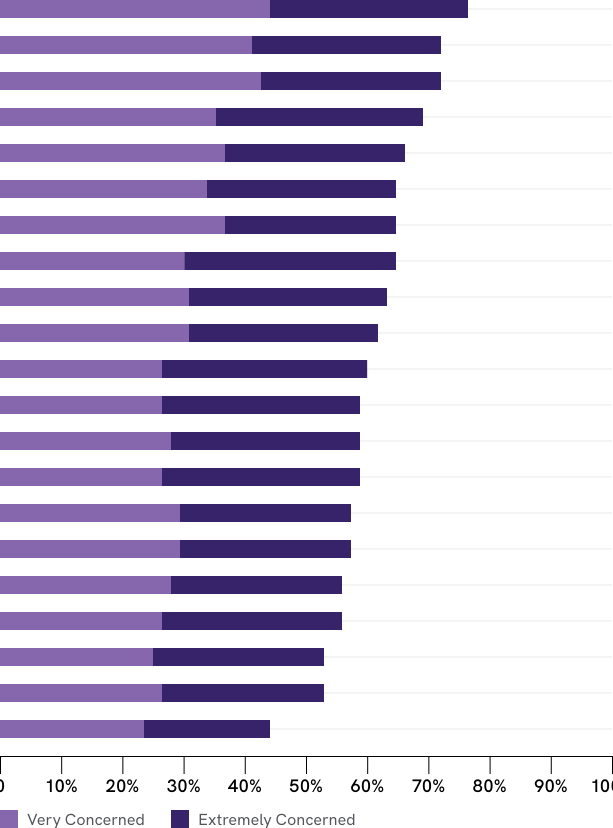
Respondents were asked their level of concern across 20 issues.
Top Issues for 2026 Midterms
When asked to name the single most important issue for the upcoming midterm elections: the economy dominates at 23%, followed by the war in the Middle East (15%), U.S. support of Israel (10%), and healthcare (8%). Traditional Democratic base issues like climate (4%), abortion (1%), and democracy/election integrity (5%) rank low. Economic anxiety and Middle East conflicts, the top issues, cut across traditional party lines.
Bottom Line
The portrait of the Muslim American community that emerges from the findings is politically heterogeneous community that does not fit neatly into either party’s agenda, with significant faultlines on many public policy issues. Notable findings include:
- 95% are proud to be American.
- 85% believe in the American Dream.
- 76% say America is one of the greatest countries in the world.
- 61% approve of President Trump’s peace deal efforts.
- 62% support prosecuting fraud to the fullest extent of the law.
- 74% support school choice.
- 68% say schools should inform parents about gender identity changes.
- 53% oppose medical transitioning for minors.
Many of the divides revealed by the poll mirror faultlines in the general American population, though one distinctive element for Muslim Americans appears to be the outsize impact of overseas influences shaping identity.
Despite the many fractures, noteworthy points of consensus include:
- Strong majorities express pride in being American, belief in the American Dream, view America as one of the greatest countries, and believe Muslims can succeed here.
- Most respondents say Muslims enjoy greater religious freedom in America than anywhere else in the world.
- There exists broad support for engaging both Republicans and Democrats rather than staying politically siloed.
- Solid support exists for socially conservative domestic policies like parental rights, educational accountability, border security, and prosecuting welfare fraud.
As America turns 250, Muslim Americans are a growing minority playing an increasingly prominent role in American society. Our country’s future direction will be significantly influenced by how Muslim American identity evolves in the coming years.
2026 Poll: 768 registered voters surveyed via online panel, April 22–May 4, 2026. Weighted by age, gender, race, education, and 2024 vote recall. MOE ±4.3 pts. 2024 Poll: 600 self-identified Muslim respondents surveyed via online panel, August 23–29, 2024. Weighted by age and gender. MOE ±4.8 pts. Note: Different weighting methodologies between polls mean direct comparisons should be interpreted as directional trends.
Endnotes
Footnotes
- The American Dream is Alive for Muslim Americans Full Wording America is my homeland and I am a patriotic American. (% strongly or somewhat agree) Muslims have more freedom in America than any other country in the world. (% strongly or somewhat agree) Do you believe in the American Dream—that anyone in the U.S. can achieve a better life through hard work and opportunity? (% definitely or probably yes) Are you proud to be an American? (% definitely or probably yes) Do you believe Muslims have the opportunity to succeed in America (% definitely or probably yes) ↩
- The American Dream is Alive for Muslim Americans “American Dream and Patriotism” Full Wording “America is my homeland and I am a patriotic American” (agree/disagree) “The United States is one of the greatest countries in the world” (yes/no) “Muslims have more freedom in America than any other country in the world” (agree/disagree) “Muslims have the opportunity to succeed in America” (yes/no) “America is a great place to make money, but not a good place to raise a family or build a society” (agree/disagree) “Even though I live in America, I feel more loyal to another country” (agree/disagree) ↩
- Immigration: Dramatic Rightward Movement Full Wording Do you support or oppose the following proposals: • “Creating a pathway to citizenship for illegal immigrants who meet certain requirements including paying back taxes, learning English, and passing a background check” • “Hiring more border patrol agents at the U.S.-Mexico border” • “Building and completing a wall along the U.S.-Mexico border” • “Deporting illegal immigrants currently living in the United States” • “Strengthening the vetting process for all people entering the United States to ensure that anyone who supports radical or anti-American ideologies is not permitted to immigrate” ↩
- Criminal Justice System Full Wording “Generally speaking, do you think the criminal justice system in this country is too tough, about right, or not tough enough in handling crime?” • Too tough on those accused of committing crimes • About right in its handling of crime • Not tough enough in handling crime • Not sure “What do you think is more important for the country right now— reducing crime by putting more criminals in jail with harsher sentences, or reducing mass incarceration by putting fewer people in jail with shorter sentences?” ↩
- Feeding Our Future Full Wording “In Minnesota, federal prosecutors allege that individuals in the Somali community stole over $250 million in taxpayer funds intended for children’s meals through the Feeding Our Future program. Do you support or oppose prosecuting these individuals to the fullest extent of the law?” “Some defendants have argued that these prosecutions are driven by anti-Muslim bias. Which comes closer to your view?” • “This is a disgusting attempt to use Muslim identity to escape responsibility for fraud” • “This is a legitimate defense, as Muslims do face bias in the legal system” • Not sure “Which comes closer to your view?” • “This is a shameful act and Muslim leaders should condemn it more forcefully” • “This story is being weaponized by politicians to smear Somali Muslims” • Not sure ↩
- Conservative Cultural & Social Values: Consistent Gains Full Wording “School choice gives parents the right to use the tax dollars designated for their child’s education to send their child to the public or private school which best serves their needs. Generally speaking, would you say you strongly support, somewhat support, somewhat oppose or strongly oppose the concept of school choice?” “Should schools be required or not required to inform parents if their child requests to go by different gender pronouns than the ones they were assigned at birth while at school?” • Should be required • Should not be required • Not sure “What is your level of concern regarding the following matters: Teaching sexually explicit materials to children in public schools” • Extremely concerned • Very concerned • Somewhat concerned • Not at all concerned • Not sure “What is your level of concern regarding the following matters: Erosion of parental rights in American public education” • Extremely concerned • Very concerned • Somewhat concerned • Not at all concerned • Not sure ↩
- Worry for Muslim Children Full Wording When you think about the future of Muslim children in America, which of the following concerns you more? • “Discrimination and Islamophobia from the political right” • “Losing their religious and cultural values to gender ideology and LGBTQ ideologies being promoted by the political left” • “Both are equally concerning” • “Neither is concerning” ↩
- Foreign Policy Full Wording “Do you approve or disapprove of President Trump’s efforts to negotiate peace deals and end foreign wars in the Middle East?” • Strongly approve • Somewhat approve • Somewhat disapprove • Strongly disapprove • Not sure “Do you support or oppose the recent US and Israeli military strikes against Iran?” • Strongly support • Somewhat support • Somewhat oppose • Strongly oppose • Not sure “Do you believe the killing of Iranian Supreme Leader Ayatollah Ali Khamenei was justified or unjustified?” • Justified • Unjustified • Not sure “Are you happy or sad that Khamenei has been removed from power?” • Happy • Sad • Not sure Which president do you think did a better job handling the Middle East—Joe Biden or Donald Trump?” • Joe Biden • Donald Trump • Not sure “In the war between Israel and Hamas, which side do you support?” • Israel • Hamas • Neither • Not sure ↩
- Support for Designating Terrorist Organizations Full Wording Please indicate whether you have a favorable or unfavorable opinion of each of the following organizations.” Muslim Brotherhood • Very favorable • Somewhat favorable • Somewhat unfavorable • Very unfavorable • Not sure CAIR (Council on American Islamic Relations) • Very favorable • Somewhat favorable • Somewhat unfavorable • Very unfavorable • Not sure “Texas Governor Greg Abbott and Florida Governor Ron DeSantis have officially designated the Muslim Brotherhood as a terrorist organization in their states, citing its alleged coordination with Hamas and other extremist groups. Do you support or oppose designating the Muslim Brotherhood as a terrorist organization?” • Strongly support • Somewhat support • Somewhat oppose • Strongly oppose • Not sure “Governor Abbott and Governor DeSantis have also called for designating the Council on American Islamic Relations (CAIR) as a terrorist organization, citing allegations that CAIR has made payments to anti-Israel agitators and has ties to Hamas. Do you support or oppose designating CAIR as a terrorist organization?” • Strongly support • Somewhat support • Somewhat oppose • Strongly oppose • Not sure Re-test: Please indicate whether you have a favorable or unfavorable opinion of each of the following organizations.” Muslim Brotherhood • Very favorable • Somewhat favorable • Somewhat unfavorable • Very unfavorable • Not sure CAIR (Council on American Islamic Relations) • Very favorable • Somewhat favorable • Somewhat unfavorable • Very unfavorable • Not sure “Some Muslim American organizations have formed alliances with LGBTQ+ activist groups. Which comes closer to your view?” • “This is a smart political strategy that builds broader coalitions” • “This is a mistake that compromises Islamic principles” • Not sure “Which of the following statements comes closer to your view?” • “Muslim Americans are natural allies of the progressive left and should work within that coalition” • “Muslim Americans have conservative values on many issues and should not be lumped in with the progressive left” • Not sure ↩
- Full Concerns Battery Full Wording “What is your level of concern regarding the following matters?” • Extremely concerned • Very concerned • Somewhat concerned • Not at all concerned • Not sure ↩