Key findings
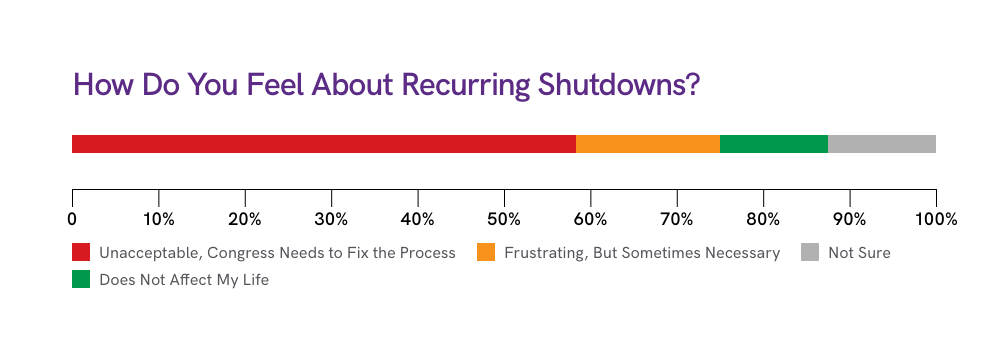
- A clear majority (58%) say the pattern is unacceptable and Congress needs to fix the process. Only 12% say it does not affect their life.
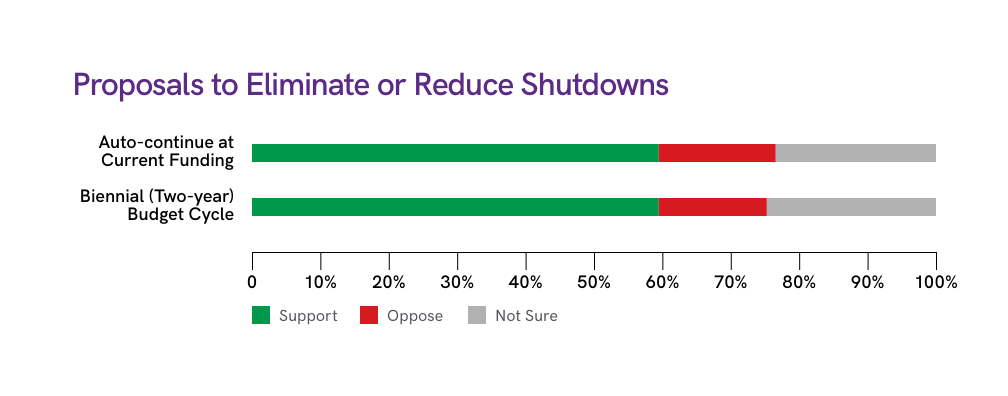
- The survey explained that a Jimmy Carter-era government memo currently allows federal agencies to shut down when Congress misses a budget deadline, and asked whether the government should instead automatically continue at current funding levels. 59% support this approach (29% strongly), while only 18% oppose.
- 59% support moving to a two-year budget cycle to reduce the frequency of crises (24% strongly), with just 17% opposed.
- 52% say Democrats should not use shutdowns as a tactic because it hurts the American people. Only 32% say Democrats are right to do so, with 16% unsure.
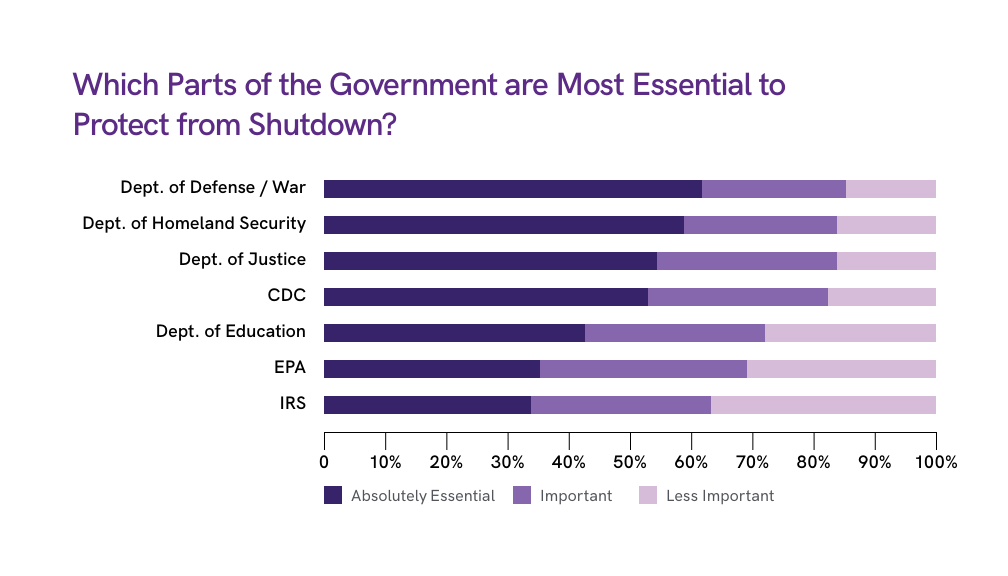
- The Department of Defense and Department of Homeland Security topped the list, while the IRS ranked lowest.
Executive summary
The Rainey Center’s March 2026 national survey finds that Americans are fed up with the cycle of government shutdowns and strongly support structural solutions to end them. Nearly six in ten voters (58%) call the current pattern unacceptable, and comparable majorities support two concrete fixes: automatically continuing government operations at current funding levels (59%) and moving to a biennial budget cycle (59%). Voters also reject the use of shutdowns as a legislative tactic, with 52% saying Democrats should not use shutdowns to secure policy wins. The polling has a warning for Democrats as they pursue their extreme partial shutdown strategy. Their favorite agencies are the ones that voters see as least vital. The Carter-era memo is an obscure piece of executive guidance that most voters have never heard of, but once explained, the solution it enables, automatic continuation of government operations, is immediately popular across the political spectrum. The American public has no appetite for continued government shutdowns.
The Rainey Center’s March 2026 national survey finds that Americans are fed up with the cycle of government shutdowns and strongly support structural solutions to end them. Nearly six in ten voters (58%) call the current pattern unacceptable, and comparable majorities support two concrete fixes: automatically continuing government operations at current funding levels (59%) and moving to a biennial budget cycle (59%). Voters also reject the use of shutdowns as a legislative tactic, with 52% saying Democrats should not use shutdowns to secure policy wins.
The polling has a warning for Democrats as they pursue their extreme partial shutdown strategy. Their favorite agencies are the ones that voters see as least vital.
The Public Says Enough
With budget shutdowns or near-shutdowns occurring every three to six months, voters have reached a breaking point. A clear majority (58%) say the pattern is unacceptable and Congress needs to fix the process. Only 12% say it does not affect their life.
Two Structural Solutions Command Supermajority Support
Voters were presented with two proposals to eliminate or reduce shutdowns. Both received nearly identical and overwhelming support.
Rescind the Carter-era Memo and Auto-Continue Operations
The survey explained that a Jimmy Carter-era government memo currently allows federal agencies to shut down when Congress misses a budget deadline, and asked whether the government should instead automatically continue at current funding levels. 59% support this approach (29% strongly), while only 18% oppose.
Biennial Budgets
59% support moving to a two-year budget cycle to reduce the frequency of crises (24% strongly), with just 17% opposed.
Voters Reject Shutdown Tactics
When told that Democrats have twice shut down all or parts of the government in the past year to secure policy changes, 52% say Democrats should not use shutdowns as a tactic because it hurts the American people. Only 32% say Democrats are right to do so, with 16% unsure.
Which Agencies Must Stay Open?
Voters were asked to rank which parts of the government are most essential to protect from shutdown. The Department of Defense and Department of Homeland Security topped the list, while the IRS ranked lowest. Democrats should consider the long-term implications of their funding government al la carte scheme, and which agencies will ultimately suffer.
Political Implications
These results present a clear opportunity for the White House and congressional leadership. The Carter-era memo is an obscure piece of executive guidance that most voters have never heard of, but once explained, the solution it enables, automatic continuation of government operations, is immediately popular across the political spectrum. Rescinding the memo would be a signature governance reform that eliminates an entirely self-inflicted crisis.
The biennial budget proposal also enjoys broad support and could be paired with the auto-continuation mechanism for a comprehensive reform package.
Democrats who are insisting on funding department a la carte, only supporting the specific agencies and functions they agree with, should realize that the long term implications will harm departments they prioritize.
Conclusion
The American public has no appetite for continued government shutdowns. Nearly 6 in 10 voters call the status quo unacceptable, and the same proportion supports each of two structural fixes.
The data makes the political case clear: ending shutdowns is a winning issue.
This poll surveyed 1,021 registered voters via online panel from March 23–26, 2026. Results were weighted by 2024 vote, gender, age, race, and education to match population demographics. The margin of error is ±3.2 percentage points at the 95% confidence level.
Downloads
Toplines
Download Toplines (PDF)↓Crosstabs
Download Crosstabs (PDF)↓Methodology
Polling methodology↗