Introduction
As the 2024 election approaches, media coverage has claimed that the United States is more divided than ever.
Concerns about electoral legitimacy are at a high, with politicians of both parties casting doubts on the democratic process.
However, there are a number of bipartisan ideas that would improve our democracy: counting ballots more quickly, mandating that all ballot counting machines are American-made and passing voter ID requirements. To explore the viability of these proposals, the Rainey Center fielded a national survey of registered voters. We find that voters overwhelmingly support bipartisan democracy reform policies.
Key Findings
- There are high levels of bipartisan support for all of our commonsense democracy reform measures, which suggests potential for passing election integrity legislation with broad backing.
- While there is general agreement on democracy reform policies, there are several where partisan differences are more pronounced, such as voter ID requirements and paper ballots. However, most of the divides were on intensity of support, rather than opposition.
- The relatively high percentage of “Don’t know” responses (ranging from 11% to 21% on various questions) suggests a need for voter education on election processes and proposed reforms. Independents consistently report high “don’t know” responses.
- Implementing these widely supported measures could help increase public confidence in the electoral system across party lines.
Methodology
Rainey Center fielded an online survey of 1,010 respondents over web panels from July 14-15, 2024 and weighted it to education, gender, race, and 2020 election results. The margin of error is +/- 4.0.
Strong Overall Support for Election Integrity Measures
The majority of voters, regardless of party affiliation, support most proposed election integrity measures.
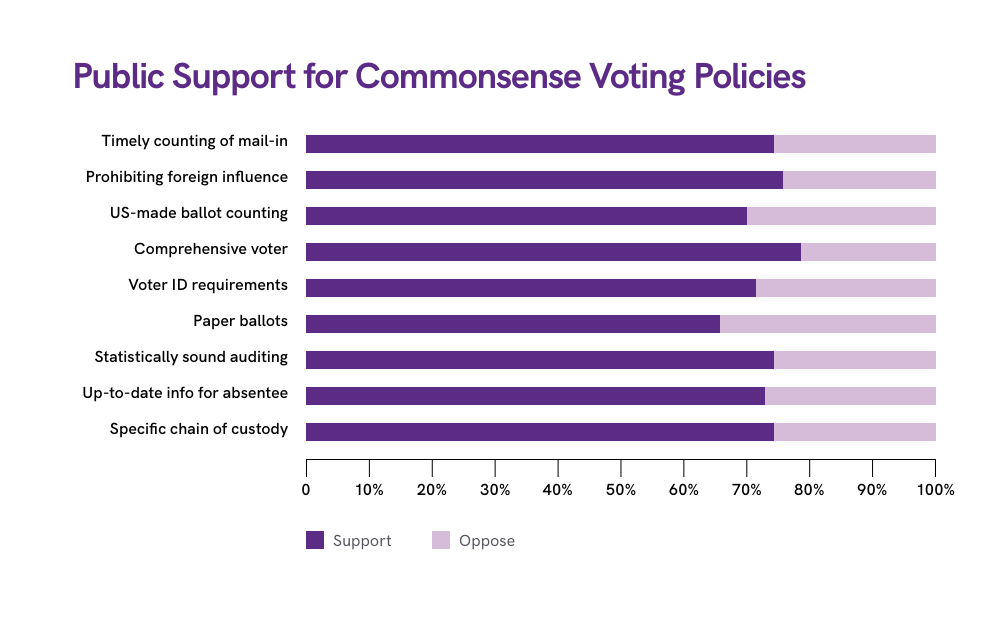
Support is particularly high for ensuring timely counting of mail-in ballots (76% overall support), statistically sound auditing methods (76%), prohibiting foreign influence in elections (76%), and maintaining comprehensive voter databases (78%).
Voters also express strong support for a specific chain of custody for election materials (76% in support, with 11% opposed).
Bipartisan Agreement on Core Principles
Both Democrats and Republicans show strong support for measures such as counting mail-in ballots promptly (81% of Democrats support, 83% of Republicans), prohibiting foreign influence in elections (80% of Democrats, 81% of Republicans), maintaining comprehensive voter databases (82% of Democrats, 82% of Republicans) and requiring a specific chain of custody for election materials (76% of Democrats, 83% of Republicans).
“Strong” support was particularly high in both parties for preventing foreign actors from spending in American elections and ensuring absentee ballots are counted in time for a final verdict on election day. For preventing foreign actors from spending 59% of Democrats and 60% of Republicans expressed “strong” support. For counting absentee ballots in time, 54% “strong” support among Democrats, 60% among Republicans.
Both parties support up-to-date information for absentee voters (75% of Democrats and 82% of Republicans support) and for using statistically sound auditing methods (79% of Democrats and 79% of Republicans support).
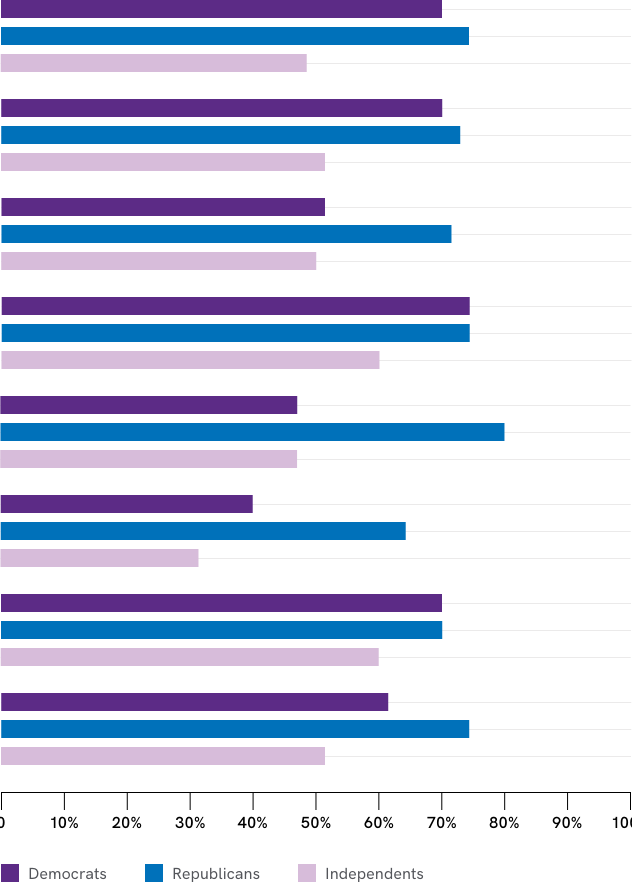
Partisan Divergence on Voter ID Requirements, Made in America and Paper Ballots
While there is majority support across parties for voter ID, the intensity of support varies:
- 86% of Republicans strongly support voter ID requirements
- 68% of Democrats support voter ID, but with less intensity (39% strongly support)
This suggests that opposition to voter ID is more concentrated among Democratic pundits than Democratic voters. Ideally, voter ID laws can be packaged with a broader bipartisan reform package.
Requiriting all software to be made in America also had a partisan intensity gap. Thirty-nine percent of Democrats “strongly” support the measure, compared with 60% of Republicans.
Republicans show stronger support for paper ballots (79%) compared to Democrats (62%), but overall support is quite strong.
Conclusion
The survey results indicate a strong foundation for bipartisan election integrity reforms. While some partisan differences exist, there is substantial common ground on key issues. Policymakers and election officials should focus on these areas of agreement to build a more trusted and secure election system that can garner support across the political spectrum.