Key findings
- Across the United States, there are 3,143 of a uniquely American institution: counties, and a few differently named county equivalents.
- They range in population from almost ten million people in Los Angeles County, California to just 57 inhabitants in Loving County, Texas.
- Unfortunately, a series of mistakes in the early 1990s compromised this carefully designed political architecture.
- The long-established method of electing Wyoming’s legislators from county-based districts abruptly changed after the 1990 census.
- The numerical reality of Wyoming’s county populations meant the 1990 redistricting cycle’s map far exceeded the federal malapportionment limit.
“Wyoming is one small town with really long streets.”
Across the United States, there are 3,143 of a uniquely American institution: counties, and a few differently named county equivalents. The term derives from European feudalism (“count” as in a title of nobility), but nowhere else has adopted anything quite like what American counties have become.
In the same way American federalism is built on the states as coherent political communities, counties often play a comparable quasi-federalism role within the states. In some, they are similarly entrenched on a constitutional level with certain protected powers, elected offices, and autonomy including taxes and spending. They range in population from almost ten million people in Los Angeles County, California to just 57 inhabitants in Loving County, Texas. But on the whole, our counties tend to be smaller and more numerous than local administrative regions in other countries. Across much of the nation, counties with four or five digit populations are common.
For many Americans, the county is a central element of their local sense of community. The county courthouse is the local landmark, the county fair the social event of the year, the county sheriff the primary law enforcement, county judges the arbiters of day-to-day disputes, county taxes how the roads get paved and plowed, and the county seat the hub of economic and cultural life.
The role of counties varies with the diverse constitutional arrangements in each state. Some states in the densely populated Northeast have abolished county governments altogether, with their boundaries existing only as historical geographic designations. In some places, most famously in the case of New York City, a single municipality may be spread across multiple counties. In Alaska, vast uninhabited swathes of the state are left outside of their county equivalents, called boroughs. Some states choose to focus local government functions more in municipalities than at the county level. And in many states, counties are combined, created, or have their boundaries adjusted with some regularity to reflect fluctuating populations and tax bases.
Wyoming is at the opposite end of the spectrum, what might be called county maximalism. In this land of “high altitudes and low multitudes,” as former governor and U.S. senator Milward Simpson once put it, counties are the foundation of politics, government, the economy, and community. In a small but telling indication of significance, the county numerical codes featured on every license plate are widely known and recognized, sometimes featuring in the names of local news outlets and events.1
Wyoming’s twenty-three counties tend to be centered on a single small city together with a few nearby towns and wide stretches of sparsely populated (and stunningly beautiful) scenery in between. From one community with a population in the thousands to the nearest similarly sized neighbor can be a drive of several hours. No municipalities cross county lines and few even abut them. In many cases, the boundaries of counties follow mountain ranges with only a few passes in between, frequently blocked by snow for much of the year.
County lines in Wyoming have remained unchanged for more than a century, as permanent on the map as the state’s quadrilateral shape. If the state is, as a popular aphorism goes, “one small town with really long streets,” then the counties are its distinct neighborhoods.
The importance of counties is reflected in the Wyoming Constitution, which mandates the use of county-based apportionment in the state legislature.2 It remains common in Cheyenne for legislators to refer to each other as from a particular county’s delegation in the same way one might identify members of Congress as being from a particular state. In the event of vacancies, replacement legislators are chosen by county commissioners.3 For most of the state’s history, this system included multi-member legislative districts based on whole, undivided counties.
Wyoming’s counties are not just local governments but the basic building blocks of how citizens interact with the rest of the state. Not just lines on a map, they are coherent political communities with shared interests in the business of statewide life. In representing counties as such, the state constitution not only sought to protect localism but also to ensure due consideration for diverse local economies. Most counties are built around a primary economic base in a particular sector such as oil and gas, mining, lumber, agriculture, or tourism.
Unfortunately, a series of mistakes in the early 1990s compromised this carefully designed political architecture. But there is a way to correct those mistakes. In the process, there is also the potential to demonstrate a better model for the rest of the country.
Uncle Sam Weighs In
The long-established method of electing Wyoming’s legislators from county-based districts abruptly changed after the 1990 census. The decennial reapportionment of the legislature, drawn up in compliance with the state constitution, was struck down in federal court in Gorin v. Karpan.4
The problem was the allocation of at least one representative to every county regardless of population, producing large disparities in how many voters each legislator represented. This, the court found, was in violation of the “one person, one vote” line of cases. Under these rulings, the Supreme Court has held extreme malapportionment of state legislatures violates the equal protection clause of the Fourteenth Amendment.5
While some deviation from perfect mathematical equality of district populations is inevitable, there is an upper limit in federal jurisprudence. Any deviations must be justified by a rational, legitimate state interest. For good reasons, citizens can not be denied their fundamental right to an equal voice in the lawmaking process. But this principle as applied by the courts has had some unintended consequences for the traditional design of many state legislatures.
The numerical reality of Wyoming’s county populations meant the 1990 redistricting cycle’s map far exceeded the federal malapportionment limit. Some voters were under-represented by up to 18 percent and others over-represented by as much as 65 percent as measured from the ideal of perfect equality, that is, dividing the state’s whole population by the total number of representatives. The absolute value of these two figures combined is the metric federal courts have adopted to define malapportionment, so Wyoming’s map was deemed off by 83 percent.
The district court, constituted as a three-judge panel under a federal law for lawsuits against state legislative maps, explained the state must meet two standards. Legislative elections can not be tilted for purposes of invidious discrimination as was done by segregationists to perpetuate Jim Crow. And the mathematically defined population deviation must not exceed a certain threshold which is somewhat fuzzily defined. America’s legal system is never at its strongest when judges and lawyers are called upon to do math.
A population deviation of less than 10 percent is considered presumptively valid, with the burden on plaintiffs to show evidence of invidious discrimination. But greater degrees of variation can be justified if the state is pursuing a legitimate interest in a rational manner. The paradigmatic example of a legitimate state interest is drawing compact, sensible districts that avoid splitting communities of interest and units of local government. In 1973, the Supreme Court upheld a deviation of 16.4 percent but warned “this percentage may well approach tolerable limits.”6 The district court applied this rule to Wyoming in Gorin.
In other words, the upper bound of permissible population deviation, so long as the map is not racially discriminatory, is roughly in the mid-teens. To be conservative, less than 15 percent is a good rule of thumb. In practice, such a small variation makes little meaningful difference and does not deprive anybody of their right to substantial equality of representation.
Arbitrary Lines
In his opinion for the unanimous three-judge panel in Gorin, Tenth Circuit Judge Wade Brorby offered the legislature a chance to try again. In line with precedent, the continued use of county-based districts was permissible, so long as the population deviation was within reason. “[T]here can be little doubt that many Wyoming counties possess a sense of identity, a sense of neighborhood and a sense of community interests,” he noted. He pointed to several proposed maps that would have passed muster and still “maintained existing county boundaries as election district boundaries.”
The legislature preferred this alternative, which would have maximized compliance with the state constitution while abiding by federal requirements. But Gov. Mike Sullivan, a Democrat, vetoed the Republican legislature’s redrawn maps which would have continued the use of county-based multi-member districts. Instead, Sullivan insisted both chambers must consist entirely of single-member districts, each electing only one representative or senator. Faced with the impasse and the prospect of the court drawing its own single-member districts, the legislature conceded and adopted a map carving up the state into single-member districts of equal population.
The previous unity of counties was lost, impossible within the confines of single-member districting. Almost everyone knows what county they live in but few voters can correctly name their numbered legislative districts. Larger communities had to be split in inherently arbitrary ways, often combined with a portion of another distant town or neighboring county to achieve the required population totals. Districts were required to awkwardly sprawl across vast areas, in one case larger than the entire state of Massachusetts.
The traditional county-based multi-member districts were eliminated by a combination of federal law and partisan maneuvering. Since that time, the legislature has only used single-member districts. But over the years, some lawmakers have advocated a return to multi-member districts. These include Sen. Cale Case, chair of the Senate Corporations, Elections, and Political Subdivisions Committee, who emphasized many of these same points in 2021.7
Every ten years, protracted wrangling consumes the legislature as it divides up the map. With little rational basis for how to split up communities, the process inevitably produces heated disputes and arduously complicated iterations of different proposals. In a practice known as nesting, two House districts are combined to make up each Senate district. This is intended to simplify things, but it actually worsens the complexity by tying each chamber’s map to the other’s. Freed from any other consideration, there is no real limit on gerrymandering, often with the primaries or incumbency in mind more than the general election. Some smaller communities are left in a district dominated by the next county or two over, and are understandably dissatisfied with the arrangement.
Equal Rights
The switch to single-member districts had another unintentional effect. The abolition of multi-member districts demonstrably results in fewer women being elected to the legislature. The precise cause of this effect is uncertain, but its existence is well-documented and statistically robust. Because Wyoming made such a radical change to its electoral system relatively recently, after women in elected office became common, it provides a compelling natural experiment.
As Michael Horan and James King of the University of Wyoming pointed out in 1999, “The proportion of women representatives in Wyoming fell from roughly one-in-three to one-in-five. In actual numbers, thirteen women serve in the House of Representatives of the Fifty-fifth Legislature [elected in 1998] whereas the Fifty-third [elected in 1994] and Forty-ninth Legislatures [elected in 1986] had eighteen and twenty-two female representatives, respectively.”8
In 2024, there are still just thirteen women representatives. In the House and Senate combined, Wyoming ranks 43rd out of the 50 states with a gender ratio of nearly four to one.9 For representation of women, the switch to single-member districts produced a clear downward divergence from national trends and similar states which Wyoming had previously tracked.
This is a particularly bitter result for the Equality State, whose motto “Equal Rights” proudly boasts of first-in-the-nation women’s suffrage. In 1924, Wyoming elected the nation’s first female governor. The first woman elected to the Wyoming legislature was in 1910, when Rep. Mary Bellamy was elected as one of five members for Albany County a decade before ratification of the Nineteenth Amendment. Women were participating in Wyoming’s territorial elections as early as 1870, half a century before the right was established nationwide.
The redistricting system adopted in 1992 undercut two of Wyoming’s most distinct and long-standing political attributes: the importance of counties, and how the state’s frontier spirit has always included an individualist respect for legal and political equality of women. Though the court’s ruling was intended to strengthen equal representation in Cheyenne, the abolition of multi-member districts had the exact opposite effect.
There’s a better solution, one that more closely follows the laws and traditions of Wyoming without running afoul of the federal judiciary.
Back to Basics
The first question is a somewhat complicated math problem with a thankfully simple answer. Given the respective populations of Wyoming’s twenty-three counties, is it possible to draw county-based legislative districts that don’t exceed population deviation limits? Will the state always be able to do so after each census? The answer is yes, even taking a cautious application of the federal rule.
A number of feasible county-based maps can be drawn with population deviations of less than 15 percent, in some cases less than 10 percent. There’s no reason the state can’t adopt one of those maps. One possible example is shown in Figure 1, and the legislature would have a reasonable degree of flexibility to choose from different possible combinations.
County-based maps solve the “one person, one vote” problem not by arbitrarily dividing communities but instead, when necessary, attaching smaller counties to an immediate neighbor. This can be done by following existing, well-recognized regional groupings. Larger counties would be able to stand on their own as a single-county district.
As desirable as it might be to secure each county its own representative, even tiniest Niobrara (population: 2,467), the only way to achieve this would be a dramatic increase in the size of the House. There is little appetite to take the body from its current sixty-two members up into the triple digits. Among other problems, that many representatives literally couldn’t fit in the existing capitol’s relatively small chamber. But in designing multi-county districts, counties of similar population can be grouped together to ensure none are unfairly overwhelmed by a larger neighbor.
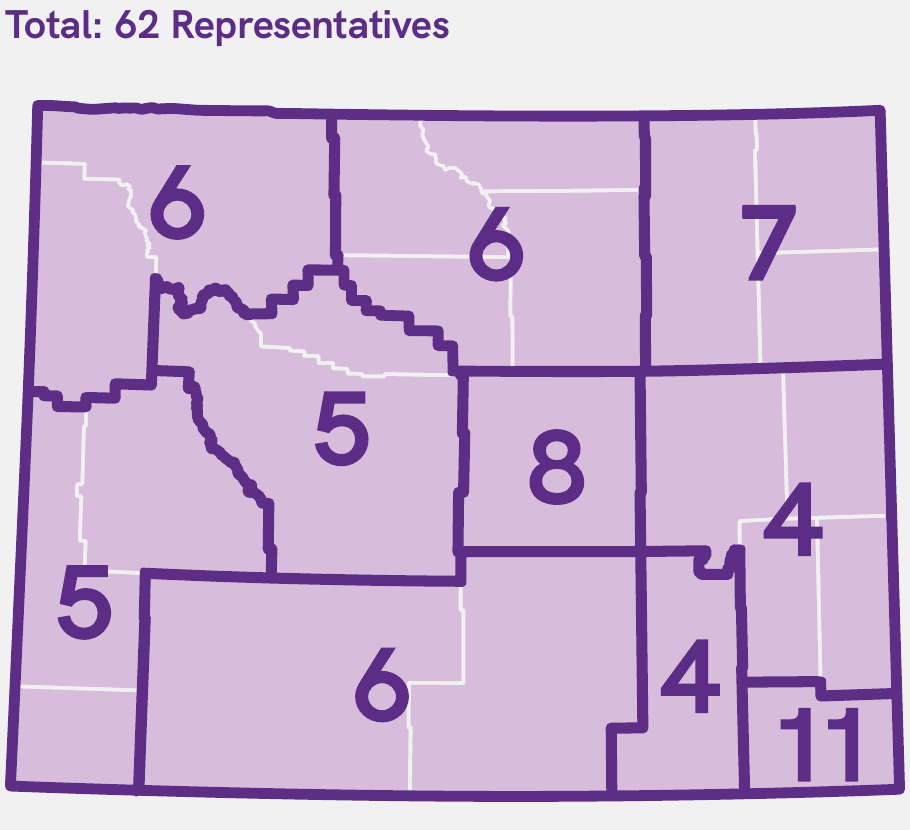
In much the same manner as congressional apportionment, each district is then assigned a number of representatives according to its population. At the current total of sixty-two seats, the most populous county (Laramie) would be allotted eleven representatives. The smallest districts, such as next-door Albany, would elect four representatives.
Instead of using complicated mapping software to parcel out individual census blocks, there would be a simple set of reasonable options to choose from. It helps that there is a tradition of minor fluctuations in the size of the House, varying over the years from sixty to sixty-four members, as permitted by the state constitution. In some decades, this sort of small adjustment could allow for more options in selecting the most preferable set of districts. Some districts could be allotted an extra representative, for example, or the legislature might opt to create more, smaller districts.
The smaller Senate, currently thirty-one senators, would probably have to retain single-member districts. While this would still mean drawing districts of equal population, the process would be made easier by decoupling from the House map. Each chamber could then take the lead on drawing its own maps, producing less friction between the two.
Retaining single-member districts in the Senate would also strengthen the traditional logic of bicameralism. Each chamber would be elected in a distinct manner, providing a balance between them rather than having one as a duplicative smaller version of the other. For those who see some value in single-member winner-take-all districts, those purposes would still be served by the Senate.
Wyoming doesn’t have to wait until after the next census. The state constitution does not restrict mid-decade redistricting. Redistricting is even given a special exemption from the usual rule imposing a two-thirds threshold on non-budgetary matters during odd-year budget sessions.10 A statute could be adopted either by the legislature or through the initiative process at any time. No amendment to the state constitution is necessary. The ideal time to make the switch would be well in advance of the end of the decade, so legislators do not have to prepare for the rigamarole of the existing process.
The state constitution is still the fundamental law of Wyoming, subject only to the supremacy of federal law. In reconciling those two obligations, lawmakers should strive to harmonize them to the greatest degree possible. Simply put, to follow the Wyoming Constitution as far as allowed.
In the process, Wyoming can do more than just restore its interest in the integrity of its counties as political units. America’s least populated state might just lead the way in fixing some of the most intractable problems poisoning American politics.
The Missing Piece
Returning to county-based districts inherently involves the use of multi-member districts, given the realities of population distribution. Instead of equalizing representation through equal populations per district, larger districts are apportioned a number of representatives to make sure everyone gets a fair say.
Aside from their history in Wyoming, multi-member districts are currently used in nine states. These range from two-member districts in South Dakota to New Hampshire’s complex system of floterial districts in its 400-member House. But multi-member districts do have some distinct legal concerns that must be taken into account.
In some contexts, multi-member districts have been used for nefarious purposes. The problem was not multi-member districts as such but the particular method of election, known as bloc voting or plurality multi-member. Under bloc voting, among all the candidates running from each party, voters pick up to the number being elected. For a five-member district, for example, the top five candidates are then elected.
While deceptively simple, this method produces indefensible results. Bloc voting guarantees a single party will sweep all of the seats up for grabs in most cases, effectively a winner-take-all mechanism. This was particularly problematic when the result was a total lack of representation for black voters in the South.
Because of this history, bloc voting is heavily disfavored under the Voting Rights Act when it produces egregious racial disparities. In a state like Wyoming, there’s a different problem: bloc voting might produce a House with only members from one party. Republicans sometimes carry all twenty-three counties in statewide elections such as presidential and gubernatorial races, and might feasibly do so in every county-based district. Even in a deep red state, a one-party legislative chamber would be a bad look. Cheyenne is not Beijing.
The solution is to allocate seats in each district on the basis of proportional representation. Under this system, local partisan minorities still get to elect the legislators of their choice, in line with their share of the electorate. A district with six members might return four Republicans and two Democrats, for instance. Or more realistically in much of Wyoming, five Republicans and one Democrat. In some smaller districts where Republican presidential candidates come close to 90 percent of the vote, all-GOP delegations might still be elected.
The use of proportional representation offers a number of concrete benefits. Almost all voters would have a representative they personally voted for. Candidates would have an incentive to build broader coalitions rather than the narrowest possible base required for a plurality win. The House of Representatives would be genuinely more representative. The partisan makeup might not change much—no electoral system is likely to touch the GOP’s robust majorities in Wyoming—but all voters would have more of a voice in the legislature.
Avoiding the pitfalls of bloc voting is the last piece of the puzzle on staying within the confines of federal law. Voting Rights Act compliance requires significant concentrations of minority voters to have a reasonable chance to elect a candidate of their choice. Simply put, districts can not be gerrymandered on the basis of race.
Given the state’s demographics, this is not an especially difficult problem in Wyoming. For purposes of VRA compliance, the only large concentration of minority voters is on the Wind River Reservation and areas immediately adjacent. Two tribes, the Eastern Shoshone and Northern Arapaho, together account for 21.5 percent of Fremont County’s population of just under forty thousand.11
The principle of proportionality ensures these voters are able to elect at least one representative commensurate with their numbers, and in fact could do so better than under the status quo. Fremont County has more Native American voters than can fit in a single-member district, which must have about nine thousand residents each. In other contexts, this result would be decried as the notorious gerrymandering practice of “cracking” a community of interest. But it’s unavoidable under the math of single-member districts even when there is no malicious intent.
Fight for Your Right to Party
Proportionality among lists of candidates also strengthens the parties, in a good way. Political scientists have long lamented how America’s electoral system, including its unusual imposition of state-run primaries, has the perverse effect of weakening the parties as organizations.12 Parties can’t serve their necessary functions of accurately representing their voters, holding their officeholders accountable, and serving as a locus of political responsibility.
When they go to the polls, voters should be able to clearly know what each party stands for. And the party’s members should get to define what that is, and how they voluntarily join together to make that decision. But by denying parties the ability to govern themselves and entrenching the two major parties from competition, the status quo instead results in two dysfunctional quasi-governmental institutions. In some respects, they aren’t much like political parties at all but are instead merely ballot labels. As private organizations exercising core First Amendment rights, parties should be free to make their own nominating decisions accountable to their own voters.
Using proportional representation, each party would nominate its list of candidates by conventions or in the primary, depending on how the law is drafted and what the parties might choose. Instead of more complicated systems for the general election, voters could then simply select a party’s list. This “closed list” model has the additional benefit of simplicity on the general election ballot, unlike more complicated “open list” systems used overseas or with ranked choice voting. Already, the vast majority of voters tend to vote straight ticket anyway, only voting for their preferred party’s candidates. Voting for the party’s slate of nominees as a group in the general election would make little practical difference.
With either nomination method, candidates with the broadest support in the party would rise to the top of the list, in line for the first seats to be elected. There would be less incentive to eke out an unrepresentative plurality over a divided field, rendering the problem of spoilers obsolete both in the primaries (or conventions) and the general election. Each party’s members would be more accurately represented in the party’s choice of candidates, including the various factions within each party. Candidates with who are broadly popular would be likelier to win a seat in November, while more divisive and unpopular candidates would fall to the bottom of the list.
Wyoming also has a history of relatively strong third parties. In 2020, one district even elected a Libertarian legislator, Rep. Marshall Burt, the only such win for that party nationwide in more than two decades. Third party presidential candidates such as Gary Johnson and Ross Perot have also seen above-average results, a manifestation of the state’s independent streak and disaffection from national politics. Under multi-member districts it’s possible a few third party members would be elected, bringing additional diversity and representation of different viewpoints to the floor of the House.
Perhaps most importantly, the use of proportional representation and allowing parties to nominate lists of candidates in a particular order would make elections more competitive. In 2022, 31 percent of state legislative primaries in Wyoming went uncontested, as were 32 percent of general elections. With safe seats and uncontested primaries, it is not unheard of for legislators to go many terms without a single opposing candidate on the ballot. Incumbents in particular faced primary competition, often not very serious, in less than half of races.13 In most districts, winning the primary is tantamount to election.
The large number of uncontested elections makes the parties—and the legislature—less responsive to voters and perpetuates the advantages of incumbency. The frustration many voters feel towards what they perceive as the party establishment is understandable. Among other negative effects, this exaggerated incumbency boost also tends to produce an older legislature with fewer seats opening up for the younger generation. This is not a trivial concern at a time when voters express high levels of frustration with what many see as gerontocracy in both major parties.
Survey Says...
To explore public opinion on electoral reform, the Rainey Center partnered with the Legislative Leadership Campaign Committee (LLCC) and nationally recognized pollster Noble Predictive Insights to conduct a survey of Wyoming voters. A total of 729 likely voters were polled for a margin of error of +/- 3.1%. The results were surprising.
For an idea often assumed to be limited to policy wonks and political scientists, proportional representation proved notably popular. Without any additional prompting or explanation, 38 percent of voters indicated support for proportional representation with county-based districts, with only 25 percent opposed and 37 percent undecided. In other words, support outpolled opposition by 13 points, a promising starting point for any proposal.
When asked simply about conforming legislative districts to county lines, the numbers were 34 percent support, 29 percent opposed, and 37 percent undecided (net +5). Thus, while both aspects of this proposal had more support than opposition, adding proportional representation increased support for county-based districts.
Even more interesting was the ideological and religious breakdown of support. Among strong Trump supporters, support was an overwhelming 50 percent to just 19 percent opposed. Among Mormons, who comprise about a tenth of Wyoming’s population and are concentrated in the southwestern counties, support was 59 percent to 15 percent opposed. Among ideological groups, conservatives and libertarians had the strongest support followed by moderates.
Curiously, liberals and progressives showed the least enthusiasm. But in a state where Trump defeated Biden by a whopping 43 points, the number of voters on the left is so small they make little difference. In fact, the topline results were nearly identical for only Republican and Republican-leaning voters as for all Wyoming voters.
Electoral reform is often seen by both advocates and critics as something too complicated to explain directly to the voters. But this isn’t giving the voters enough credit. In fact, average citizens are perfectly able to grasp the ideas and express a reasonably informed opinion. And in Wyoming, it seems the people like the idea of returning to county-based districts with the use of proportional representation.
A Representative Election for Representatives
To illustrate the way elections would work under this system, the following offers a hypothetical election for a county-based district with five representatives.
In the Republican primary, voters can vote for up to five individual candidates, the number of seats being elected. This is the same rule and ballot design already used in multi-member races for certain boards and special purpose districts in Wyoming. Out of eight candidates running, the top five candidates then become the nominated Republican list for the general election. Note that the percentages do not necessarily add up to 500% because not all voters select five candidates, which is a permissible option and would not be discarded as an undervote.
Republican Primary
Nominated Candidates
- Cand. A - 82%
- Cand. B - 68%
- Cand. C - 61%
- Cand. D - 58%
- Cand. E - 43%
Not Nominated
- Cand. F - 40%
- Cand. G - 23%
- Cand. H - 21%
In the Democratic primary, only four candidates are running in this predominantly conservative district, so the vote is less split, but the primary still serves to order their positions on the Democratic list.
Democratic Primary
Nominated Candidates
- Cand. I - 92%
- Cand. J - 86%
- Cand. K - 82%
- Cand. L - 76%
Additionally, one independent candidate (Cand. M) petitions onto the general election ballot, where he is treated as a list consisting of a single nominee. The general election ballot then appears as follows, along with the results:
General Election
Vote for one
- REPUBLICAN List of Candidates – 68%
- DEMOCRATIC List of Candidates – 27%
- By Petition: Candidate M – 5%
Using these results, the five seats are then allocated proportionally among each list. In this case, that means four Republicans and one Democrat are elected, with the independent candidate falling short. Thus, the first four candidates off the Republican list (Candidates A, B, C, and D) are elected, along with the first candidate off the Democratic list (Candidate I).
In this scenario, 95% of voters would have elected representation they voted for, a much greater degree of representation than can be obtained under winner-take-all single-member districts. That figure could often be as high as 100% if all parties on the ballot win at least one seat, and would almost always be greater than or close to 90%.
There are several different apportionment formulas that could be used to determine how many seats each list has won. Many were originally created for use in congressional apportionment based on state populations, which is determined by the same kind of proportionality. These include methods devised by Thomas Jefferson, Alexander Hamilton, Daniel Webster, and John Quincy Adams. All of them amount to slightly different ways to round the percentages to arrive at the needed set of whole numbers.
Mathematicians and political scientists debate which apportionment formula is best, and there is no objective rule about which one to select. Some provide a slight advantage to larger parties and others give a small boost to smaller parties. But the differences are mostly irrelevant for our purposes. With a relatively small number of seats to be allocated in each multi-member district, most apportionment formulas would produce the same outcome most of the time. The differences between them only become significant when a very large number of seats must be allocated, such as apportioning the 435 members of the U.S. House.
The exact percentage threshold needed to win at least one seat for a party list would vary with the number of representatives being elected and how many parties are competing. But in absolute terms, the number of votes needed for each seat would be roughly the same across different districts. With a total of 62 members, this would equate to a number of votes somewhere in the low thousands per candidate, depending on voter turnout.
While these back-end details can get technical, the basic principle is easy to understand. A party that gets about a fifth of the vote gets about a fifth of the seats. Far from being a novel idea, this is already the intuitive expectation most people have for what it means to democratically elect a legislature.
The Way Forward
County-based multi-member districts with proportional representation is, admittedly, a bit of a mouthful. Consider it instead the Wyoming model, a plan for electoral reform tailored to the state’s distinct needs, laws, culture, and history. A plan that would reassert the state’s constitutional rights, respect the original intent of the state constitution, and make the legislature more representative of the people it governs.
There is much to dislike about the state of our politics, from the national level down. Mostly, in fact, from the national level down. The overwhelming nationalization of partisanship has made it increasingly difficult for state elections to focus on state issues.14 Our electoral system accelerates the downward spiral, incentivizing candidates to pursue polarization to the extremes and leaving many voters effectively unrepresented. This is especially acute for a state whose small population often means being ignored in a national discourse dominated by “back East.”
In returning to the traditional, constitutionally mandated role of its twenty-three counties, Wyoming can show the way for the rest of the United States. As the Founders intended, best practices in the states can inspire eventual reforms at the federal level. Wyoming’s own history proves that, where women were voting a full fifty years before the rest of the nation caught up.
For now, Wyoming should do what’s best for Wyoming. This solution for redistricting is less of a novel innovation and more a matter of returning to a long-established tradition, at least as far as the federal government will allow. The Wyoming legislature can and should reflect the practical realities of a unique state, respecting the choices made by the people in their state constitution.
Footnotes
- For example, County 10 is a popular local news website with three radio stations covering Fremont County. https://county10.com/about/ ↩
- Wyo. Const., Art. 3, Sec. 3 ↩
- W.S. 22-18-111(iii) ↩
- Gorin v. Karpan, 775 F. Supp. 1430 D. Wyo. (1991) ↩
- Baker v. Carr, 369 U.S. 186 (1962); Reynolds v. Sims, 377 U.S. 533 (1964) ↩
- Mahan v. Howell, 410 U.S. 315 (1973) ↩
- Drake, Kerry. “Back to the future: Could Wyo revive multi-member districts?” WyoFile. June 29, 2021 https://wyofile.com/back-to-the-future-could-wyo-revive-multi-member-districts/ ↩
- Horan, Michael J. and King, James D. (1999) "The 1992 Reapportionment Law: The Demise of the MultiMember District System and Its Effect upon the Representation of Women in the Wyoming Legislature," Land & Water Law Review: Vol. 34, Iss. 2. https://scholarship.law.uwyo.edu/land_water/vol34/iss2/5 ↩
- Center for American Women and Politics, “Women in State Legislatures 2023.” https://cawp.rutgers.edu/facts/levels-office/state-legislature/women-state-legislatures-2023 ↩
- Wyo. Const., Art. 3, Sec. 48 ↩
- U.S. Census Bureau. https://www.census.gov/quickfacts/fact/table/fremontcountywyoming/ ↩
- Azari, Julia. “The Puzzle of Weak Parties and Strong Partisanship” Library of Congress John W. Kluge Center. March 15, 2019. https://blogs.loc.gov/kluge/2019/03/the-puzzle-of-weak-parties-and-strong-partisanship/ ↩
- Ballotpedia. “Annual State Legislative Competitiveness Report: Vol. 12, 2022” https://ballotpedia.org/Annual_State_Legislative_Competitiveness_Report:_Vol._12,_2022 ↩
- see Rogers, Steven. Accountability in State Legislatures. The University of Chicago Press, 2023. https://press.uchicago.edu/ucp/books/book/chicago/A/bo199643199.html ↩