Key findings
- When voters learn that modern data centers recycle water and reuse it for up to a decade, support swings by a net +31 points, the strongest result in three waves of polling.
- Sixty-one percent want Congress to turn the pledge into binding federal legislation, and only 15% think the voluntary commitment is sufficient.
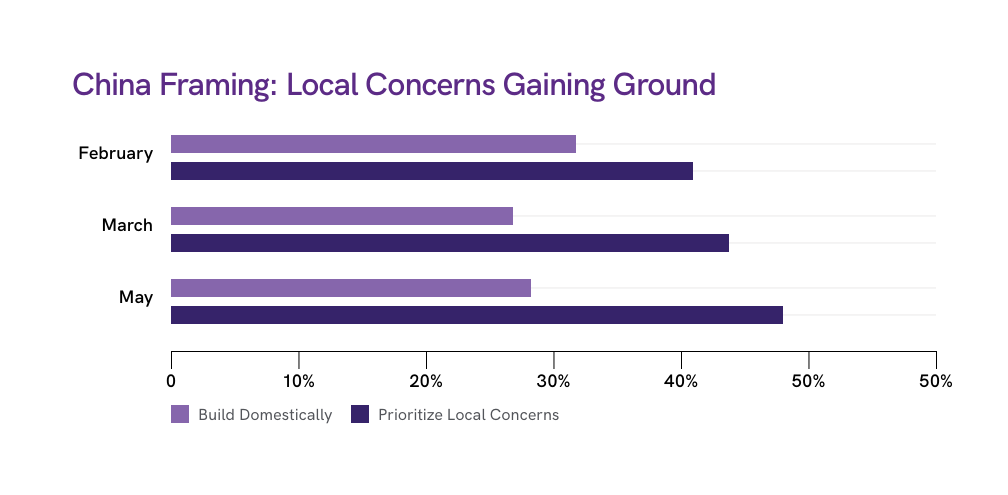
- Forty-eight percent of voters now say the U.S. should prioritize local concerns about electricity and water use even if it means more data centers are built overseas, versus only 28% who say the U.S. should make it easier to build domestically.
- Two-thirds of voters (66%) support requiring data center operators to sign community benefits agreements before construction begins (35% strongly support).
- Voters trust Democrats and Republicans equally on data centers (38% to 38%) and on AI (38% to 37%).
Data centers are underwater with voters (29% favorable, 48% unfavorable), but the opposition is built on a foundation of misinformation that crumbles when voters get the facts.
When voters learn that modern data centers recycle water and reuse it for up to a decade, support swings by a net +31 points, the strongest result in three waves of polling.
Every information treatment we tested moved voters toward support, and the most effective messages are concrete and tangible: the truth about water and power (+37 net), tax benefits (+36 net), and blue-collar jobs (+35 net).
The Ratepayer Protection Pledge retains majority support at 56%, but voters want it codified into law. Sixty-one percent want Congress to turn the pledge into binding federal legislation, and only 15% think the voluntary commitment is sufficient. Meanwhile, awareness of the actual signing is shockingly low: only 9% of voters had heard about it.
The path forward for data center development is education, binding commitments, community benefits, and clean energy. The data makes clear that voters are persuadable when they hear the truth and when they see concrete accountability.
Rising Awareness, But Unfavorable First Impressions
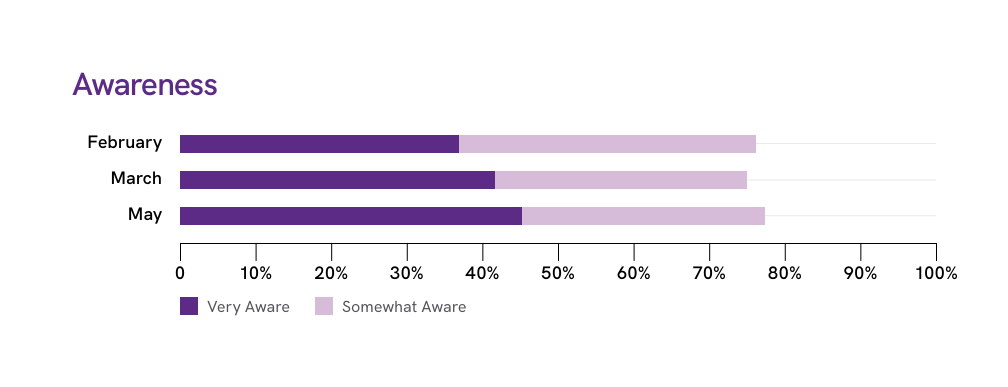
Americans are increasingly aware of data center construction. Seventy-eight percent of voters now say they are aware (45% very aware, 33% somewhat aware). Intensity of awareness continues to deepen, with “very aware” climbing from 37% in February to 42% in March to 45% in May.
However, when asked directly about their overall view of data centers, sentiment is net negative: 29% favorable versus 48% unfavorable. Men are significantly more favorable (39%) than women (20%). Republicans are the most favorable partisan group (37%), followed by Democrats (26%) and Independents (22%). College-educated voters (36%) are more favorable than non-college voters (24%).
Education Is the Most Powerful Tool, and It’s Getting Stronger
The single most important finding in this survey is the growing power of education to shift public opinion. Voters were read the following statement about water recycling:
Modern data centers recycle water similarly to how car washes recycle water. Many facilities fill their cooling systems once and reuse the same water for up to 10 years. Some newer facilities use gel-based cooling systems that require minimal water.
After hearing this, 37% of voters became more supportive and only 6% became less supportive, a net shift of +31 points.
Other education treatments also move voters toward support. Learning about community benefits (infrastructure upgrades, community funds, local jobs) produces a net +28 shift. The Ratepayer Pledge message produces a net +22 shift. And the prospect of grid infrastructure upgrades produces the largest raw shift, with 42% becoming more supportive (net +33).
Argument Testing: Truth, Taxes, and Jobs Lead the Way
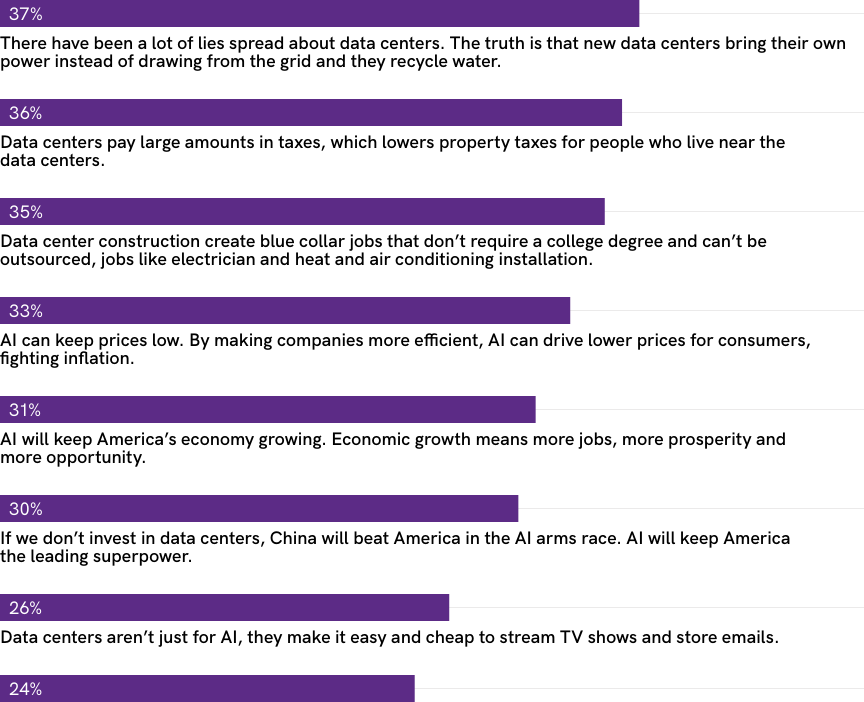
We tested eight pro-data center arguments. Each was read to voters, who indicated whether the argument made them more or less likely to support data center construction.
Pocketbook arguments consistently outperform geopolitical ones. Taxes, jobs, and inflation-fighting all score higher than the China national security frame. However, the China argument still carries real weight and should be used in combination with economic arguments.
| Argument | Net support |
|---|---|
| There have been a lot of lies spread about data centers. The truth is that new data centers bring their own power instead of drawing from the grid and they recycle water. | 37% |
| Data centers pay large amounts in taxes, which lowers property taxes for people who live near the data centers. | 36% |
| Data center construction create blue collar jobs that don’t require a college degree and can’t be outsourced, jobs like electrician and heat and air conditioning installation. | 35% |
| AI can keep prices low. By making companies more efficient, AI can drive lower prices for consumers, fighting inflation. | 33% |
| AI will keep America’s economy growing. Economic growth means more jobs, more prosperity and more opportunity. | 31% |
| If we don’t invest in data centers, China will beat America in the AI arms race. AI will keep America the leading superpower. | 30% |
| Data centers aren’t just for AI, they make it easy and cheap to stream TV shows and store emails. | 26% |
| If we don’t build data centers here, they will have to be built in China which means your family photos and passwords will be stored in data centers accessible to the Chinese government. | 24% |
Source: page 7
Ratepayer Pledge: Popular, But Needs Teeth and a Megaphone
Voters were told:
President Trump has announced a “Ratepayer Protection Pledge” requiring major technology companies that build data centers to generate their own electricity by building their own power plants so that local residents’ electricity prices are not affected.
The Ratepayer Protection Pledge retains majority support at 56% (34% strongly, 22% somewhat), with only 14% opposed. Support is strongest among Republicans (65%), followed by Independents (55%) and Democrats (46%). By 2024 vote, Trump voters support the pledge at 68%, Harris voters at 48%.
Critically, 61% of voters want Congress to turn the pledge into binding federal law. Only 15% think the voluntary commitment is sufficient. This is a clear mandate for legislation.
National Security: The China Case Still Matters, But Local Concerns Are Gaining
The national security dimension of the data center debate remains potent, but voters are increasingly prioritizing local concerns over geopolitical framing.
Americans care deeply about where their data is stored. Sixty-six percent say it is extremely (45%) or very (21%) important that Americans’ personal data is not stored in data centers located in China or other adversary countries. Forty-eight percent support banning the storage of Americans’ personal data in Chinese data centers (32% strongly), though 36% oppose (27% strongly). And 53% say it is extremely or very important that the energy powering American data centers is generated exclusively with domestically produced energy.
However, when the debate is framed as a direct tradeoff between building domestically and prioritizing local concerns, local concerns are winning and the margin is growing:
Forty-eight percent of voters now say the U.S. should prioritize local concerns about electricity and water use even if it means more data centers are built overseas, versus only 28% who say the U.S. should make it easier to build domestically. This gap has widened from 10 points in February to 20 points in May.
The partisan breakdown reveals an important dynamic.
Republicans are perfectly split on this question (39% domestic, 39% local), making them the only group where the China frame effectively neutralizes local concerns. Democrats (55% local, 22% domestic) and Independents (50% local, 18% domestic) both strongly favor prioritizing local communities. By ideology, only very conservatives (42% domestic, 35% local) favor building domestically; all other groups prioritize local concerns.
When voters rank their policy priorities for data centers, the results are telling. Protecting local land, water, and natural resources ranks first (22% ranked it #1), followed by protecting Americans’ personal data from foreign access (21%) and keeping local electricity prices low (20%). “Ensuring the U.S. beats China in the AI race” ranks dead last, with only 10% ranking it first and 36% ranking it last out of seven options.
The strategic implication is clear: the China and national security arguments are valuable reinforcements, particularly with Republican audiences, but they cannot carry the debate alone. The most effective approach combines the economic case (truth about water/power, tax benefits, jobs) with the national security case, rather than leading with geopolitics.
Solar Is the Path of Least Resistance
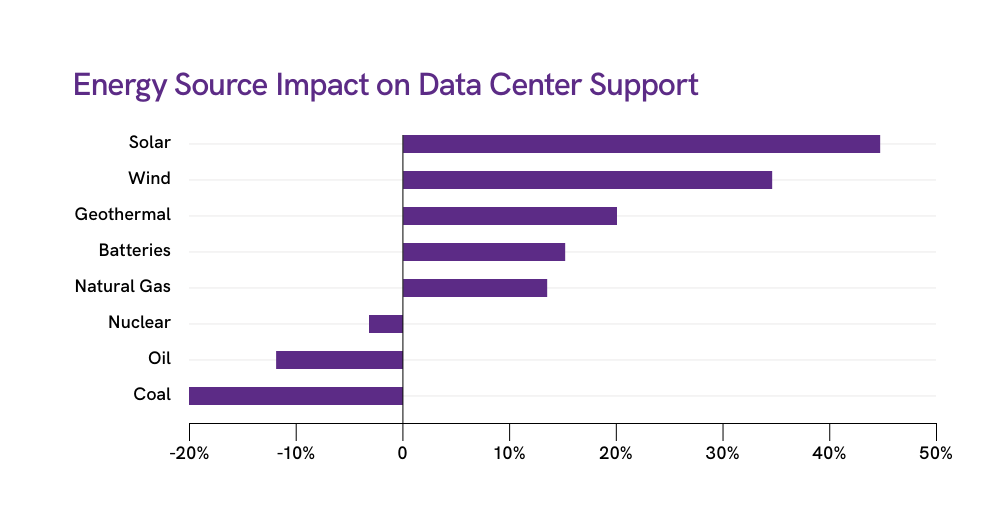
When voters are asked what energy source they’d prefer for a nearby data center, solar and battery storage is the clear winner at 25%, followed by a mix of all sources (22%), wind (11%), natural gas (9%), and nuclear (6%).
Companies and policymakers who pair data center development with clean energy investment have a built-in advantage. Nuclear remains divisive. Coal and oil generate active opposition.
Voters Support Data Centers for Services They Already Use
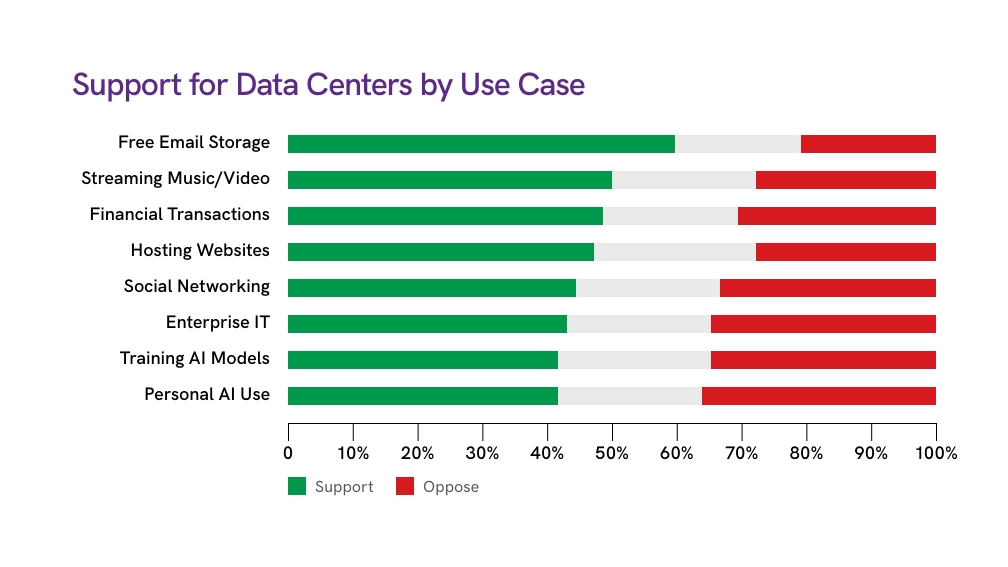
When data centers are connected to services voters rely on, support rises. Sixty percent support building data centers to ensure free email storage remains available. Support drops when tied to AI.
AI Job Fears Are Deep and Resistant to Rebuttal
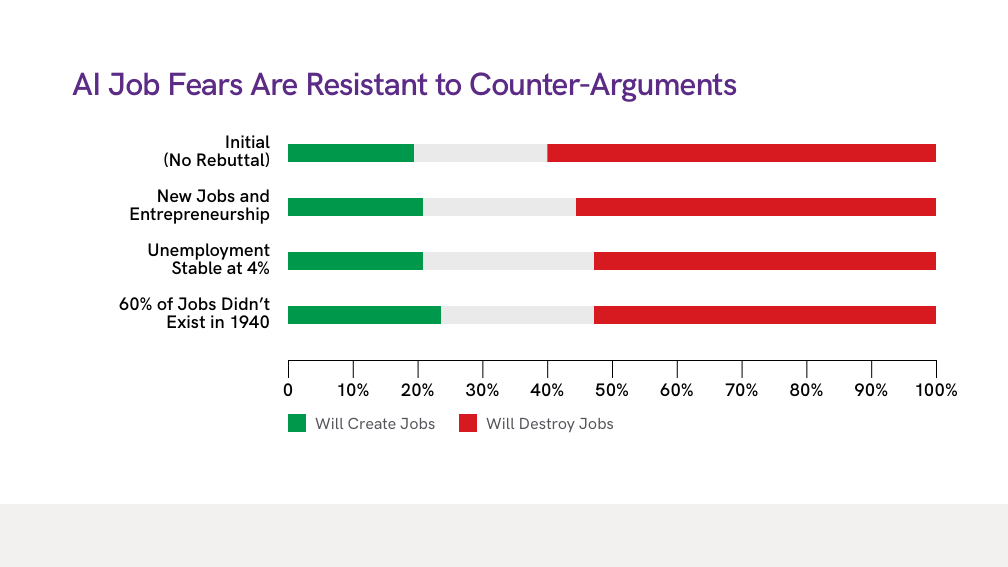
Sixty percent of voters believe AI will destroy jobs, against just 19% who say it will create them. This belief spans every demographic group: 64% of Democrats, 57% of Republicans, 58% of Independents. Women (64%) are more pessimistic than men (55%). Older voters (65+) are most pessimistic at 66%. Counter-arguments chip away at the margin but do not break through.
Notably, 14% of voters already say they know someone who lost a job to AI. The industry needs to take this concern seriously and lead with concrete commitments to workforce development and the blue-collar jobs that data center construction itself creates.
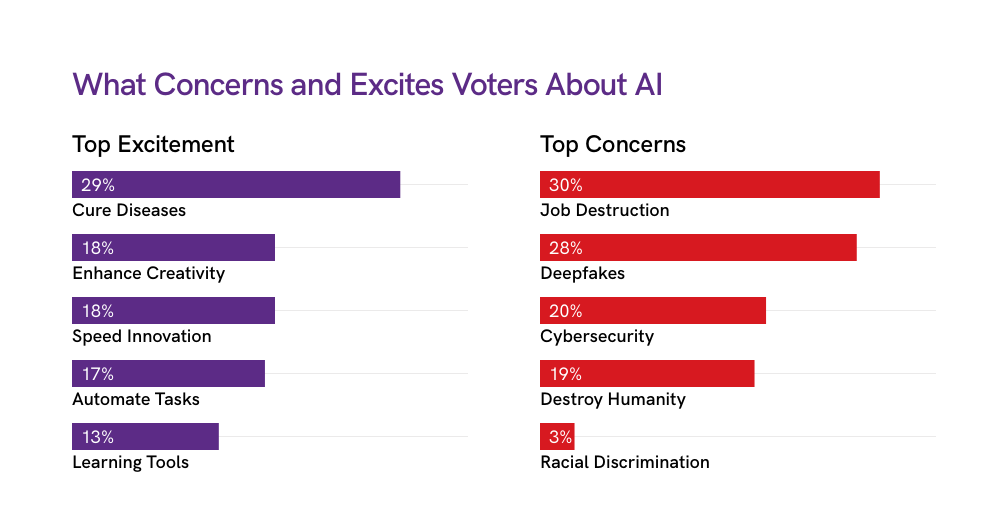
AI Sentiment: Concern Outweighs Excitement Two-to-One
Fifty-seven percent of voters say they are more concerned about AI risks, while only 28% say they are more excited about the opportunity. After being walked through a series of questions about AI and jobs, concern actually ticked up slightly to 59%.
The top concern is job destruction (30%), followed by deepfakes and deceptive images (28%) and cybersecurity (20%). The top source of excitement is curing diseases (29%), followed by enhancing creativity (18%) and speeding up innovation (18%). Eighty percent of voters are concerned about AI chatbots specifically (25% extremely, 20% very, 35% somewhat), and 47% say the government should regulate chatbots now.
Community Benefits Agreements: The Key to Local Support
Two-thirds of voters (66%) support requiring data center operators to sign community benefits agreements before construction begins (35% strongly support). Nearly half (48%) say the community itself should have the primary say through a public vote on whether a data center gets built. Only 9% say the federal government should decide.
On land use, 51% say data centers use too much land that should be preserved for housing, farming, or open space. Only 26% see them as a legitimate use of land. Companies that proactively offer CBAs, local hiring, infrastructure upgrades, and tax contributions will reduce opposition and build durable local support.
Neither Party Owns This Issue
Voters trust Democrats and Republicans equally on data centers (38% to 38%) and on AI (38% to 37%). This is rare in today’s political environment and represents an asset. Bipartisan legislation on ratepayer protection and community benefits agreements would lock in this advantage before either party tries to weaponize the issue.
This poll surveyed 1,010 registered voters via online panel from May 15–18, 2026. Results were weighted by 2024 vote, gender, age, race, and education to match population demographics. The margin of error is ±3.3 percentage points at the 95% confidence level. February and March comparison data from Rainey Center surveys conducted in February and March 2026 using identical methodology.
Appendix: Full Question Text
Questions referenced in this memo, with full text as fielded.
Q7. Data Center Awareness
Are you aware that large technology companies are building data centers in many communities across America to power AI and cloud computing?
- Yes, very aware
- Somewhat aware
- Not very aware
- Not at all aware
Q8. Data Center in Community
To the best of your knowledge, is there a data center being built or operating in your community?
- Yes, one is already operating
- Yes, one is being built or proposed
- No, there is no data center in my community
- Not sure
Q9. Overall Favorability
Overall, do you have a favorable or unfavorable view of data centers?
- Very favorable
- Somewhat favorable
- Somewhat unfavorable
- Very unfavorable
- Not sure
Q10. Electricity Costs
Do you believe data centers in your area are driving up your electricity costs?
- Yes, significantly
- Yes, somewhat
- No, not really
- No, not at all
- There are no data centers in my area
- I don’t know
Q11. Biggest Concern
Which of the following is your BIGGEST concern about data centers being built in American communities?
- They will drive up electricity prices for local residents
- They use too much water
- They generate too much heat
- They take up too much land
- They don’t create enough permanent jobs
- They may store Americans’ personal data insecurely
- They are needed for national security and I don’t have concerns
- They are supporting artificial intelligence which will destroy jobs
- Something else
- Not sure
Q12. Grid Reliability
(Preceded by: U.S. electricity demand is projected to see its strongest growth since 2000, driven by data centers, manufacturing, and industrial expansion.) How concerned are you about the reliability of America’s electric grid to meet this growing demand?
- Very concerned
- Somewhat concerned
- Not very concerned
- Not at all concerned
- Not sure
Q13. Ratepayer Pledge Support
(Preceded by: President Trump has announced a “Ratepayer Protection Pledge” requiring major technology companies that build data centers to generate their own electricity by building their own power plants so that local residents’ electricity prices are not affected.) Do you support or oppose the Ratepayer Protection Pledge?
- Strongly support
- Somewhat support
- Somewhat oppose
- Strongly oppose
- Not sure
Q14. Ratepayer Pledge Impact on View
Does knowing that tech companies are required to build their own power for data centers change your view of data centers?
- Much more supportive
- Somewhat more supportive
- No change in my view
- Somewhat less supportive
- Much less supportive
- Not sure
Q15. Awareness of Pledge Signing
(Preceded by: On March 4, 2026, several major data center developers, together with the White House, publicly signed on to the Ratepayer Protection Pledge—committing to cover the full cost of new electric generation resources needed to meet their energy demands.) Before today, were you aware that major data center developers had signed on to the Ratepayer Protection Pledge?
- Yes, I had heard about this
- I had heard something about it but didn’t know the details
- No, this is the first I’m hearing of it
- Not sure
Q16. Voluntary vs. Binding Law
The Ratepayer Protection Pledge is currently a voluntary commitment by major tech companies, with no legal enforcement mechanism. Which comes closer to your view?
- The voluntary pledge is sufficient. If companies break it, market and political pressure will hold them accountable
- Congress should turn the pledge into binding federal law so that all data center operators are legally required to protect ratepayers
- Not sure
Q17. Preferred Energy Source
If a new data center is built near your community and the tech company is required to generate its own power, which energy source would you MOST prefer it use?
- Natural gas
- Nuclear (including small modular reactors)
- Solar and battery storage
- Wind
- A mix of all of the above
- No preference
- Not sure
Q18. Water Recycling Impact
(Preceded by: Modern data centers recycle water similarly to how car washes recycle water. Many facilities fill their cooling systems once and reuse the same water for up to 10 years. Some newer facilities use gel-based cooling systems that require minimal water.) Does knowing this information change your view of data centers?
- Much more supportive
- Somewhat more supportive
- No change in my view
- Somewhat less supportive
- Much less supportive
- Not sure
Q19. Permitting
Do you support or oppose speeding up federal permitting so tech companies can build their own on-site power plants to serve their data centers without burdening the local grid?
- Strongly support
- Somewhat support
- Somewhat oppose
- Strongly oppose
- Not sure
Q20. Land Use
Some data center campuses can cover hundreds or even thousands of acres. Which of the following comes closer to your view?
- Data centers use too much land and that land should be preserved for housing, farming, or open space
- Data centers are a legitimate and valuable use of land and should be built where they make economic sense
- Not sure
Q21. Who Should Decide
Who should have the PRIMARY say in whether a data center gets built in a given community?
- Local city or county officials
- The state government
- The federal government
- The community itself, through a public vote
- Not sure
Q22. Community Benefits Impact
(Preceded by: When technology companies build data centers in a community, they often invest in upgrading local electrical infrastructure including transmission lines and grid modernization, create community investment funds that support local charities and programs, and bring construction and operations jobs to the area.) Does knowing about these community benefits change your view of data centers being built near your community?
- Much more supportive
- Somewhat more supportive
- No change in my view
- Somewhat less supportive
- Much less supportive
- Not sure
Q23. Grid Upgrades Impact
If a data center being built in your area would also result in significant upgrades to the local electrical grid and infrastructure that benefit all residents, would you be more or less supportive of the project?
- Much more supportive
- Somewhat more supportive
- Would not change my view
- Somewhat less supportive
- Much less supportive
- Not sure
Q24. Community Benefits Agreement
Do you support or oppose requiring data center operators to sign a “community benefits agreement” committing to local hiring, infrastructure upgrades, and payments to the community before construction begins?
- Strongly support
- Somewhat support
- Somewhat oppose
- Strongly oppose
- Not sure
Q25. U.S. vs. Overseas
(Preceded by: AI requires massive computing power housed in data centers. If the United States does not build enough data centers domestically, technology companies may build them in other countries, including China.) Which comes closer to your view?
- The U.S. should make it easier to build data centers domestically, even if it increases local electricity demand
- The U.S. should prioritize local concerns about electricity and water use, even if it means more data centers are built overseas
- Not sure
Q26. U.S. vs. China in AI
How important is it to you that the United States, rather than China, leads the world in AI and data infrastructure?
- Extremely important
- Very important
- Somewhat important
- Not very important
- Not at all important
- Not sure
Q27. Data Stored in China
How important is it to you that Americans’ personal data is NOT stored in data centers located in China or other adversary countries?
- Extremely important
- Very important
- Somewhat important
- Not important
- Not sure
Q28. Domestic Energy
How important is it that the energy powering American data centers is generated exclusively with domestically produced energy?
- Extremely important
- Very important
- Somewhat important
- Not important
- Not sure
Q29. Ban Data in China
Do you support or oppose banning the storage of Americans’ personal data in data centers located in China?
- Strongly support
- Somewhat support
- Somewhat oppose
- Strongly oppose
- Not sure
Q33. Data Center Use Cases
Do you support or oppose data centers being built to support the following: ensure e-mail storage remains free, streaming music and video, maintaining social networking sites, training AI and deploying AI models, hosting websites, enterprise IT systems, financial transactions, personal AI use
- Strongly support
- Somewhat support
- Somewhat oppose
- Strongly oppose
- Not sure
Q34/Q58. AI Risk vs. Opportunity
When it comes to artificial intelligence would you say you are…
- More concerned about the risk
- More excited about the opportunity
- Not sure
Q35. AI Concerns
What concerns you most about artificial intelligence?
- AI will destroy jobs
- AI poses a cybersecurity risk
- AI will lead to the spread of deepfakes
- AI will lead to more racial discrimination
- AI will destroy all of humanity
Q36. AI Excitement
What excites you most about artificial intelligence?
- Automate mundane tasks
- Allow me to vibecode my own apps
- Allow me to enhance my creativity
- Create educational and learning tools
- Cure diseases
- Speed up innovation
Q53. AI Create or Destroy Jobs
Do you think artificial intelligence will create jobs or destroy jobs?
- Artificial intelligence will create jobs
- Artificial intelligence will destroy jobs
- Not sure
Q55-57. AI Jobs Rebuttals
Three versions tested sequentially:
- Others say AI will create new jobs such as building data centers and stimulate new entrepreneurship
- Others note unemployment has remained stable around 4%
- Others note 60% of jobs today didn’t exist in 1940
Q38. Party Trust on Data Centers
Which party do you trust more when it comes to data center construction?
- Democrats
- Republicans
- Not sure
Q39. Party Trust on AI
Which party do you trust more when it comes to artificial intelligence?
- Democrats
- Republicans
- Not sure
Downloads
Toplines
Download Toplines (PDF)↓Crosstabs
Download Crosstabs (PDF)↓Methodology
Polling methodology↗