Key findings
- A strong 77% of voters say they are aware that large technology companies are building data centers across America (37% very aware, 40% somewhat aware).
- Net more supportive: +20 points overall (33% more supportive minus 13% less supportive).
- Our survey found that 34% of voters believe data centers are driving up their electricity costs (15% significantly, 19% somewhat).
- Our December survey confirmed the national security dimension: 74% of voters say it is extremely or very important that Americans’ personal data is not held in Chinese data centers.
- After learning that the battery storage industry’s failure rate has dropped 97% since 2018, and that several states require compliance with national fire safety codes, support for state legislation surges to 73% (43% strongly, 30% somewhat).
Executive summary
The debate over data centers is being driven by misinformation and when voters get the facts, they move decisively toward support. Here’s the key finding: when voters learn that modern data centers recycle water similarly to car washes and reuse the same water for up to 10 years, support jumps dramatically. Thirty-three percent become more supportive, while only 13% become less so, a better than 2.5-to-1 ratio in favor of data centers. The anti-data-center narrative is built on a misconception about water usage, and it collapses when voters hear the truth. President Trump addressed this issue head-on in his State of the Union, announcing his “ratepayer protection pledge” requiring major tech companies to build their own power plants to serve their data centers, so that no one’s electricity prices go up. The data makes clear: the path forward for data center development is education, energy independence, and the kind of bold executive action this President specializes in.
The debate over data centers is being driven by misinformation and when voters get the facts, they move decisively toward support.
That’s the clear takeaway from our February survey, and it’s a powerful argument for the kind of public education effort the industry and the Trump administration need to be making.
Here’s the key finding: when voters learn that modern data centers recycle water similarly to car washes and reuse the same water for up to 10 years, support jumps dramatically. Thirty-three percent become more supportive, while only 13% become less so, a better than 2.5-to-1 ratio in favor of data centers. Among Republicans, that ratio is even stronger. The anti-data-center narrative is built on a misconception about water usage, and it collapses when voters hear the truth.
President Trump addressed this issue head-on in his State of the Union, announcing his “ratepayer protection pledge” requiring major tech companies to build their own power plants to serve their data centers, so that no one’s electricity prices go up. As the President put it: “In many cases prices of electricity will go down for the community.” This innovative, market-driven solution can turn voter skepticism of data centers into support.
The data makes clear: the path forward for data center development is education, energy independence, and the kind of bold executive action this President specializes in.
High Awareness, But Misconceptions Persist
Americans are paying attention to the data center buildout. A strong 77% of voters say they are aware that large technology companies are building data centers across America (37% very aware, 40% somewhat aware). Only 23% are not very or not at all aware.
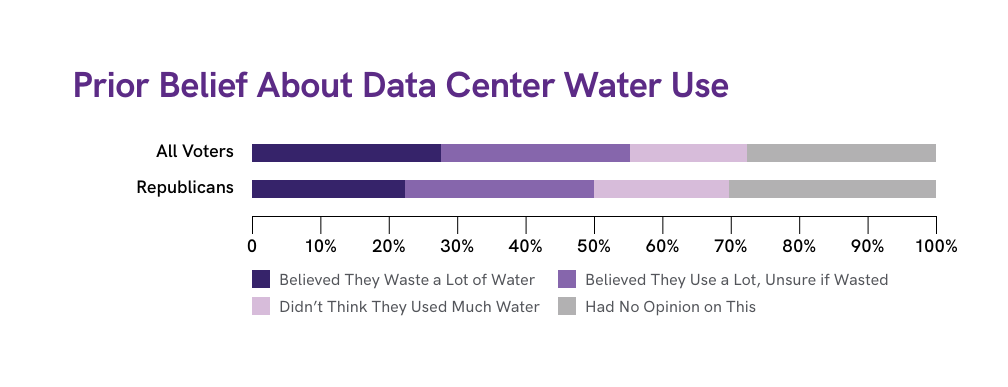
But awareness of data centers has been paired with misinformation about their environmental impact. On the water question specifically, a combined 55% of voters held negative or uncertain beliefs about data center water use.
This is a messaging opportunity.
Education Works: Support Surges When Voters Learn the Facts
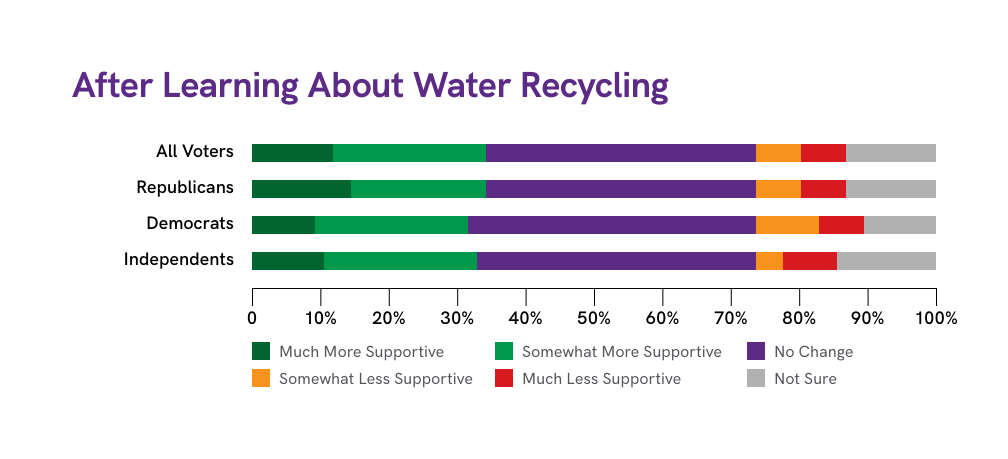
After being told that modern data centers recycle water similarly to car washes, and that many facilities reuse the same water for up to 10 years, voter sentiment shifted dramatically.
Net more supportive: +20 points overall (33% more supportive minus 13% less supportive). Among Republicans, the net is +23 points. Among Independents, +22 points. Even Democrats show a net positive shift of +17 points. This is a rare issue where education moves all partisan groups in the same direction. Among electricity bill payers, the voters most concerned about energy costs, 36% became more supportive after learning about water recycling, compared to just 21% of non-bill-payers. The people who pay the bills are the most persuadable on this issue.
Trump’s Ratepayer Pledge: Addressing the #1 Voter Concern
Voters’ top concern about data centers is the impact on their electricity bills. Our survey found that 34% of voters believe data centers are driving up their electricity costs (15% significantly, 19% somewhat). And 71% are concerned about America’s electric grid meeting growing demand (31% very concerned, 40% somewhat concerned).
President Trump’s State of the Union announcement directly addresses this anxiety. His “ratepayer protection pledge” requires major tech companies to provide for their own power needs by building their own power plants. As the President explained: “We have an old grid. It could never handle the kind of numbers, the amount of electricity that’s needed. So I’m telling them they can build their own plant.”
This is the kind of innovative, pro-growth executive action that turns the data center debate on its head. Instead of choosing between technology leadership and affordable electricity, the Trump approach delivers both data center expansion and ratepayer protection. It’s a model that should be the centerpiece of every data center advocacy effort going forward.
The China Question: National Security Shifts the Debate
When voters are told that if the U.S. doesn’t build enough data centers domestically, technology companies may build them in China, the debate shifts. Thirty-two percent say the U.S. should make it easier to build data centers domestically even if it increases local electricity demand and among Republicans, that number jumps to 43%.
Our December survey confirmed the national security dimension: 74% of voters say it is extremely or very important that Americans’ personal data is not held in Chinese data centers. And 62% say it is extremely or very important that energy powering data centers is generated exclusively with domestically produced energy.
The framing matters enormously. When data centers are presented as a local nuisance, voters are skeptical. When data centers are presented as critical national infrastructure in competition with China, support crystallizes especially among Republicans and Independents.
Grid Solutions Enjoy Strong Bipartisan Support
Voters are ready to act on grid reliability. Battery energy storage facilities, which store electricity during low demand and deliver it during peaks, enjoy 62% support (27% strongly, 35% somewhat), with only 13% opposed. Support is bipartisan: 63% among Republicans, 62% among Democrats, and 58% among Independents when accounting for undecided voters.
After learning that the battery storage industry’s failure rate has dropped 97% since 2018, and that several states require compliance with national fire safety codes, support for state legislation surges to 73% (43% strongly, 30% somewhat). Once again, education drives support.
This poll surveyed 1,008 registered voters via online panel from February 25–27, 2026. Results were weighted by 2024 vote, gender, age, race, and education to match population demographics. The margin of error is ±3.3 percentage points at the 95% confidence level. December 2025 comparison data from a Rainey Center survey conducted in December 2025 using identical methodology.