
Key findings
- 75% of respondents believe AI advancement raises legitimate security concerns, indicating a broad recognition of potential risks.
- 79% of voters support mandatory safety testing for powerful AI models, with 54% strongly supporting this measure.
- 75% of respondents favor a carefully regulated approach to maximizing long-term benefits from AI, compared to only 8% who prefer a hands-off approach.
- 76% view open source AI models as bad for society, suggesting potential support for regulations on AI development and distribution.
- For example, 81% of Democrats and 80% of Republicans support mandatory safety testing.
Executive summary
Rainey Center conducted survey research to help understand how voters feel about artificial intelligence and what, if any, regulatory approach they would support. We find that voters have deep concerns about a number of aspects of artificial intelligence developments and support an active public sector approach to regulation, rather than embracing a hands off approach. We find that voters are both concerned about the national security and societal implications of artificial intelligence. Lawmakers would be wise to adopt a commonsense approach to artificial intelligence with an eye to avoiding large scale social disruption and dislocation and protecting American national security. The polling data reveals a clear and consistent message: American voters are deeply concerned about the potential risks associated with artificial intelligence and strongly support measures to ensure AI safety and responsible development. This sentiment cuts across demographic lines, though it is particularly pronounced among older voters and college-educated respondents.
The release of ChatGPT set off a flurry of media, investor and public policy interest in the topic of artificial intelligence.
Over the last year, there have been bipartisan working groups on artificial intelligence in both chambers of Congress and the Executive Branch, and a number of states are exploring legislation to regulate artificial intelligence.
Rainey Center conducted survey research to help understand how voters feel about artificial intelligence and what, if any, regulatory approach they would support. We find that voters have deep concerns about a number of aspects of artificial intelligence developments and support an active public sector approach to regulation, rather than embracing a hands off approach.
We find that voters are both concerned about the national security and societal implications of artificial intelligence. Voters are worried about the possibility that artificial intelligence is used by foreign adversaries but are also concerned that artificial intelligence will disrupt American society in worrying ways, such as the advent of “AI boyfriends” and “AI girlfriends.”
Concerns about artificial intelligence is not concentrated in any single demographic or political party, but are strong across all demographics and partisan affiliations. Lawmakers would be wise to adopt a commonsense approach to artificial intelligence with an eye to avoiding large scale social disruption and dislocation and protecting American national security.
Policy Findings
Widespread Concern
75% of respondents believe AI advancement raises legitimate security concerns, indicating a broad recognition of potential risks.
Strong Support for Safety Testing
79% of voters support mandatory safety testing for powerful AI models, with 54% strongly supporting this measure. This suggests a clear public mandate for safety protocols.
Preference for Regulation
75% of respondents favor a carefully regulated approach to maximizing long-term benefits from AI, compared to only 8% who prefer a hands-off approach.
Export Control Support
61% of respondents support making it illegal to export dangerous AI capabilities to hostile countries, indicating a desire for international AI safety measures.
Open Source AI Concerns
76% view open source AI models as bad for society, suggesting potential support for regulations on AI development and distribution.
Child Protection Concerns
67% view AI chatbots for children and teens as bad for society, indicating a specific area of AI safety concern related to minors.
Demographic Findings
Age-Related Trends
Older voters consistently show stronger support for AI safety measures and regulations. For instance, support for mandatory safety testing increases from 67% among 18-44 year-olds to 90% among those 65 and older.
Bipartisan Agreement
Support for AI safety measures often transcends party lines. For example, 81% of Democrats and 80% of Republicans support mandatory safety testing.
Education Factor
College-educated respondents generally show stronger support for AI safety measures. 87% of college graduates support mandatory safety testing compared to 74% of non-college graduates.
Rainey Center fielded an online survey of 1,010 respondents over web panels from July 14-15, 2024 and weighted it to education, gender, race, and 2020 election results. The margin of error is +/- 4.0.
Recommendations for Policymakers
Prioritize AI Safety Regulations
Given the overwhelming support for a regulated approach (75%), policymakers should prioritize developing and implementing comprehensive AI safety regulations. These should focus on mandatory safety testing, which enjoys broad bipartisan support (79% overall).
Establish Robust Testing Protocols
Develop and implement stringent safety testing protocols for powerful AI models. This should be a cornerstone of any AI governance framework, given the strong public support (54% strongly in favor).
Implement Export Controls
Consider implementing strict controls on the export of advanced AI capabilities to potentially hostile nations, in line with the 61% of voters who support such measures.
Address Open Source AI Concerns
Given that 76% view open source AI models as potentially harmful, develop guidelines or regulations for the responsible development and use of open source AI technologies.
Protect Minors
Craft specific regulations to protect children and teenagers from potential harm from AI applications, reflecting the 67% of voters concerned about AI chatbots for minors.
Engage in Public Education
With 21% unsure about banning powerful open source AI models and 18% uncertain about approaches to maximize AI benefits, there’s a clear need for public education on AI technologies and their implications.
Foster Bipartisan Cooperation
Leverage the areas of bipartisan agreement on AI safety to build consensus for effective regulation that can withstand political shifts.
AI Chatbots and Girlfriends
One of the most popular uses of AI is for AI chatbots. We asked voters whether AI chatbots that children and teens can chat with, including 'AI boyfriends' and 'AI girlfriends,' are a good thing or bad thing for society. We found that only 11% of voters believed these were a “good thing,” while 67% said they were a “bad thing.”
AGE Younger adults (18-44) are more accepting (17% positive) compared to older groups (8% for 45-64, 6% for 65+).
RACE Black Americans show higher acceptance (21% positive) compared to white (9%) and Latino/a (15%) respondents.
POLITICAL AFFILIATION Democrats (18%) are more likely to view it positively than Republicans (7%).
EDUCATION Little difference between college-educated (12%) and non-college (10%) respondents.
Open Source AI Models
We asked voters their views on open source AI models, asking “Do you believe open source AI models, where anyone can use and alter them, are a good thing or bad thing for society?” and found that only 24% of voters view them as a good thing and 76% as a bad thing.
Analysis
A significant majority view open source AI models negatively. This sentiment is consistent across demographics, with some variations.
AGE Younger adults (18-44) are somewhat more positive (33% good) than older groups (19% for both 45-64 and 65+).
RACE Black (33%) and Latino/a (27%) respondents view it more favorably than White respondents (21%).
POLITICAL AFFILIATION Democrats (30%) view it more favorably than Republicans (22%).
EDUCATION Little difference between college-educated (26%) and non-college (24%) respondents.
Restricting AI Export to Hostile Countries
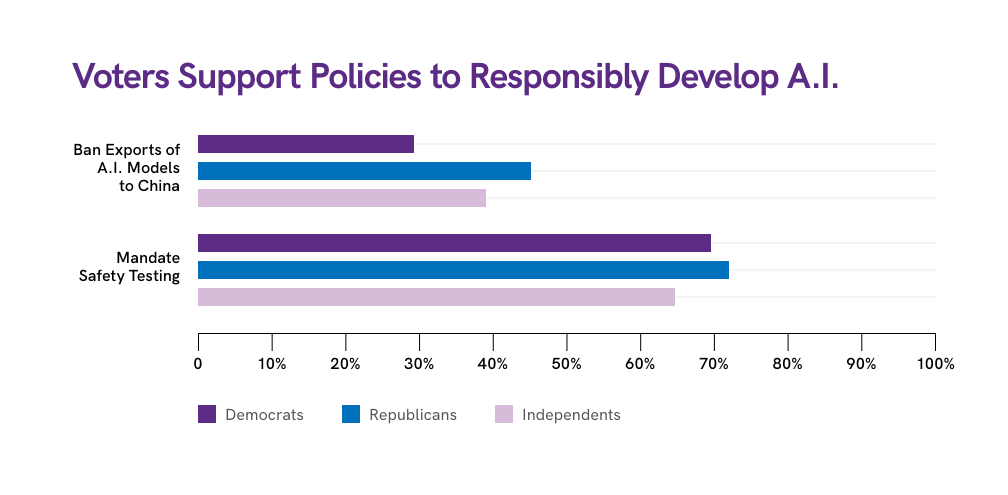
One policy idea gaining support in Congress is export controls to hostile countries. We asked voters whether they would support or oppose making it illegal to export AI models with dangerous capabilities to China and other countries hostile to the US. We find strong support for the idea, with 61% of voters in support (44% strongly, 17% somewhat) and 23% opposed (9% somewhat, 14% strongly) and 17% unsure.
AGE Support increases significantly with age (49% of 18-44 vs. 75% of 65+).
RACE White respondents show higher support (67%) compared to Black (36%) and Latino/a (50%) respondents.
POLITICAL AFFILIATION Republicans (66%) show stronger support than Democrats (58%).
EDUCATION Similar levels of support between college-educated (66%) and non-college (58%) respondents.
AI Security Concerns
We asked respondents whether they felt the rapid advancement of AI raises legitimate concerns about misuse that could undermine security, or are those fears overblown compared to AI's potential benefits. By an overwhelming 75% to 11% margin, voters said AI raises legitimate security concerns, with 14% unsure.
AGE Concern increases with age (63% of 18-44 vs. 87% of 65+).
RACE White respondents show higher concern (79%) compared to Black (62%) and Latino/a (68%) respondents.
POLITICAL AFFILIATION Republicans (82%) are more concerned than Democrats (75%).
EDUCATION College-educated respondents (79%) show slightly higher concern than non-college (73%).
The high level of concern across demographics suggests broad support for security-focused AI regulations.
Voters support mandatory safety testing on the most powerful AI models, with 79% in support (54% strongly, 25% somewhat), 10% opposed (6% somewhat, 4% strongly) abd 11% unsure.
AGE Support increases with age (67% of 18-44 vs. 90% of 65+).
RACE Support is high across all racial groups (White 83%, Black 60%, Latino/a 73%).
POLITICAL AFFILIATION High support across party lines (Democrats 81%, Republicans 80%).
EDUCATION College-educated respondents (87%) show higher support than non-college (74%).
Broad Regulatory Approach
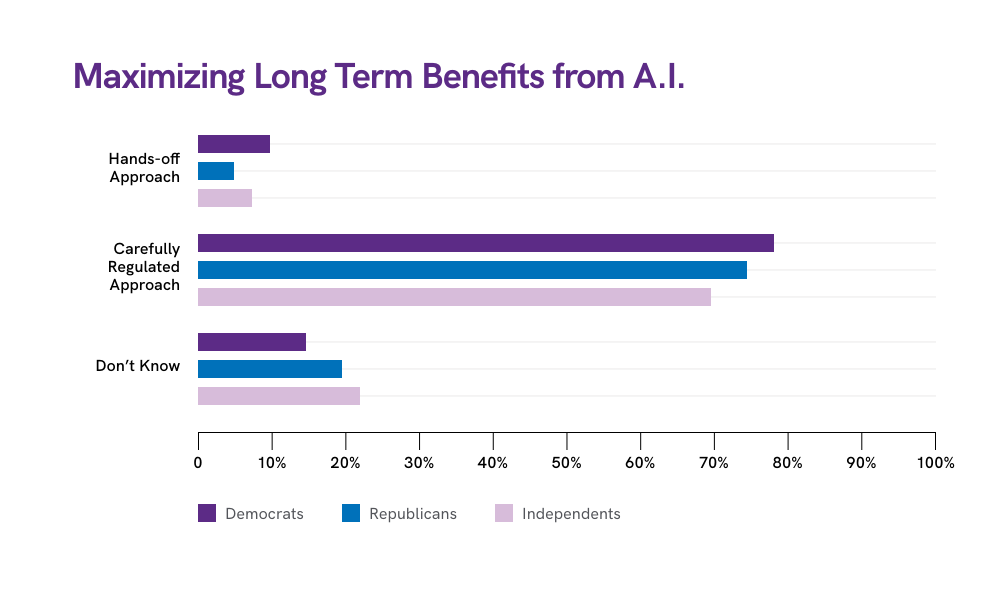
We asked voters what approach they believed is most compatible with maximizing the long term benefits from AI, a carefully regulated approach or a hands-off approach. Voters support a careful regulatory approach (75%), rather than a hands-off approach (8%), with 18% undecided. This support is strong across the partisan spectrum and suggests that a laissez-faire approach to AI will be rejected by the public.
Analysis
A strong majority favor a carefully regulated approach to AI development.
AGE Support is consistent across age groups (69% of 18-44, 77% of 45-64, 80% of 65+).
RACE Support is high across all racial groups (White 78%, Black 60%, Latino/a 72%).
POLITICAL AFFILIATION High support across party lines (Democrats 77%, Republicans 76%).
EDUCATION College-educated respondents (80%) show higher support than non-college (72%).
Conclusion and Recommendations
The polling data reveals a clear and consistent message: American voters are deeply concerned about the potential risks associated with artificial intelligence and strongly support measures to ensure AI safety and responsible development. This sentiment cuts across demographic lines, though it is particularly pronounced among older voters and college-educated respondents.
Policymakers examining AI issues can address the clear public mandate for AI safety measures while fostering responsible innovation in this rapidly evolving field. AI governance frameworks should keep public sentiment in mind as society seeks to harness the benefits of AI while mitigating its potential risks.