
Key findings
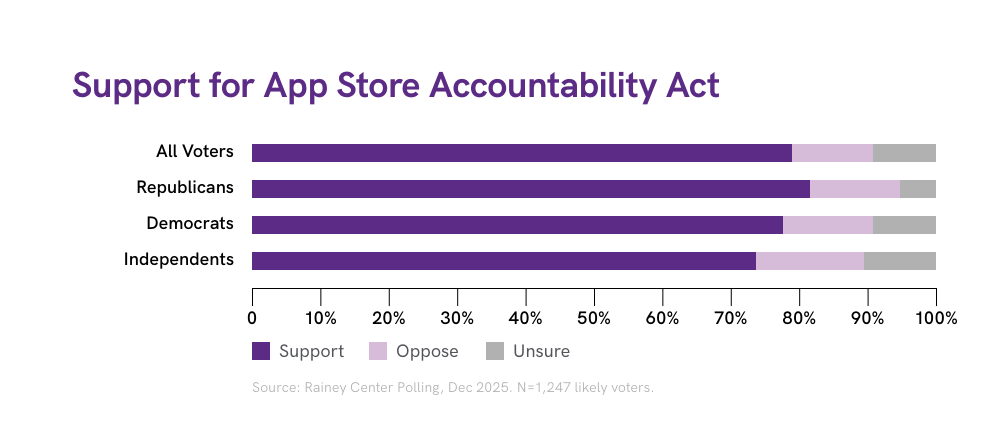
- The latest Rainey Center polling shows overwhelming support (79%) for the App Store Accountability Act, which shifts the burden of age verification to the app store level (e.g., Apple and Google) rather than individual apps.
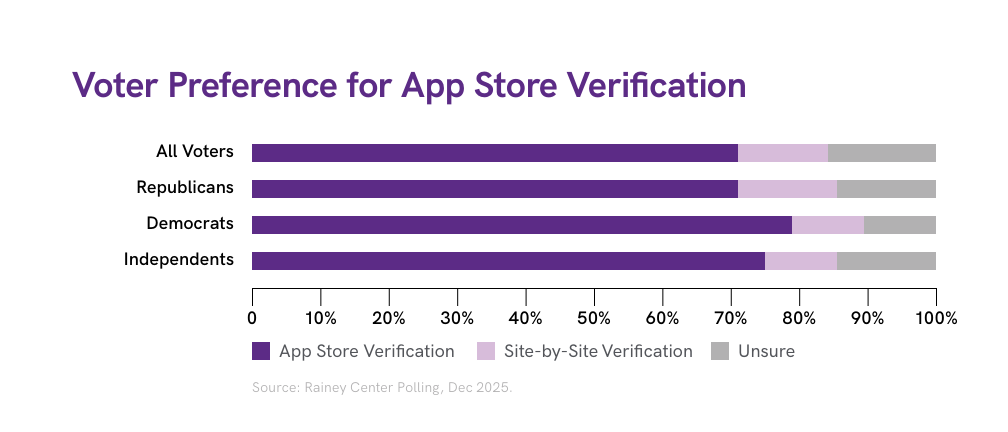
- When presented with the two options, 71% of voters prefer verifying age once through an App Store, compared to just 13% who support uploading government IDs to individual websites.
- 87% of voters agree that parents, not the government, should determine what content minors engage with online
- 82% of voters support requiring app stores to obtain parental approval for users under 16 (Source: “Them”
- 81% of voters support legislation generally requiring app stores to verify the age of users
Executive Summary
As states across the country move to enact age verification legislation, a clear consensus has emerged among voters: they want parents, not the government, to decide what content their children access.
However, they prefer a streamlined, secure solution over cumbersome mandates that require uploading sensitive ID documents to every single website.
The latest Rainey Center polling shows overwhelming support (79%) for the App Store Accountability Act, which shifts the burden of age verification to the app store level (e.g., Apple and Google) rather than individual apps. This support is robust across party lines.
It’s time for the federal government to create a comprehensive App Store Policy.
The “Alcohol Bracelet” Solution
The current “app-by-app” verification model is akin to requiring a concertgoer to show their ID at every single concession stand inside a venue. It is inefficient, invasive, and risks data security.
The App Store Accountability model offers a common-sense alternative: the “Alcohol Bracelet” approach. Just as a venue verifies age once at the door and issues a wristband, app stores should verify a user’s age once at the device setup level. This allows parents to “wristband” their children’s devices, ensuring they cannot download age-inappropriate apps without parental consent, while protecting user privacy.
The Voter Mandate
Voters overwhelmingly prefer the centralized App Store model over the fragmented “ID for every site” approach.
Key Finding
When presented with the two options, 71% of voters prefer verifying age once through an App Store, compared to just 13% who support uploading government IDs to individual websites.
The App Store Accountability Act is a federal bill that would make large app stores (such as Apple and Google) responsible for verifying each user’s age, linking under-18 users to a verified parent/guardian, and requiring parental consent before minors can download apps or make in-app purchases. Do you support or oppose the App Store Accountability Act?
Additional Key Findings
- 87% of voters agree that parents, not the government, should determine what content minors engage with online
- 82% of voters support requiring app stores to obtain parental approval for users under 16 (Source: “Them” Poll)
Beyond privacy concerns, the “App Store” model wins on practicality across the political spectrum. Parents understand that managing permissions for dozens of individual apps is a logistical nightmare.
When asked specifically about the method of verification, voters from all parties clearly favored the centralized model over the repetitive, app-by-app alternative.
To protect minors from harmful content online, lawmakers are considering requiring age verification. Which method do you prefer?
Broad Support for Parental Control
Our polling found consistent, high-level support for measures that put parents back in the driver’s seat:
- 81% of voters support legislation generally requiring app stores to verify the age of users
- 87% agree with the statement that parents, not the government, should be the ones deciding what content their children engage with
- 71% percent prefer verifying age once through an App Store (like Apple or Google) rather than uploading sensitive ID documents to every individual website (13%)
Companies are releasing tools to do exactly this. For instance, Meta released a new feature on Instagram will start notifying parents using supervision if their teen repeatedly tries to search for terms related to suicide or self-harm within a short period of time.
Legislative Landscape
Momentum for App Store-level solutions is accelerating in statehouses, despite opposition from entrenched incumbents.
Alabama (Active Victory)
As of February 10, 2026, HB 161 has passed the legislature unanimously and is currently on Governor Kay Ivey’s desk. This marks the first successful passage of the App Store Accountability Act in the 2026 session.
Texas (Legal Battle)
While SB 2420 was signed into law, it is currently enjoined by a federal court as of January 2026. This underscores the need for “content-neutral” federal guardrails that rely on contract law (parental consent for minors) rather than content restriction.
Federal Level The App Store Accountability Act (S. 1586 / H.R. 3149) remains introduced in Congress. This is a powerful tool for parental empowerment and should be passed.
Expanding Map
Legislation has been introduced or is active in over a dozen states this session, including key battlegrounds in Ohio, Florida, and Louisiana.
Conclusion
The data is clear: voters across the political spectrum want to protect children online, but they reject invasive, patchwork solutions.
The App Store Accountability Act provides the privacy-preserving, parental-empowerment tool that families are demanding.